


























Views
Downloads


Essential Temperature and Gas Laws Worksheet | Grade 9
Paste this activity's link or code into your existing LMS (Google Classroom, Canvas, Teams, Schoology, Moodle, etc.).
Students can open and work on the activity right away, with no student login required.
You'll still be able to track student progress and results from your teacher account.
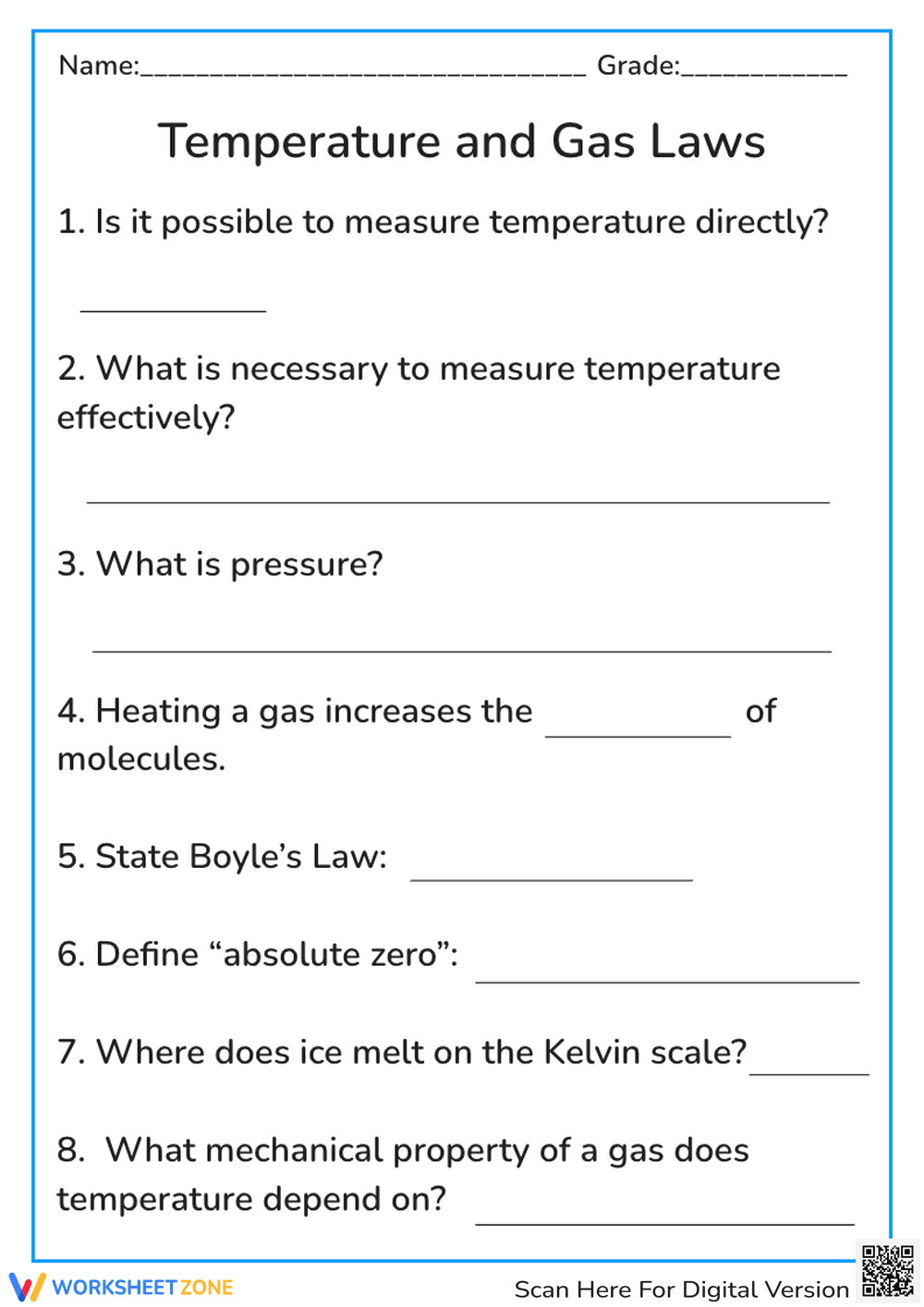
This Grade 9 Science worksheet provides a focused review of temperature scales and fundamental gas laws to help students master the relationship between heat and molecular motion. By answering 8 targeted questions, learners demonstrate their understanding of Boyle's Law, absolute zero, and the Kelvin scale. This resource ensures students can explain the mechanical properties of gases effectively.
At a Glance
- Grade: 9 · Subject: Science
- Standard:
HS-PS3-2— Explain macroscopic energy as the motion of particles and kinetic energy- Skill Focus: Temperature scales and Gas Laws
- Format: 2 pages · 8 problems · Answer key included · PDF
- Best For: Quick assessment or sub plan
- Time: 15–20 minutes
What's Inside: This two-page PDF includes a clean, student-facing question sheet and a comprehensive answer key. The 8 tasks range from defining key terms like absolute zero to stating Boyle's Law and identifying the melting point of ice on the Kelvin scale. The layout provides ample space for student responses without unnecessary visual clutter.
Zero-Prep Workflow:
- Print: Select the 2-page PDF and print enough copies for your class in under 30 seconds.
- Distribute: Hand out the single-sided question sheet as a warm-up, exit ticket, or homework assignment.
- Review: Use the provided answer key to grade or conduct a peer-review session in approximately 5 minutes.
Total teacher preparation time is under 2 minutes, making this an ideal resource for busy classrooms or emergency sub plans.
Standards Alignment: Primary Standard: `HS-PS3-2`. Students develop and use models to illustrate that energy at the macroscopic scale can be accounted for as a combination of energy associated with the motions of particles. This worksheet specifically targets the kinetic energy of molecules as the basis for temperature. This standard code can be copied directly into lesson plans, IEP goals, or district curriculum mapping tools.
How to Use It: Use this as a formative assessment after introducing the Kinetic Molecular Theory. It works best during the elaborate phase of a 5E lesson cycle. Teachers should observe if students can correctly link heating a gas to the increase in molecular kinetic energy. Completion typically takes 15–20 minutes depending on prior knowledge.
Who It's For: Designed for Grade 9 Physics or Physical Science students. It is particularly helpful for learners who need a concise review of gas properties before moving into complex mathematical calculations. Pair this with a Boyle's Law simulation or an anchor chart showing the Kelvin versus Celsius scales for maximum impact.
This Grade 9 Physics resource focuses on the fundamental relationship between temperature and the kinetic energy of gas molecules, a core component of the HS-PS3-2 standard. By requiring students to define absolute zero and state Boyle’s Law, the worksheet reinforces the conceptual framework necessary for understanding thermodynamic systems. Research from EdReports (2024) emphasizes that high-quality science materials must bridge the gap between macroscopic observations, such as pressure and temperature, and microscopic particle behavior. This worksheet facilitates that transition by prompting students to identify the mechanical properties that temperature depends on. The inclusion of the Kelvin scale and specific melting points ensures that students develop the quantitative literacy required for advanced chemistry and physics coursework. As a standalone assessment or a guided practice tool, it provides clear evidence of student mastery regarding the kinetic molecular theory and its application to gas behavior in closed systems.


