


























Views
Downloads



Essential Ideal Gas Law Worksheet | Grade 11 Chemistry
Paste this activity's link or code into your existing LMS (Google Classroom, Canvas, Teams, Schoology, Moodle, etc.).
Students can open and work on the activity right away, with no student login required.
You'll still be able to track student progress and results from your teacher account.
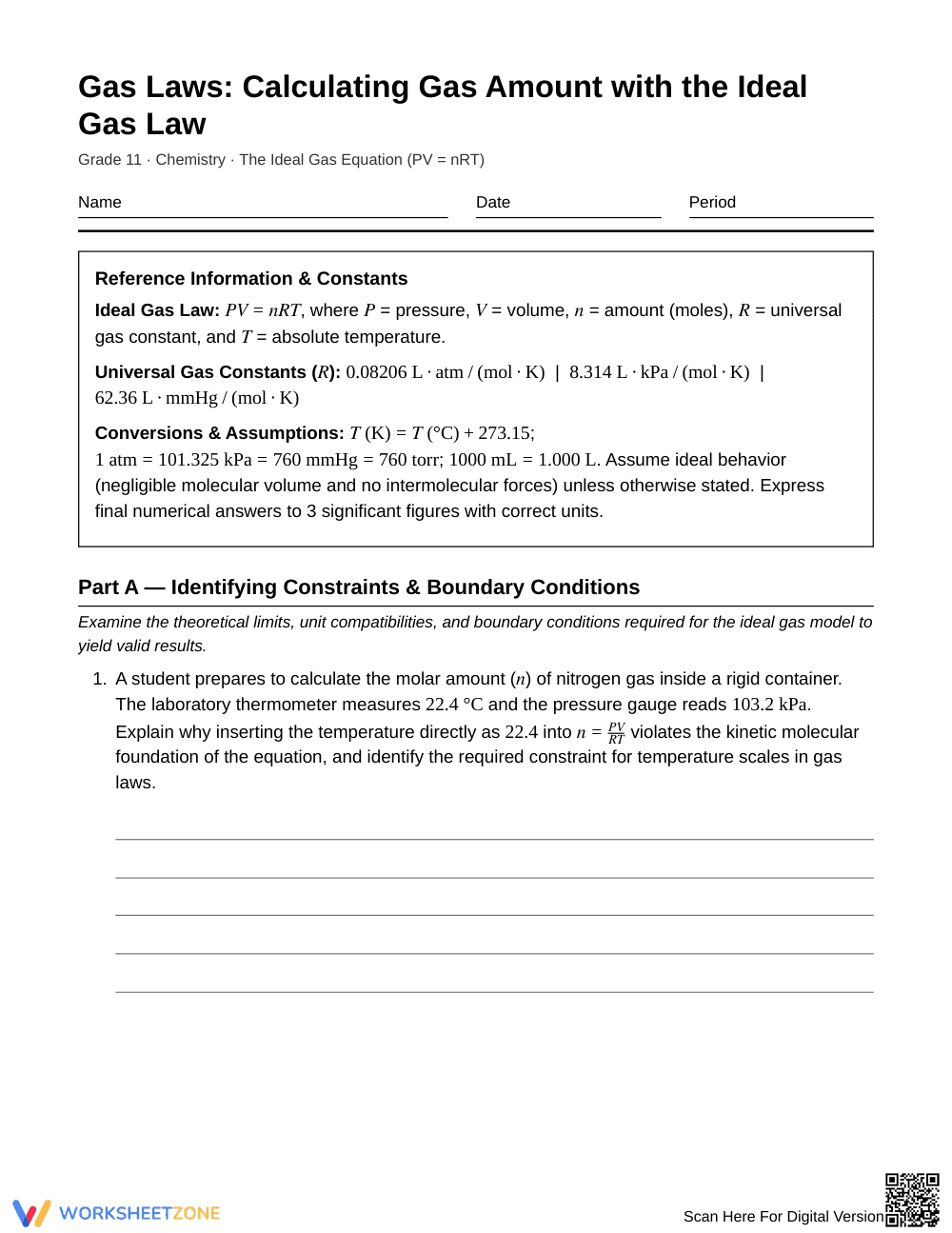
This Grade 11 chemistry worksheet equips students to master molar calculations using the ideal gas equation, PV = nRT. Learners analyze thermodynamic constraints, convert pressure and temperature values into compatible units, solve authentic laboratory scenarios, and evaluate experimental error sources. By working through rigorous quantitative problems, students develop conceptual fluency and quantitative accuracy in gas law stoichiometry.
At a Glance
- Grade: 11 · Subject: Chemistry
- Standard: Gas Laws — Solve quantitative problems using the ideal gas law and kinetic molecular theory
- Skill Focus: Calculate Gas Amount with the Ideal Gas Law
- Format: 5 pages · 10 problems · Answer key included · PDF
- Best For: Guided problem solving and lab analysis
- Time: 45–60 minutes
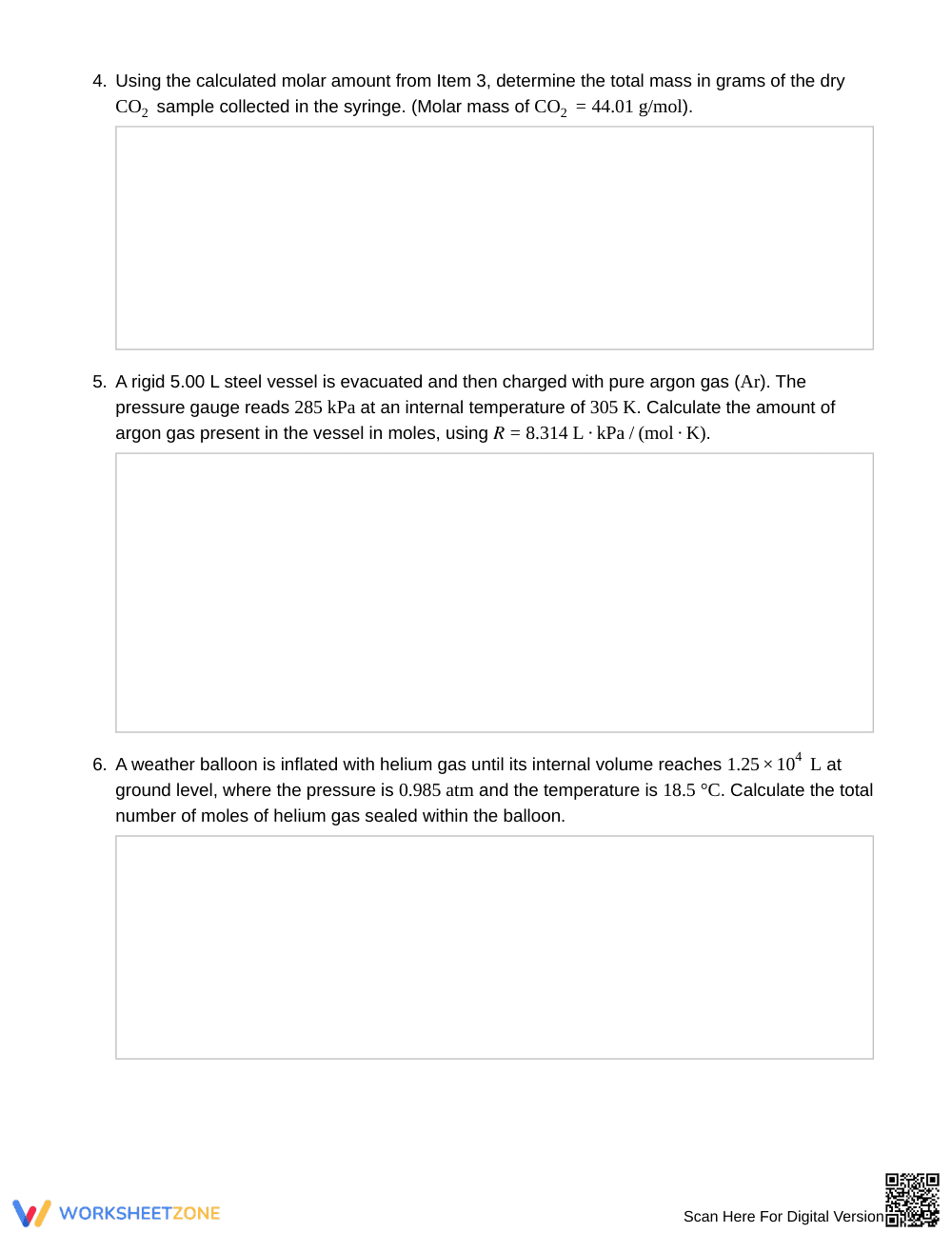
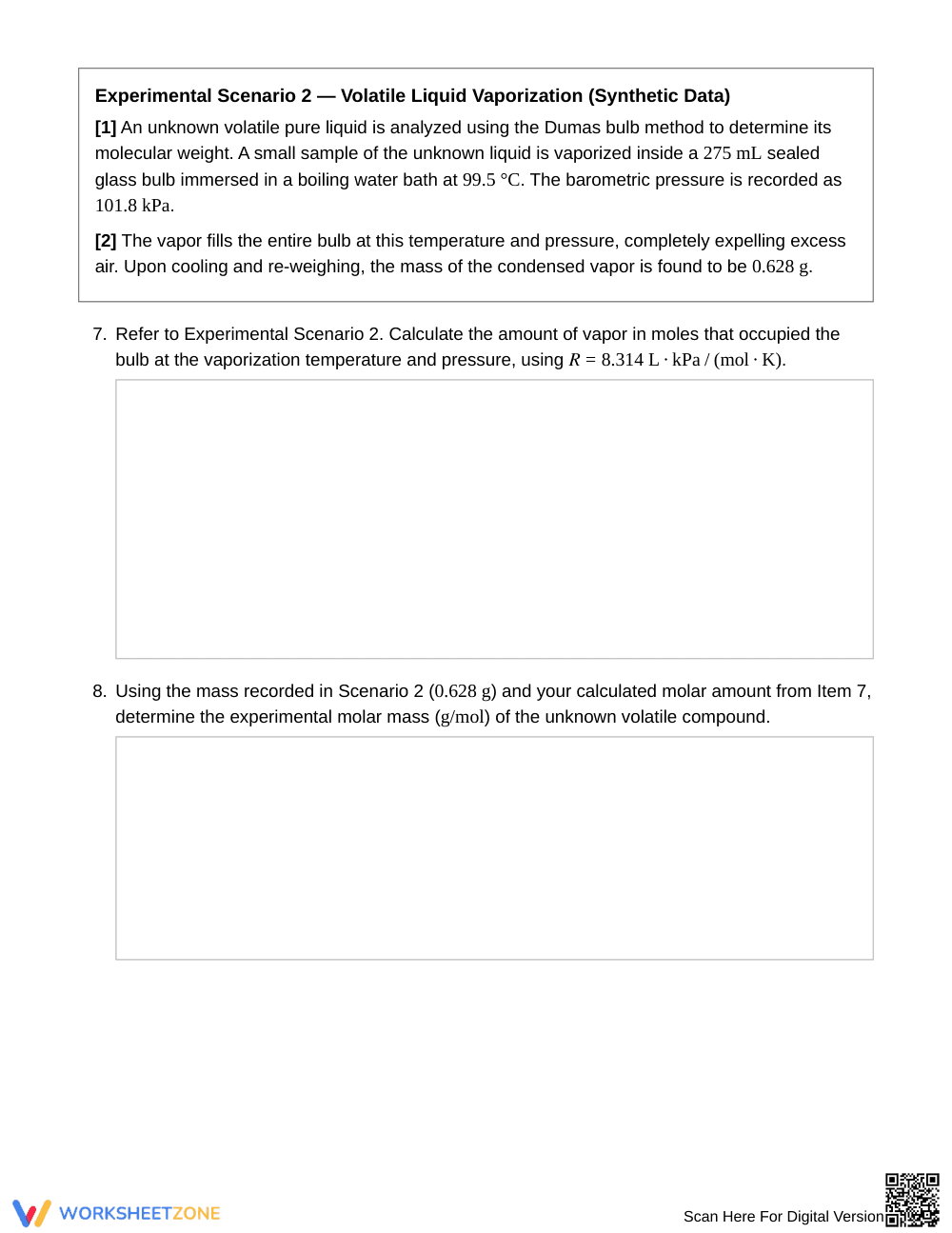
This 5-page printable resource includes 10 multi-step chemistry tasks divided into three pedagogical sections. Students work with realistic experimental datasets, including syringe gas collection and Dumas bulb vaporization. The document provides reference constants, temperature and pressure conversion factors, and a comprehensive 3-page answer key detailing complete mathematical setups and significant figures.
Skill Progression
- Guided practice (Problems 1–2): Students examine theoretical constraints, identify absolute temperature scale requirements, and articulate boundary conditions where the ideal gas model breaks down under extreme pressures.
- Supported practice (Problems 3–6): Learners execute multi-step algebraic rearrangements to compute moles and masses from syringe measurements, rigid canisters, and weather balloon data sets.
- Independent practice (Problems 7–10): Students evaluate Dumas method vaporization data, determine molar masses, and critically diagnose laboratory error sources.
This structured progression reflects an intentional gradual-release model, transitioning students from foundational boundary analysis to independent quantitative critique.
Standards Alignment
This activity aligns with high school chemistry expectations for gas behavior, requiring students to mathematically model macroscopic gas properties using pressure, volume, temperature, and molar amounts based on the kinetic molecular theory. Both standard codes can be copied directly into lesson plans, IEP goals, or district curriculum mapping tools.
How to Use It
Deploy this worksheet after direct instruction on gas laws as an in-class collaborative activity, or assign Parts B and C as post-lab analysis following a gas evolution investigation. When circulating during formative assessment, check whether students convert Celsius temperatures to Kelvin before inserting numbers into formulas. Most high school learners complete all ten tasks within 45 to 60 minutes.
Who It's For
This resource serves general and honors Grade 11 chemistry students seeking rigorous quantitative gas law practice. It offers embedded constants for developing learners and error-analysis challenges for advanced thinkers. Pair this worksheet directly with a kinetic molecular theory lecture presentation.
Calculating gas amounts with the ideal gas law requires high school chemistry students to coordinate multi-variable algebraic reasoning with microscopic particle concepts. Research synthesized by Fisher & Frey (2014) highlights that structured cognitive scaffolding—moving deliberately from conceptual constraints to guided numerical applications and independent error evaluation—significantly strengthens problem-solving retention in high school science. This ten-problem instructional resource targets core chemistry competencies by guiding learners through unit conversions, universal gas constant selection, molar mass determinations, and experimental critique. Grounded in authentic laboratory contexts such as pneumatic syringes and Dumas bulb vaporization, the worksheet reinforces rigorous quantitative standards while systematically surfacing common misconceptions regarding absolute temperature and real gas behavior. By pairing transparent reference tables with progressive problem complexity, this material delivers measurable instructional support for secondary classrooms mastering complex quantitative chemical equations and stoichiometry investigations.


