


























Views
Downloads


Essential Gas Variables Worksheet | Grade 11 Chemistry
Paste this activity's link or code into your existing LMS (Google Classroom, Canvas, Teams, Schoology, Moodle, etc.).
Students can open and work on the activity right away, with no student login required.
You'll still be able to track student progress and results from your teacher account.
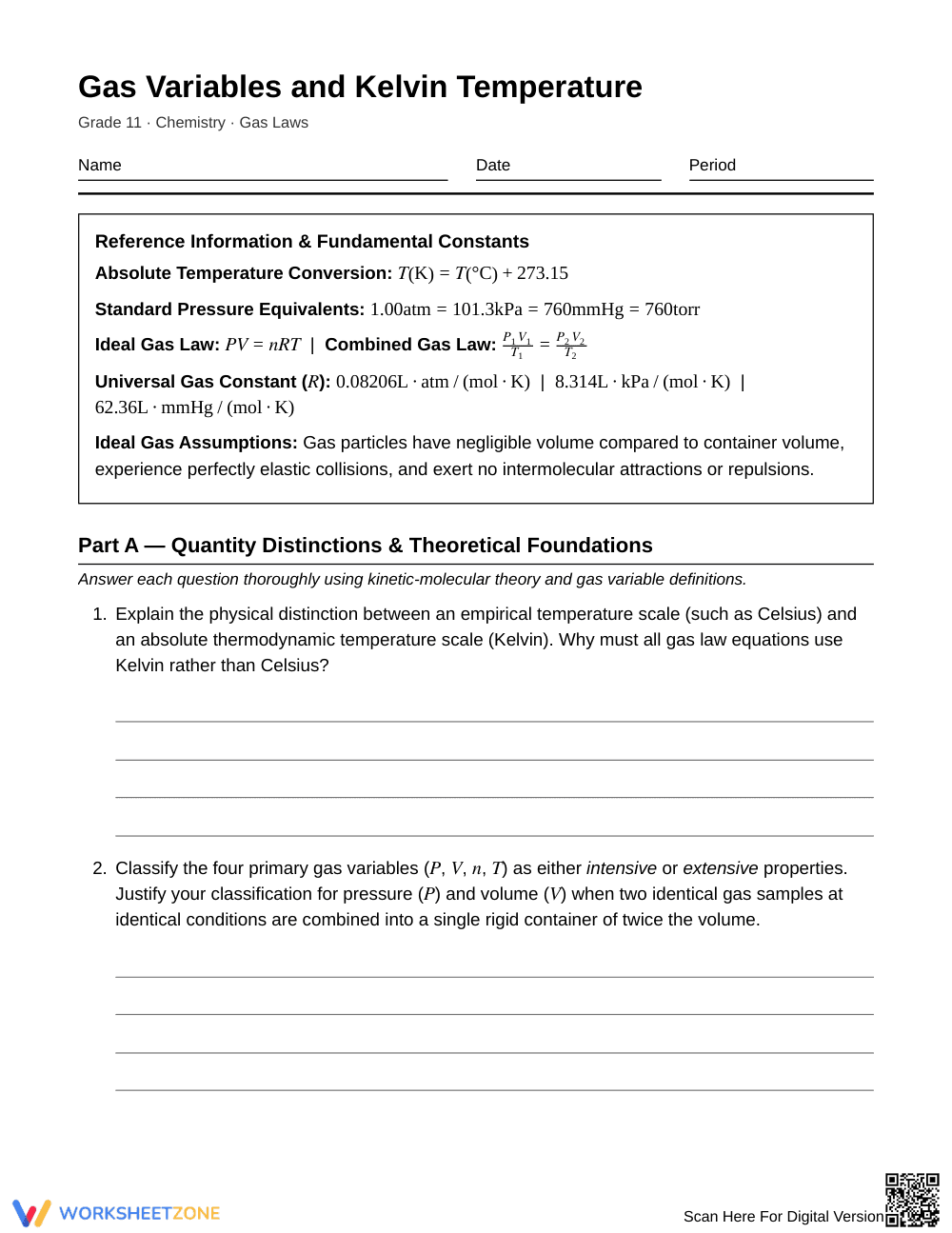
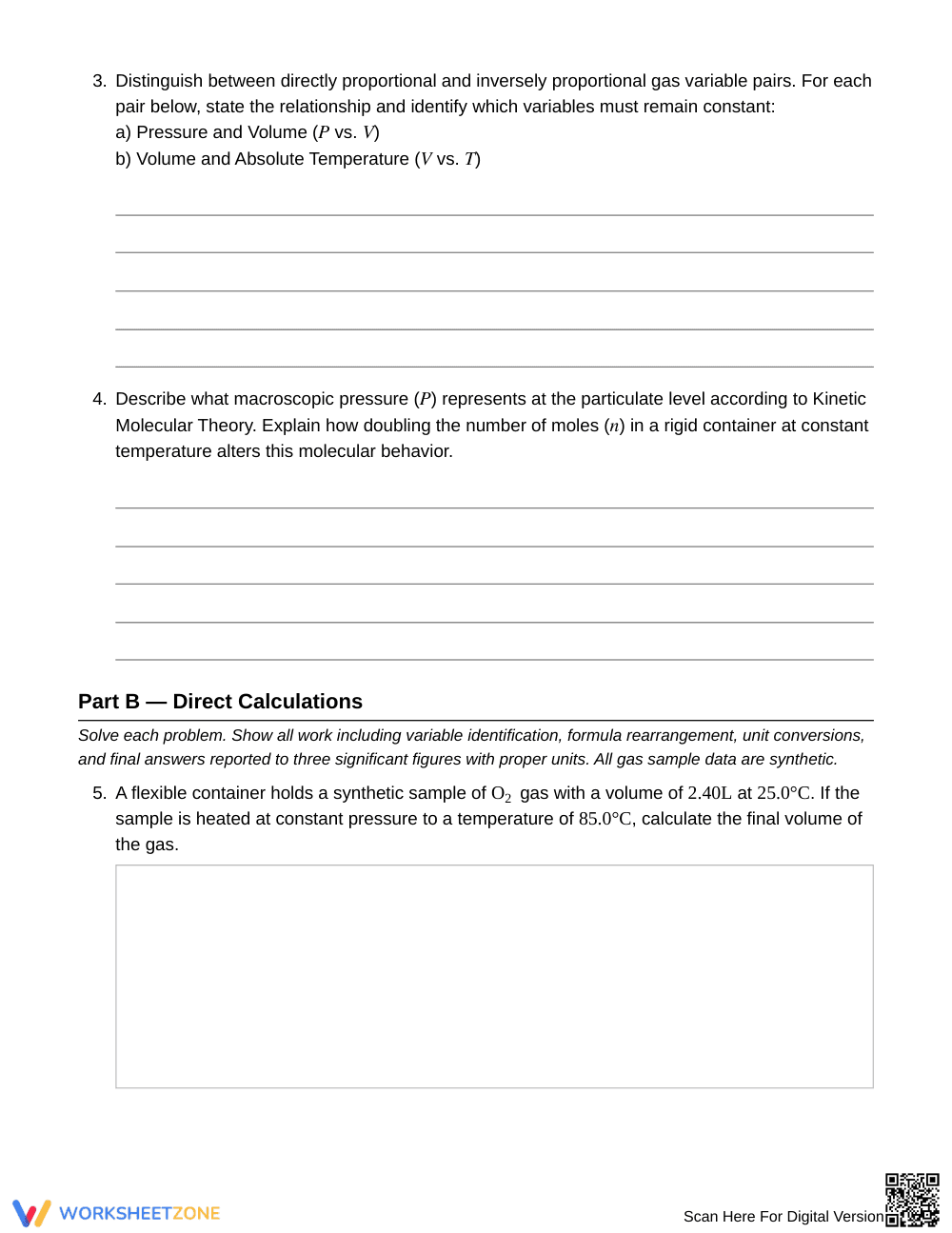
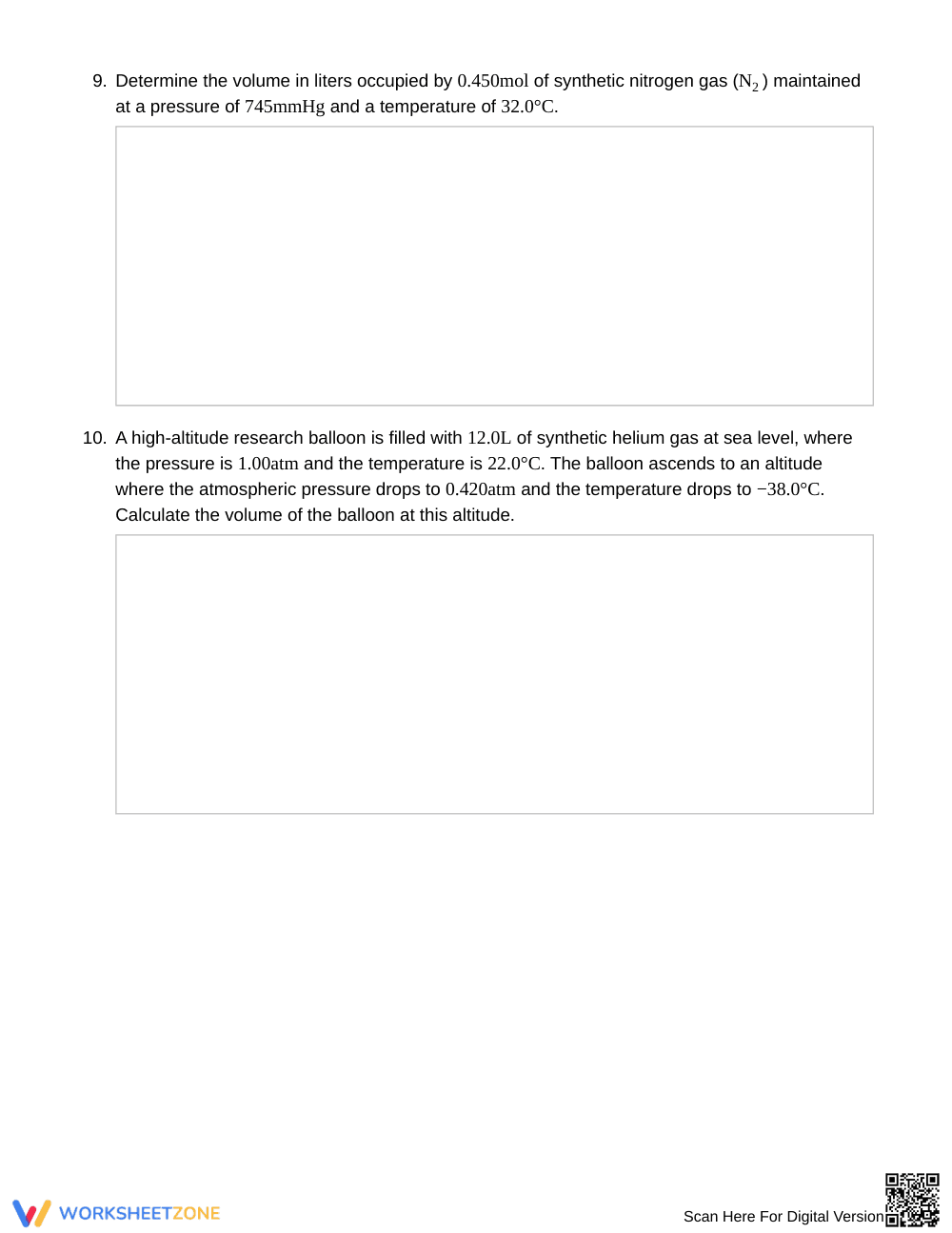
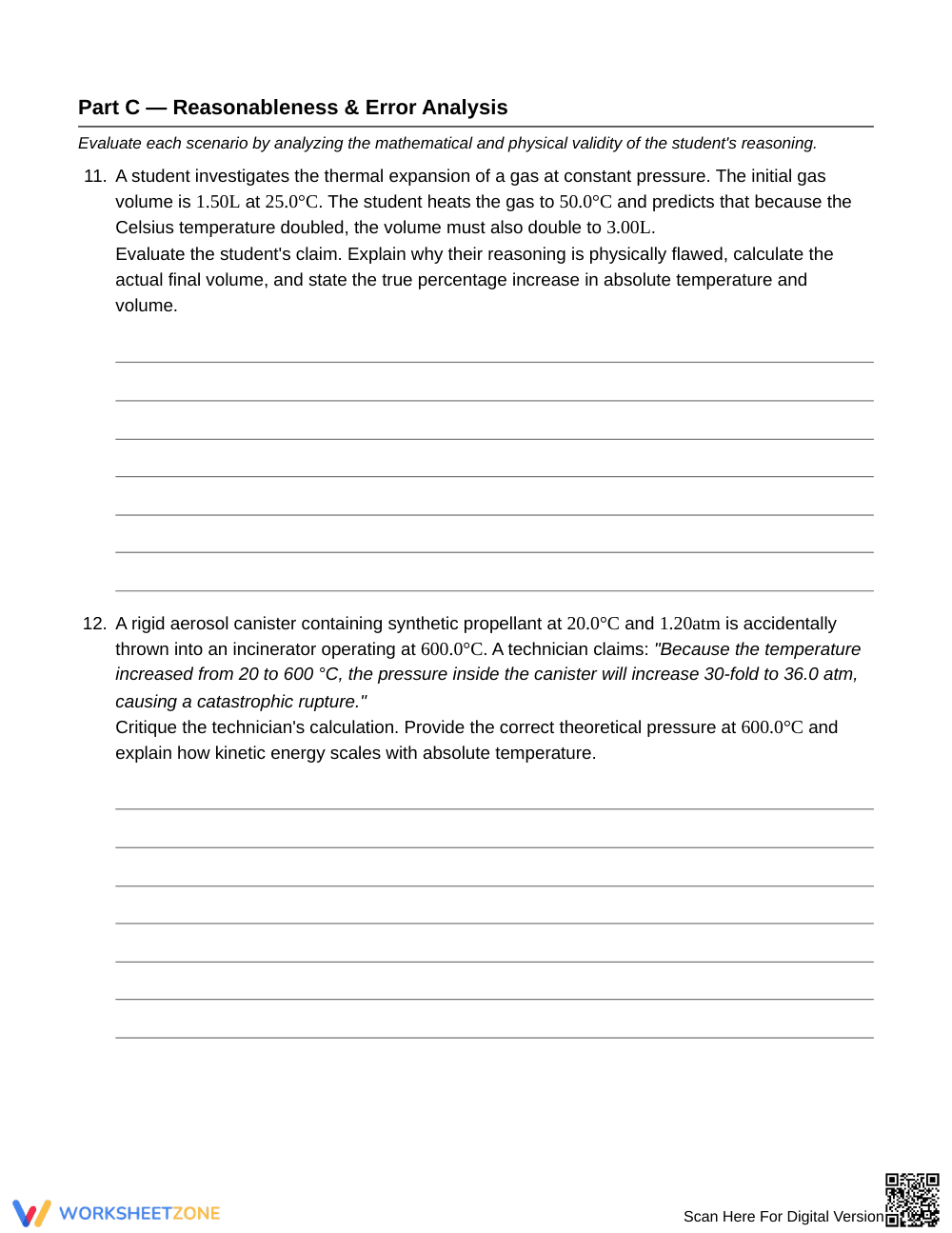
This Grade 11 chemistry worksheet guides students through gas variables and Kelvin temperature conversions across 12 structured tasks. High school learners analyze thermodynamic principles, perform gas calculations using standard formulas, and evaluate flawed student reasoning to develop conceptual fluency with kinetic-molecular theory.
At a Glance
- Grade: 11 · Subject: Chemistry
- Standard: Model macroscopic gas properties using kinetic-molecular theory and absolute temperature scales
- Skill Focus: Gas Variables, Proportionality, and Kelvin Temperature
- Format: 5 pages · 12 problems · 3-page answer key included · PDF
- Best For: Gas laws direct instruction follow-up
- Time: 45–60 minutes
What's Inside
The 5-page resource includes a 2-page student worksheet with 12 problems across three sections, supported by a reference header of gas constants, pressure conversions, and kinetic-molecular theory assumptions. A complete 3-page teacher answer key provides full mathematical solutions, unit conversions, and conceptual explanations for every question.
Skill Progression
- Guided Practice: Tasks 1–4 establish theoretical foundations by requiring students to explain Kelvin versus Celsius scales, classify intensive and extensive gas variables, define proportionality, and connect pressure to molecular collisions.
- Supported Practice: Tasks 5–10 transition students into quantitative problem-solving across six computational exercises involving Charles's Law, Boyle's Law, Gay-Lussac's Law, and the Ideal Gas Law.
- Independent Practice: Tasks 11–12 present unprompted error-analysis scenarios where learners evaluate student misconceptions regarding Celsius doubling and pressure escalation during thermal expansion.
This structured progression reflects the gradual-release framework, moving learners systematically from conceptual identification to independent critical evaluation.
Standards Alignment
This resource aligns with high school physical science standards requiring students to use mathematical representations to describe relationships between macroscopic gas properties and molecular interactions. Supporting standards emphasize applying kinetic-molecular theory to explain macroscopic behavior during thermal expansion and pressure changes. Both standard codes can be copied directly into lesson plans, IEP goals, or district curriculum mapping tools.
How to Use It
Assign this worksheet immediately following direct instruction on kinetic-molecular theory and gas law formulas to reinforce proportional reasoning. Alternatively, use the computational section for collaborative partner work while reserving the error-analysis prompts for an exit ticket. During classwork, observe whether students convert Celsius to Kelvin prior to calculating, as skipping conversion is the most frequent procedural pitfall. Plan for 45 to 60 minutes.
Who It's For
This printable activity is designed for eleventh-grade chemistry students studying gas behavior. Built-in reference formulas and defined constants support developing learners while multi-step gas calculations challenge advanced students. Pair this document with an interactive gas properties simulation or laboratory pressure-temperature experiment.
Instruction in gas variables and Kelvin temperature demands that students bridge macroscopic observations with submicroscopic particulate models. According to Fisher & Frey (2014), structured instructional progressions that guide high school students from foundational conceptual definitions through direct computational modeling and rigorous error analysis significantly improve cognitive retention and scientific reasoning. By requiring learners to actively analyze why empirical Celsius temperatures fail in gas equations and identify proportional relationships between pressure, volume, and temperature, this worksheet targets frequent misconceptions documented in secondary chemistry classrooms. Research confirms that evaluating non-examples and student calculation errors promotes higher-order metacognition compared to rote formulaic substitution alone. Consequently, this comprehensive 12-task learning sequence provides high school chemistry educators with an empirically validated resource that builds lasting quantitative competence and conceptual clarity in kinetic-molecular theory and thermodynamic principles across varied instructional environments.


