




























Views
Downloads
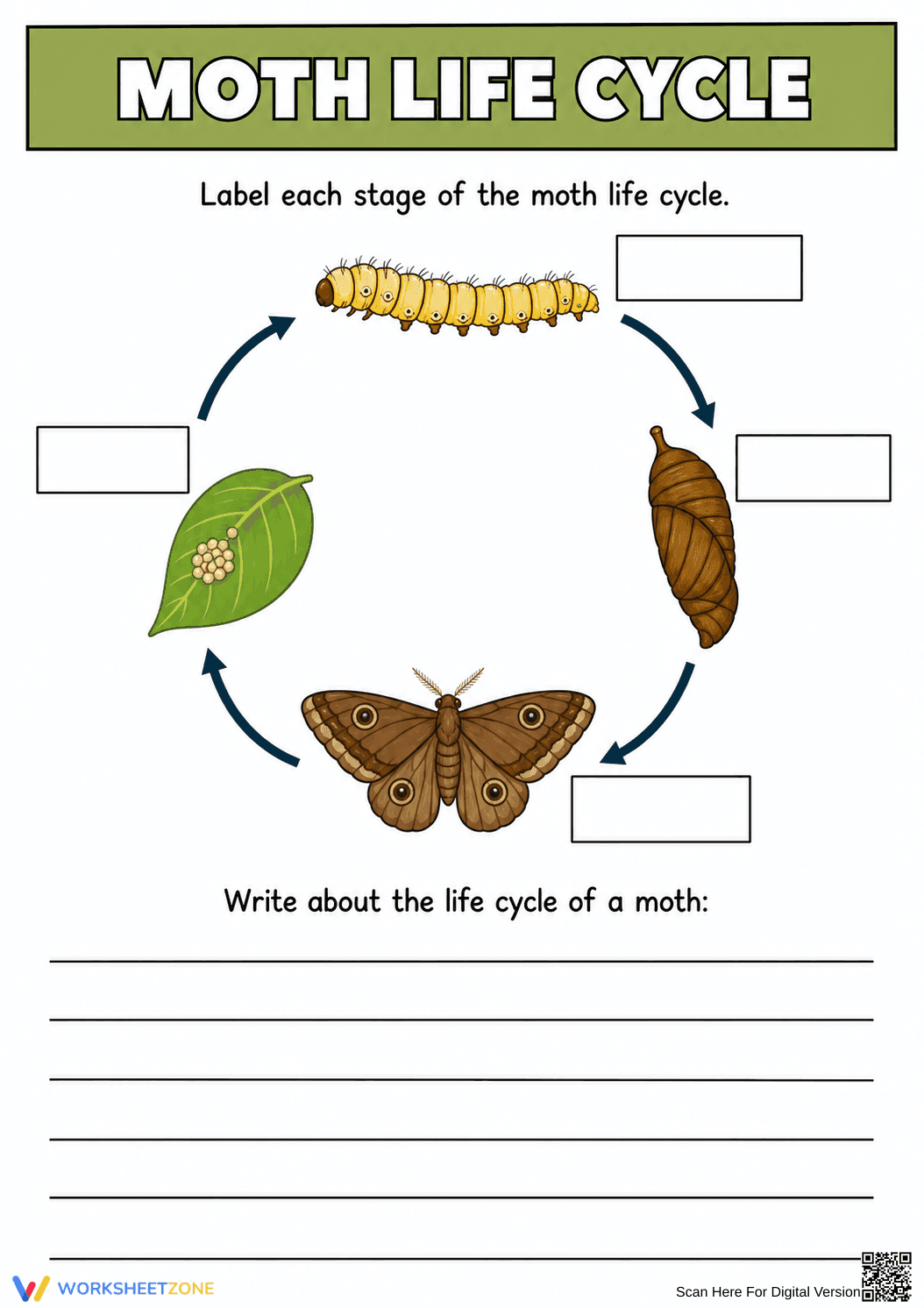

Grade 3 Moth Life Cycle — Printable No-Prep Worksheet

Paste this activity's link or code into your existing LMS (Google Classroom, Canvas, Teams, Schoology, Moodle, etc.).
Students can open and work on the activity right away, with no student login required.
You'll still be able to track student progress and results from your teacher account.
This printable moth life cycle worksheet helps students visualize and explain the stages of metamorphosis. By combining diagram labeling with an explanatory writing prompt, learners actively process how a moth transforms from an egg to an adult, strengthening both their scientific vocabulary and foundational writing skills.
At a Glance
- Grade: 3 · Subject: Science
- Standard:
3-LS1-1— Develop models to describe organism life cycles- Skill Focus: Life cycle labeling and explanatory writing
- Format: 1 page · 5 tasks · PDF
- Best For: Independent practice or science centers
- Time: 15–20 minutes
Inside this single-page resource, educators will find a clear, circular diagram illustrating the four distinct stages of a moth's development: egg, caterpillar, cocoon, and adult moth. Students are tasked with filling in four blank labeling boxes corresponding to each stage. Below the diagram, a lined writing section prompts students to synthesize their knowledge by writing a short explanatory paragraph about the life cycle process, integrating science and literacy.
Zero-Prep Workflow
- Print (1 minute): Simply download the PDF and print a class set. The black-and-white friendly design ensures crisp copies without draining printer ink.
- Distribute (1 minute): Hand out the worksheet as a standalone activity. The instructions are straightforward, requiring no complex teacher setup or additional materials.
- Review (3 minutes): Quickly check student understanding by reviewing their labeled diagrams and reading their short paragraphs. Total teacher prep time is under two minutes, making this an excellent option for emergency sub plans.
Standards Alignment
Aligned to primary standard 3-LS1-1: Develop models to describe that organisms have unique and diverse life cycles but all have in common birth, growth, reproduction, and death. It also supports cross-curricular ELA standards by requiring students to write informative/explanatory texts to examine a topic and convey ideas clearly. Both standard codes can be copied directly into lesson plans, IEP goals, or district curriculum mapping tools.
How to Use It
Use this worksheet as an independent practice activity following a direct instruction lesson on insect metamorphosis. It serves as an excellent formative assessment tool; teachers can observe whether students correctly sequence the stages and use appropriate scientific vocabulary in their writing. Alternatively, place it in a science center for collaborative group work. Expected completion time ranges from 15 to 20 minutes.
Who It's For
This resource is primarily designed for third-grade students, though it easily scales for second-grade learners needing visual scaffolds or fourth-grade students practicing descriptive writing. For differentiation, teachers can provide a word bank for students who need spelling support, or challenge advanced learners to include specific transitional words in their paragraphs. It pairs perfectly with a read-aloud book about moths or butterflies.
Integrating literacy into science instruction significantly improves student comprehension of complex biological processes. According to Fisher & Frey (2014), combining visual models with explanatory writing tasks helps students solidify their academic vocabulary and conceptual understanding. This worksheet aligns with 3-LS1-1, requiring students to develop models to describe organism life cycles. By labeling the diagram and immediately applying that knowledge in a written summary, learners engage in dual-coding, a proven strategy for long-term retention. The structured format ensures that students do not just passively consume information but actively construct meaning about metamorphosis. This cross-curricular approach maximizes instructional time, allowing educators to assess both scientific knowledge and writing proficiency simultaneously within a single, efficient activity.


