


























Views
Downloads
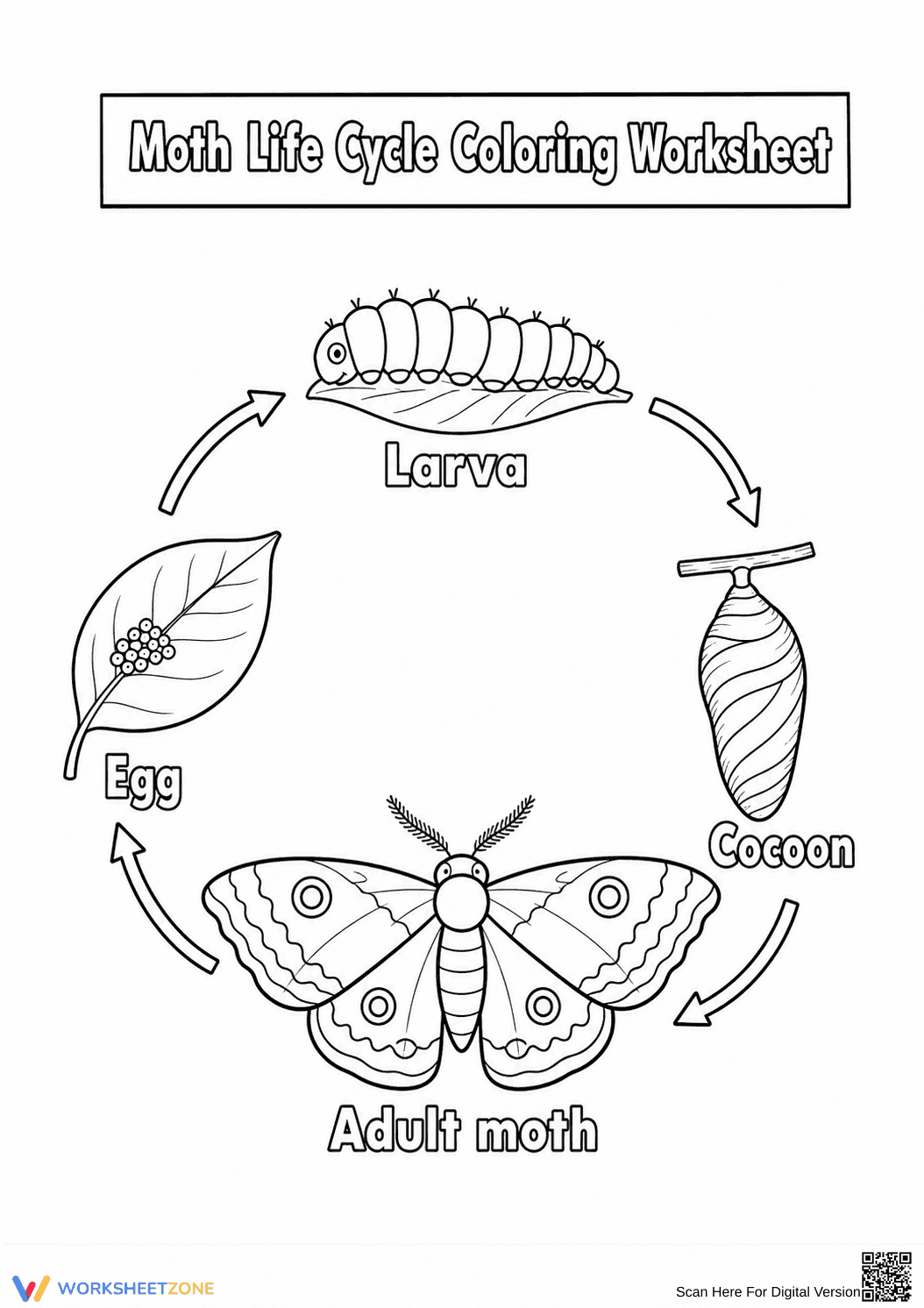

Moth Life Cycle Coloring Worksheet | Essential Science
Paste this activity's link or code into your existing LMS (Google Classroom, Canvas, Teams, Schoology, Moodle, etc.).
Students can open and work on the activity right away, with no student login required.
You'll still be able to track student progress and results from your teacher account.
This printable moth life cycle worksheet helps elementary students visualize the four distinct stages of metamorphosis. By engaging with the diagram through coloring, learners internalize the sequence of biological development from egg to adult. It provides a clear, accessible model for understanding how insects grow and change over time in their natural habitats.
At a Glance
- Grade: K-4 · Subject: Science
- Standard:
3-LS1-1— Develop models to describe that organisms have unique and diverse life cycles- Skill Focus: Metamorphosis sequencing
- Format: 1 page · 4 stages · Self-labeled · PDF
- Best For: Science centers and early finisher activities
- Time: 15–20 minutes
Inside this resource, you will find a single-page, high-resolution black-and-white diagram. It features four detailed illustrations representing the egg, larva (caterpillar), cocoon (pupa), and adult moth stages. The worksheet includes directional arrows to emphasize the cyclical nature of growth and clear text labels for each phase, ensuring students can identify biological terms while they color.
The zero-prep workflow for this activity is designed for maximum efficiency. First, print the single-page PDF for your entire class in under 30 seconds. Next, distribute the sheets with a set of crayons or colored pencils, requiring no additional teacher explanation. Finally, review the completed cycles as a group to check for understanding, totaling less than 2 minutes of preparation time.
This resource aligns with 3-LS1-1, which requires students to develop models to describe that organisms have unique and diverse life cycles but all have in common birth, growth, reproduction, and death. It also supports K-LS1-1 by observing what plants and animals need to survive. Both standard codes can be copied directly into lesson plans, IEP goals, or district curriculum mapping tools.
Use this worksheet during the "Explore" phase of a 5E science lesson to introduce insect anatomy. It also serves as an excellent formative assessment tool; observe if students color the larva and adult moth with realistic patterns to gauge their prior knowledge of nature. Completion typically takes 15 to 20 minutes depending on the level of artistic detail.
This activity is ideal for general education classrooms, homeschool environments, and English Language Learners who benefit from visual aids. It pairs naturally with a classroom observation of live caterpillars or a non-fiction read-aloud about nocturnal insects. The simple layout makes it accessible for students with fine motor goals in occupational therapy.
According to the RAND AIRS 2024 report, visual models in early science education significantly improve the retention of complex biological sequences among K-5 learners. This moth life cycle worksheet utilizes the 3-LS1-1 standard to provide a concrete representation of metamorphosis, a foundational concept in life science. Research by Fisher & Frey (2014) suggests that combining linguistic labels with non-linguistic representations, such as coloring diagrams, helps bridge the gap between vocabulary acquisition and conceptual understanding. By identifying the egg, larva, cocoon, and adult stages, students engage in active modeling that mirrors professional scientific observation. This resource is designed to reduce cognitive load while maintaining rigorous alignment with NGSS expectations for modeling organism growth. Educators can reliably use this tool to meet curriculum requirements for life cycle education while providing a low-stakes, high-engagement entry point for diverse learners in the elementary classroom.


