


























Views
Downloads

Moth Life Cycle Worksheet — Printable Grade 1-5 Science
Paste this activity's link or code into your existing LMS (Google Classroom, Canvas, Teams, Schoology, Moodle, etc.).
Students can open and work on the activity right away, with no student login required.
You'll still be able to track student progress and results from your teacher account.
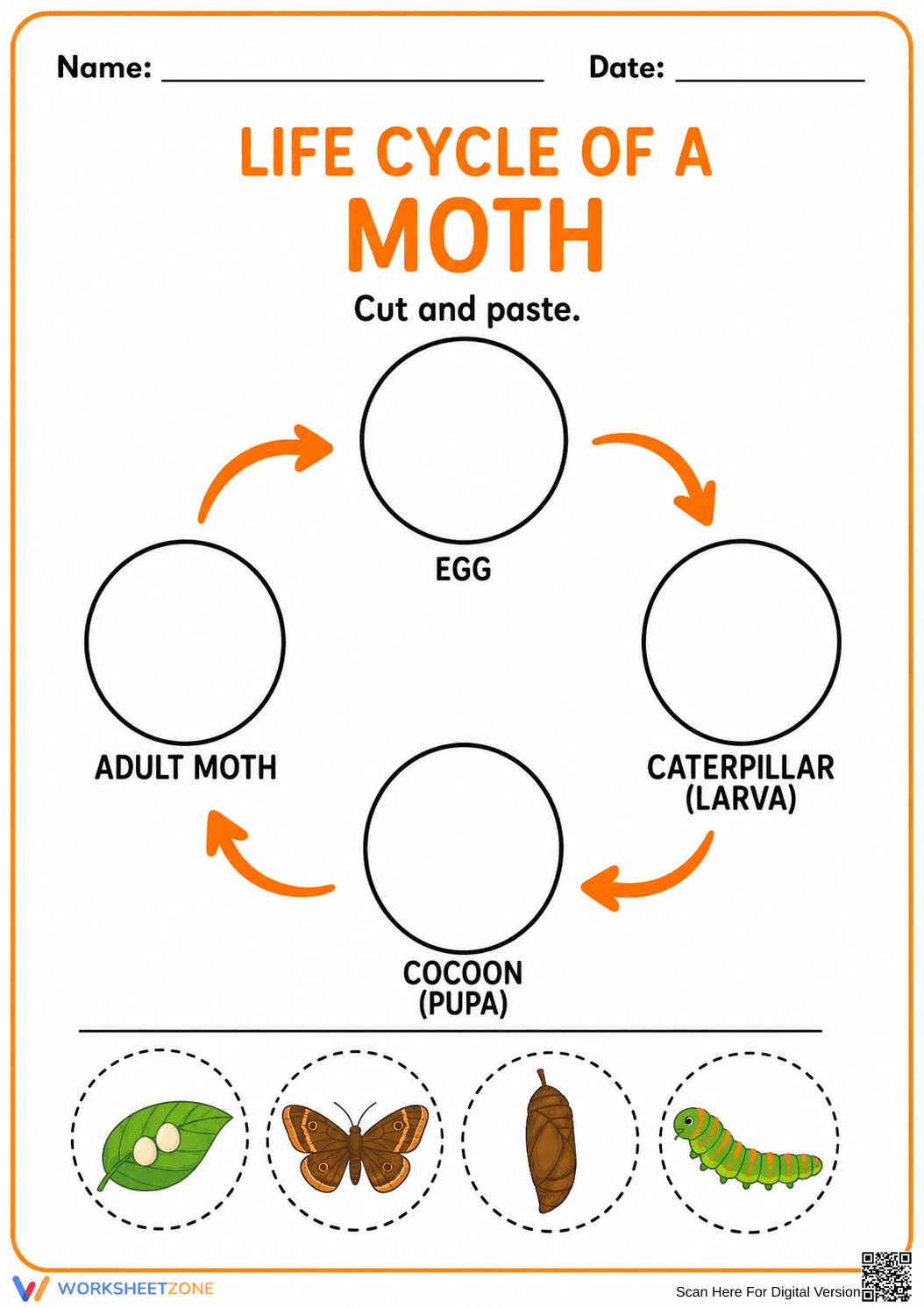
This moth life cycle worksheet provides a hands-on approach to understanding biological metamorphosis. Students engage with the four distinct stages of development by physically sequencing the egg, larva, pupa, and adult phases. This activity transforms abstract biological concepts into a concrete visual model, ensuring students grasp the cyclical nature of insect growth and reproduction.
At a Glance
- Grade: 1-5 · Subject: Science
- Standard:
3-LS1-1— Develop models to describe unique and diverse organism life cycles- Skill Focus: Chronological sequencing and metamorphosis identification
- Format: 1 page · 4 problems · Answer key included · PDF
- Best For: Independent science centers and formative assessment
- Time: 15–20 minutes
Inside this resource, you will find a single-page, high-contrast activity designed for maximum clarity. The top section features a circular flow diagram with four labeled landing zones: Egg, Caterpillar (Larva), Cocoon (Pupa), and Adult Moth. The bottom of the page contains four corresponding illustrations with dashed cutting lines. The layout is optimized for fine motor skill practice while maintaining a strict focus on the scientific vocabulary associated with lepidopteran development.
Zero-Prep Workflow
- Print (30 seconds): Simply print the PDF in color or grayscale; the high-contrast images remain clear in both formats.
- Distribute (1 minute): Provide students with scissors and glue. The self-explanatory layout requires minimal verbal instruction, making it an ideal choice for substitute folders.
- Review (5 minutes): Use the completed diagrams for a quick whole-class check or as a visual entry in science interactive notebooks.
This worksheet is aligned with the primary standard 3-LS1-1: "Develop models to describe that organisms have unique and diverse life cycles but all have in common birth, growth, reproduction, and death." By creating a physical model of the moth's progression, students satisfy the modeling requirement of the NGSS framework. Both standard codes can be copied directly into lesson plans, IEP goals, or district curriculum mapping tools.
To maximize instructional impact, use this worksheet as a formative assessment after a read-aloud about insects. Teachers can observe students during the cutting phase to identify those who may struggle with the distinction between the larva and pupa stages. It serves as an excellent bridge between direct instruction and independent inquiry, typically requiring 15 to 20 minutes for completion depending on the student's manual dexterity.
This resource is designed for elementary students in grades 1 through 5, offering enough simplicity for early learners while providing the technical vocabulary required for upper elementary review. It pairs naturally with an anchor chart on metamorphosis or a live classroom observation of silkworms or similar moth species. The clear labeling supports English Language Learners by connecting visual icons with specific scientific terminology.
According to the RAND AIRS 2024 report on elementary science instruction, tactile engagement with biological models significantly increases long-term retention of life science concepts compared to passive observation. This moth life cycle worksheet utilizes a cut-and-paste modality to reinforce the 3-LS1-1 standard, requiring students to actively process the chronological order of metamorphosis. By physically manipulating the images of the egg, larva, pupa, and adult moth, learners build a mental schema for insect development that aligns with the Fisher & Frey (2014) gradual release of responsibility model. Research indicates that such structured sequencing tasks reduce cognitive load while allowing students to focus on the specific characteristics of each life stage. This printable resource provides a reliable, evidence-based method for assessing student mastery of life cycle patterns in a classroom or homeschool setting.


