




























Views
Downloads

Moth Life Cycle Worksheet | Grade 3 Essential Science

Paste this activity's link or code into your existing LMS (Google Classroom, Canvas, Teams, Schoology, Moodle, etc.).
Students can open and work on the activity right away, with no student login required.
You'll still be able to track student progress and results from your teacher account.
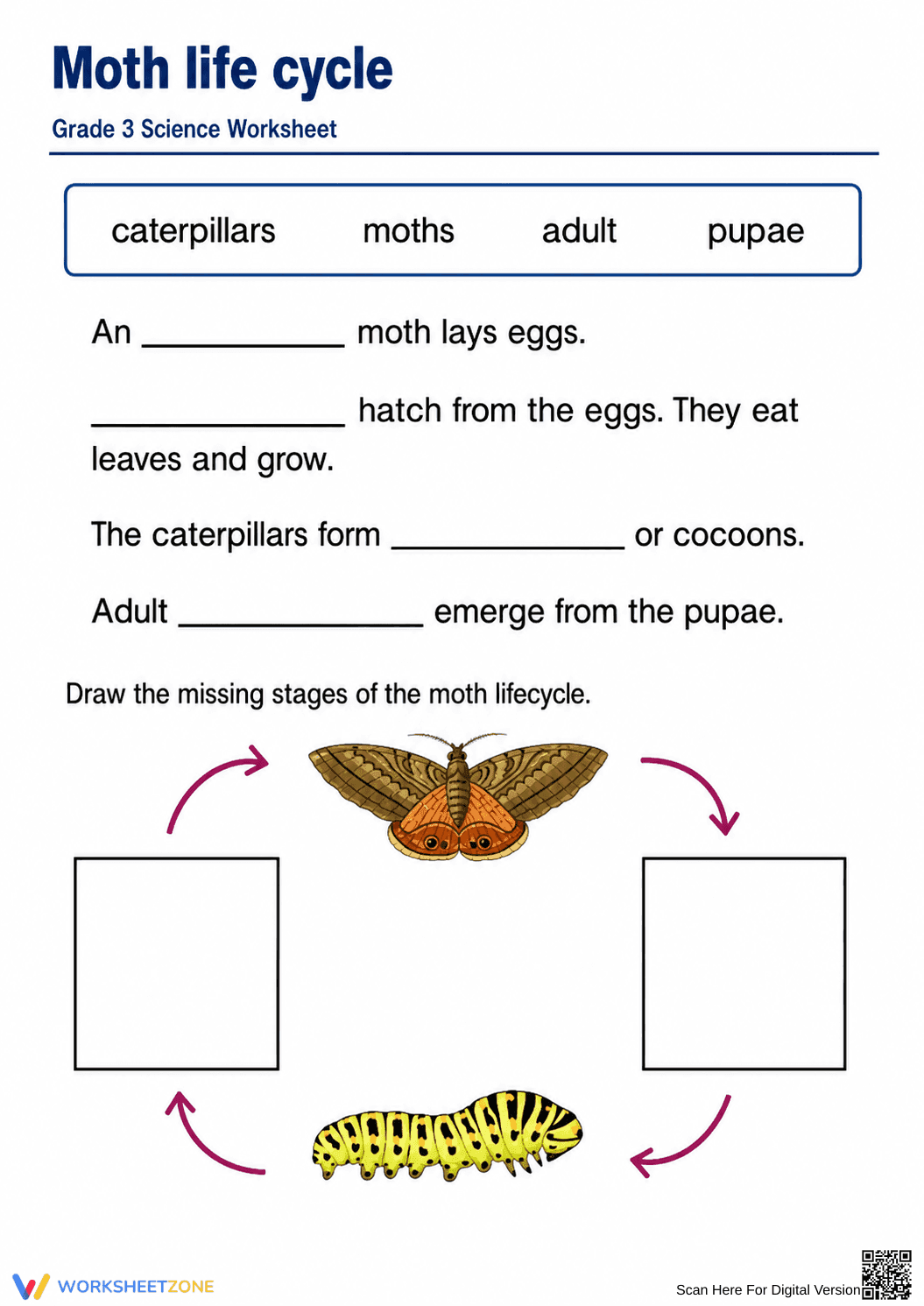
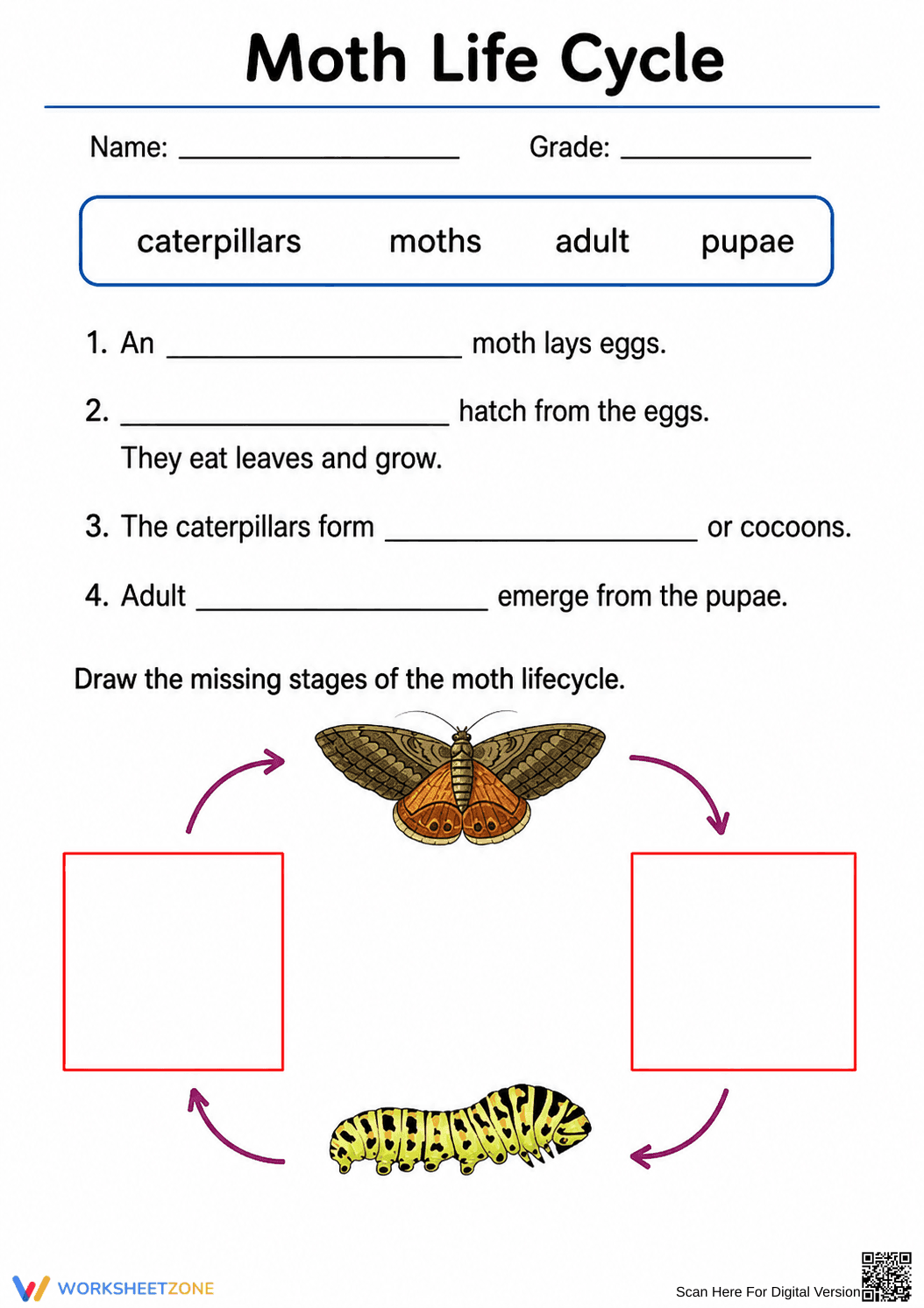
This Grade 3 moth life cycle worksheet helps students master the four stages of insect metamorphosis through integrated literacy and art. By combining vocabulary reinforcement with visual modeling, students internalize the biological progression from egg to adult. It provides a clear, structured way to assess understanding of how organisms grow and change over time.
At a Glance
- Grade: 3 · Subject: Science
- Standard:
3-LS1-1— Develop models to describe that organisms have unique and diverse life cycles- Skill Focus: Moth metamorphosis stages
- Format: 1 page · 6 problems · Answer key included · PDF
- Best For: Independent practice or formative assessment
- Time: 15–20 minutes
The worksheet features a dedicated word bank containing key scientific terms: caterpillars, moths, adult, and pupae. Students complete four contextual sentences that describe the biological transitions. Below the text, a circular life cycle diagram requires students to illustrate the missing "egg" and "cocoon" stages, bridging the gap between verbal descriptions and visual models.
Zero-Prep Workflow
- Print: Generate the single-page PDF in under 30 seconds for your entire class.
- Distribute: Hand out the sheets as a transition activity or a focused science center task.
- Review: Use the included answer key for a rapid whole-class review or individual grading in about 60 seconds.
Its self-contained nature makes it an ideal candidate for emergency sub plans or quiet morning work with zero teacher setup required.
Standards Alignment
This resource aligns with `3-LS1-1`: "Develop models to describe that organisms have unique and diverse life cycles but all have in common birth, growth, reproduction, and death." It specifically addresses the "growth" and "reproduction" components by highlighting the transition from larvae to egg-laying adults. Both standard codes can be copied directly into lesson plans, IEP goals, or district curriculum mapping tools.
How to Use It
Use this worksheet as a formative assessment after a direct instruction lesson on lepidoptera. It works best during the "elaborate" phase of a 5E science lesson. Teachers should observe students during the drawing phase to identify misconceptions regarding the physical appearance of the pupa versus the larva. Completion typically takes 15 to 20 minutes depending on the detail of student drawings.
Who It's For
This activity is designed for third-grade general education classrooms, but the visual scaffolds make it highly effective for English Language Learners (ELLs) and students with IEPs requiring simplified text. It pairs naturally with a classroom butterfly or moth kit, providing a paper-based record of observable biological changes during a life science unit.
Research from Fisher & Frey (2014) emphasizes that combining linguistic tasks with non-linguistic representations—such as the drawing and fill-in-the-blank components found here—significantly increases long-term retention of scientific concepts. This worksheet utilizes the 3-LS1-1 standard to move students beyond rote memorization toward a conceptual model of metamorphosis. By requiring students to identify the specific roles of caterpillars and pupae, the activity addresses the NAEP science framework's focus on life science systems and cycles. The inclusion of a word bank serves as a critical scaffold for Tier 2 vocabulary acquisition, ensuring that learners can focus on the biological sequence rather than spelling hurdles. This dual-modality approach is a proven method for supporting diverse learners in elementary science settings, providing measurable evidence of student mastery for gradebooks and progress monitoring.


