


























Views
Downloads
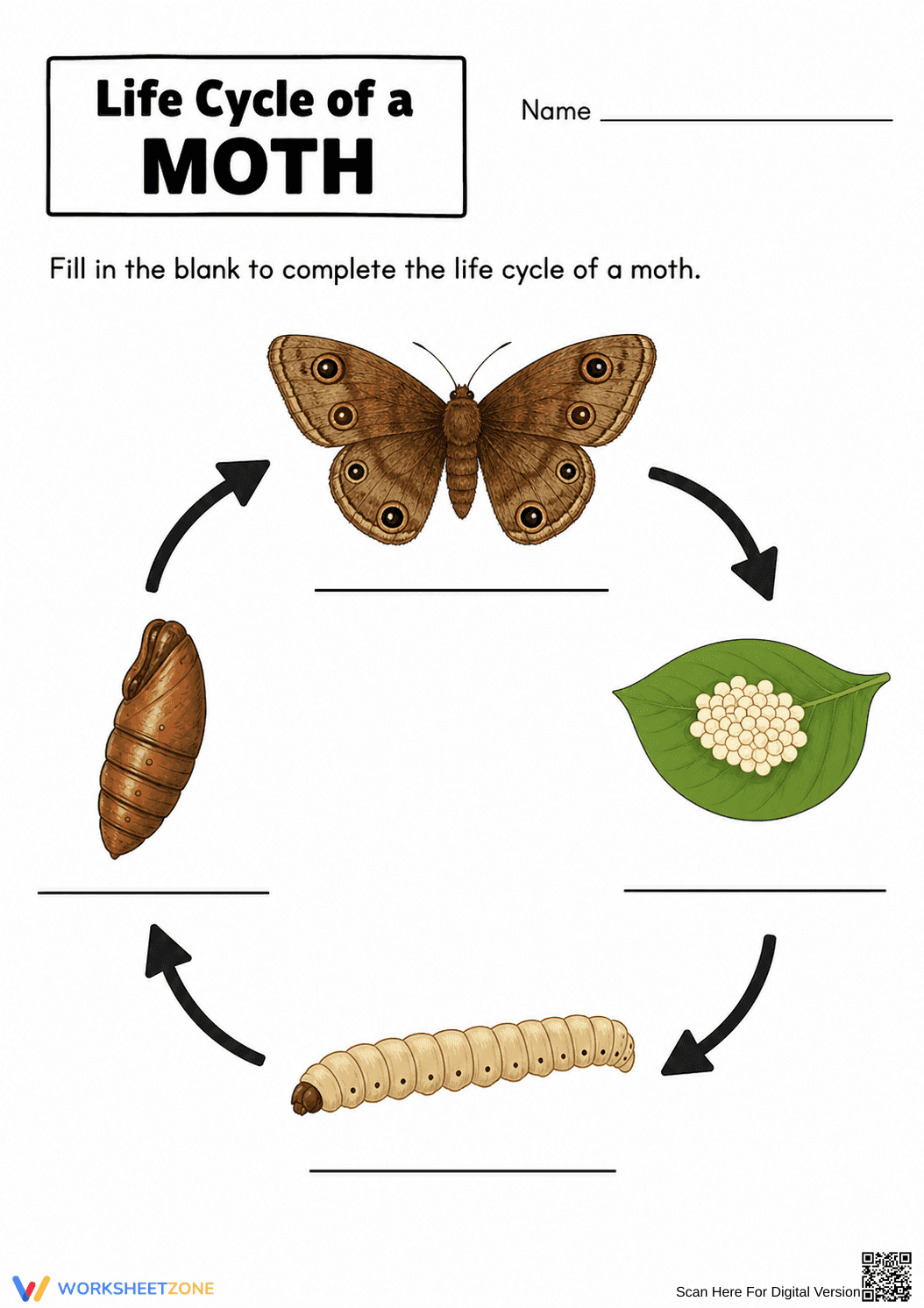

Printable Moth Life Cycle Worksheet | Grade 3 Science
Paste this activity's link or code into your existing LMS (Google Classroom, Canvas, Teams, Schoology, Moodle, etc.).
Students can open and work on the activity right away, with no student login required.
You'll still be able to track student progress and results from your teacher account.
This Grade 3 science worksheet helps students visualize and understand the stages of metamorphosis by labeling a moth's life cycle. By completing this clear, circular diagram, learners will identify the egg, caterpillar, cocoon, and adult stages, reinforcing essential life science vocabulary and sequencing skills.
At a Glance
- Grade: 3 · Subject: Science
- Standard:
3-LS1-1— Describe that organisms have unique and diverse life cycles- Skill Focus: Labeling stages of metamorphosis
- Format: 1 page · 4 problems · Answer key included · PDF
- Best For: Independent practice
- Time: 10–15 minutes
This single-page resource features a high-quality, full-color illustration of a moth's life cycle arranged in a continuous circle. Students are presented with four distinct visual cues—an adult moth, eggs on a leaf, a caterpillar, and a cocoon—and must write the correct stage name on the corresponding blank line. A complete answer key is provided to ensure quick and accurate grading.
Zero-Prep Workflow
- Print (1 minute): Simply download the PDF and print a class set. The clear illustrations print well in both color and grayscale.
- Distribute (1 minute): Hand out the worksheets as a quick transition activity or science center task. No additional materials or word banks are required to set up.
- Review (3 minutes): Go over the four stages together as a class using the included answer key, or have students self-check their work.
With under two minutes of total teacher prep time, this activity is an excellent addition to any emergency sub plan or busy afternoon schedule.
Standards Alignment
This resource is aligned to the Next Generation Science Standard 3-LS1-1: Develop models to describe that organisms have unique and diverse life cycles but all have in common birth, growth, reproduction, and death. By labeling the specific stages of a moth, students are directly interacting with a model of an organism's life cycle. Both standard codes can be copied directly into lesson plans, IEP goals, or district curriculum mapping tools.
How to Use It
This worksheet is highly versatile and fits perfectly into the "during" phase of direct instruction. After reading a book or watching a video about insect metamorphosis, assign this page to solidify the new vocabulary. Alternatively, use it as a quick formative assessment at the end of a life cycles unit. As students work, observe whether they correctly sequence the caterpillar and cocoon stages, as these are commonly swapped by early learners. Expected completion time is a brief 10 to 15 minutes.
Who It's For
This activity is primarily designed for third-grade science students, though it serves as an excellent review for fourth and fifth graders studying broader biology concepts. For students needing extra support, consider writing the four stage names on the board to serve as an impromptu word bank. This worksheet pairs beautifully with a hands-on caterpillar observation station or a read-aloud session focusing on insect development.
Understanding the sequential nature of biological development is a foundational element of early elementary science education. When students engage with visual models of metamorphosis, they build essential cognitive frameworks for more complex biological systems later on. According to a ScienceDirect TpT Analysis, integrating clear, diagram-based activities significantly improves vocabulary retention in elementary science learners. This worksheet directly supports this methodology by requiring students to map specific terms to accurate biological illustrations. By mastering the skill to describe that organisms have unique and diverse life cycles, aligned with standard 3-LS1-1, learners develop a stronger grasp of continuity and change in the natural world. Providing structured, visual labeling tasks ensures that abstract concepts like metamorphosis become concrete, observable phenomena, ultimately fostering deeper scientific literacy and curiosity about local ecosystems.


