


























Views
Downloads

Mealworm Life Cycle Wheel | Essential Grade 3 Science
Paste this activity's link or code into your existing LMS (Google Classroom, Canvas, Teams, Schoology, Moodle, etc.).
Students can open and work on the activity right away, with no student login required.
You'll still be able to track student progress and results from your teacher account.
This interactive Mealworm Life Cycle wheel provides a hands-on way for students to visualize and internalize the stages of insect metamorphosis. By creating a physical model, learners move beyond passive observation to active engagement with biological sequences. This activity ensures students can identify and explain the transition from larva to pupa and finally to the adult beetle stage.
At a Glance
- Grade: 3 · Subject: Science
- Standard:
3-LS1-1— Develop models to describe that organisms have unique and diverse life cycles- Skill Focus: Mealworm metamorphosis stages
- Format: 2 pages · 4 stages · Interactive Wheel · PDF
- Best For: Hands-on science centers or interactive notebooks
- Time: 20–30 minutes
What's Inside
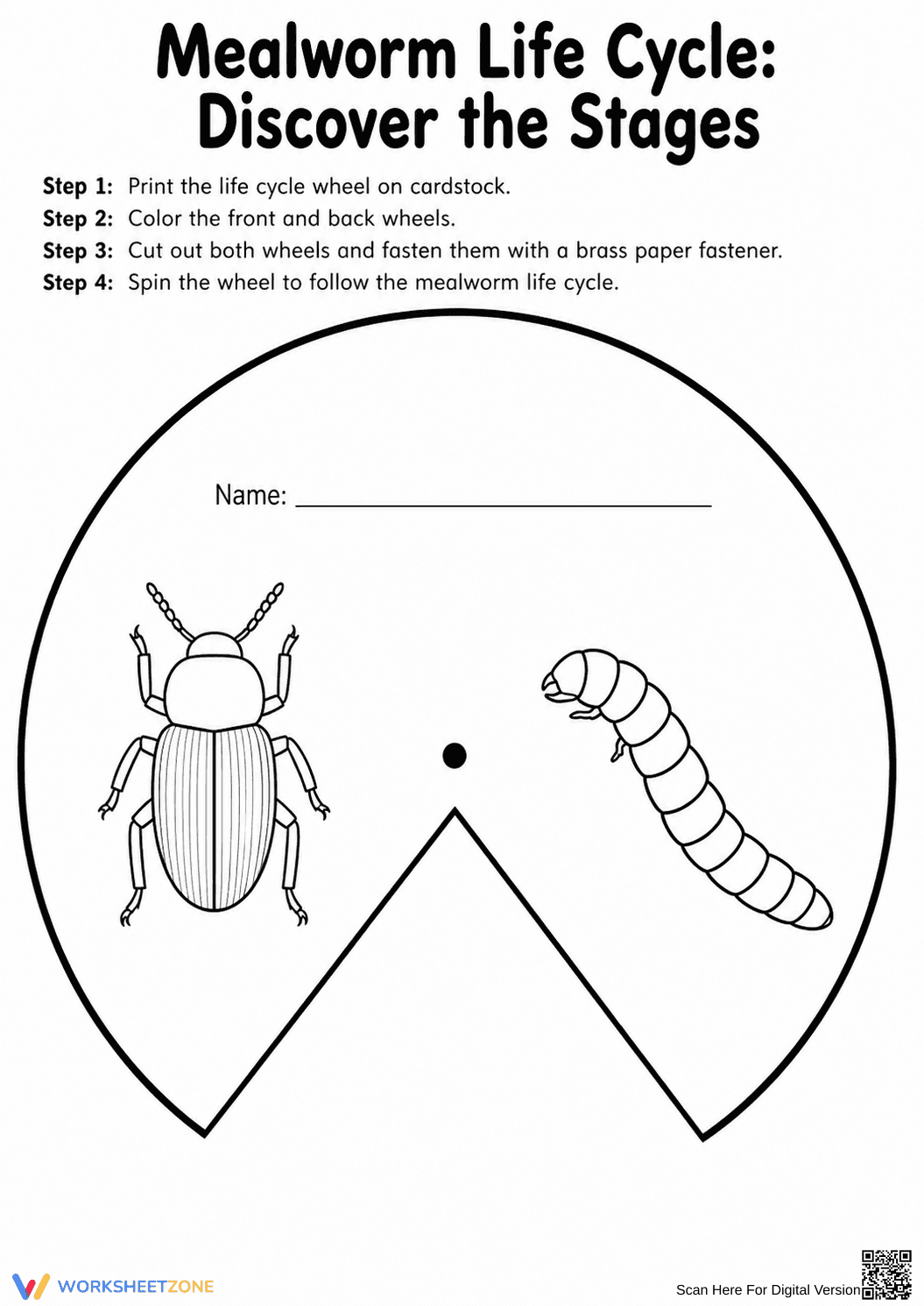
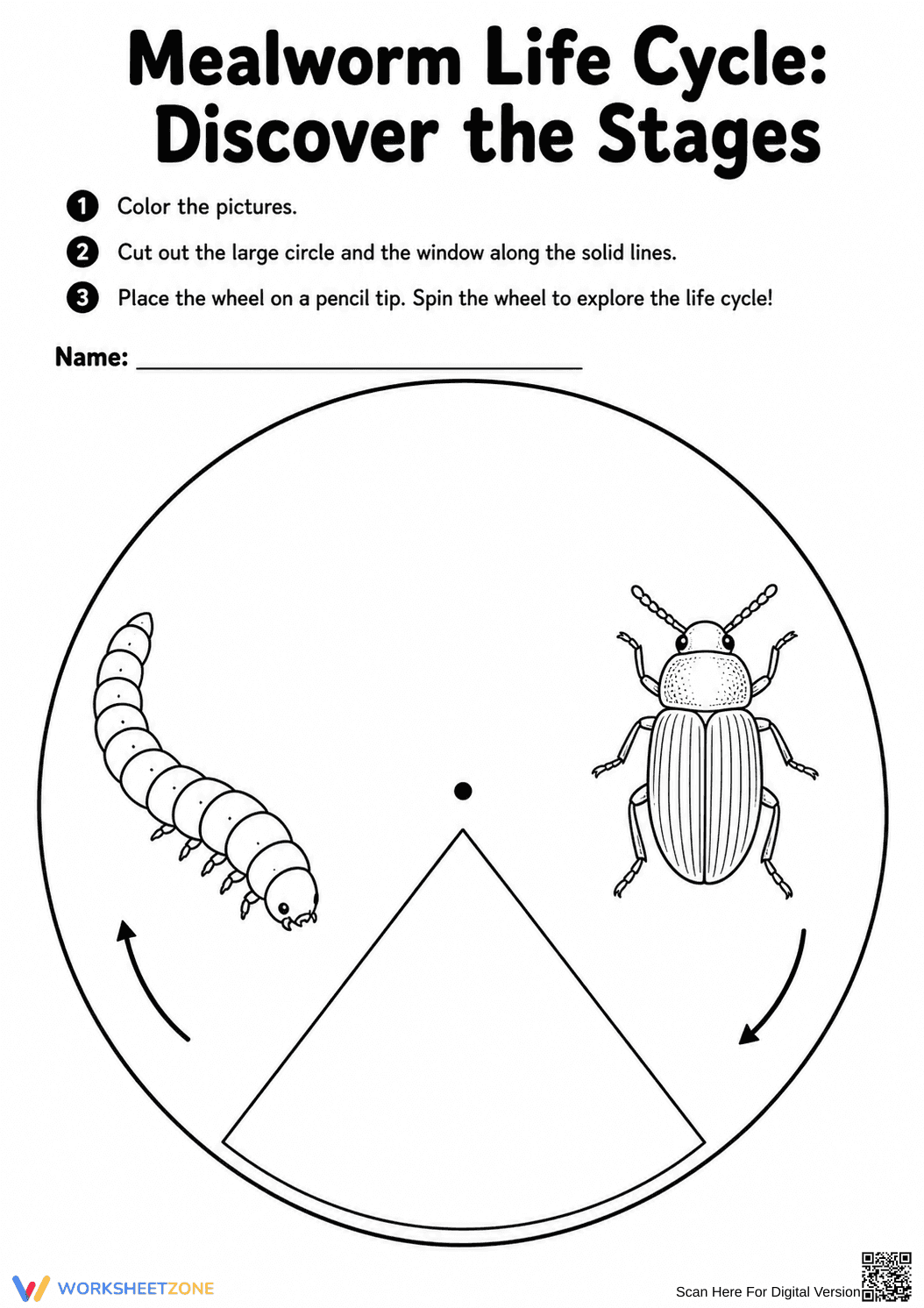
The download includes two PDF pages designed for durability when printed on cardstock. The first page features the base wheel with illustrations of the mealworm and the adult beetle, while the second page provides the cover wheel with a viewing window. Clear, numbered instructions are printed directly on the worksheet to guide students through coloring, cutting, and fastening the components with a brass paper fastener.
Zero-Prep Workflow
The workflow for this activity is designed for classroom efficiency. Print copies in 30 seconds. Distribution takes approximately one minute, as the worksheet is self-contained with all necessary instructions. The final review and assembly check typically require five minutes of teacher oversight, making this an ideal solution for science centers or as a high-quality sub plan that maintains instructional rigor without requiring complex setup.
Standards Alignment
This resource is primarily aligned with 3-LS1-1: "Develop models to describe that organisms have unique and diverse life cycles but all have in common birth, growth, reproduction, and death." It also supports CCSS.ELA-LITERACY.RI.3.3 by asking students to describe the relationship between a series of scientific steps. Both standard codes can be copied directly into lesson plans, IEP goals, or district curriculum mapping tools.
How to Use It
Use this wheel as a formative assessment after a lesson on insect metamorphosis. As students spin their completed wheels, ask them to describe the physical changes occurring at each stage to a partner. It also functions perfectly as a centerpiece for an interactive science notebook, providing a tactile reference that students can revisit throughout the unit. Completion takes 20-30 minutes.
Who It's For
This activity is tailored for Grade 3 students but is adaptable for Grade 2 or Grade 4 learners exploring life sciences. It supports visual and kinesthetic learners manipulating physical objects. Pair this worksheet with a live mealworm observation kit or a non-fiction text about beetles to create a comprehensive learning experience.
The Mealworm Life Cycle Wheel is a pedagogical tool designed to facilitate the development of mental models regarding biological growth and development. By physically assembling a rotating wheel, students engage in kinesthetic learning that reinforces the sequential nature of metamorphosis. This worksheet aligns with the Next Generation Science Standards (NGSS) 3-LS1-1, which requires students to develop models to describe that organisms have unique and diverse life cycles but all have in common birth, growth, reproduction, and death. According to research by Fisher & Frey (2014) on the gradual release of responsibility, hands-on modeling serves as a critical bridge between direct instruction and independent mastery of complex biological concepts. The interactive nature of the wheel allows for repeated self-testing of stage identification, which has been shown to improve long-term retention of scientific vocabulary and process-oriented knowledge in elementary learners. This resource provides a structured yet creative pathway for students to internalize the four distinct stages of the mealworm's journey.


