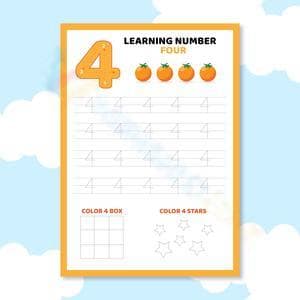
These number 4 worksheets give kindergarten teachers a targeted set of printables for every stage of early numeral instruction — tracing formation, counting sets of four, recognizing the digit among other numerals, and connecting the written symbol to a physical quantity. The set covers the full arc from first introduction through independent practice, so teachers can pull individual worksheets based on where students actually are rather than moving the whole class in lockstep.
What Each Worksheet Targets
The skills across the set break into four distinct areas. Tracing worksheets use directional arrows and starting dots to walk students through stroke sequence — down, across, and down again — with enough repetition on each worksheet to begin building muscle memory without exhausting a four- or five-year-old's attention span. Counting worksheets ask students to match the numeral to sets of objects: circling groups of four, marking exactly four items in a larger array, or filling in a ten frame to show the quantity. Recognition worksheets present the number 4 alongside other digits and require students to locate, color, or cross out all instances — a task that builds visual discrimination rather than just handwriting. Cut-and-paste worksheets add a motor layer: students sort picture cards by quantity or match numerals to dot sets, which also gives teachers a natural formative check on scissor control and spatial reasoning.
Several worksheets include multiple representations of four at once — ten frame, tally marks, finger-counting illustration, and numeral — so students see the same quantity expressed four different ways on a single page. That side-by-side format supports subitizing: with enough exposure, children stop counting individual dots and begin recognizing "four" as a visual gestalt.
Standard Alignment
These worksheets address CCSS.MATH.CONTENT.K.CC.A.3, which requires kindergarteners to write numbers from 0 to 20 and represent a number of objects with a written numeral. The tracing and independent-writing worksheets cover the formation standard directly. The counting and ten-frame worksheets address the representation requirement — students demonstrate that the numeral 4 corresponds to a specific countable quantity, not just a shape to reproduce. In instructional terms, this standard typically appears in the first quarter of kindergarten and anchors the counting-and-cardinality work that underlies addition readiness later in the year.
Common Errors These Worksheets Help You Catch
Numeral reversals get the most attention, but the more instructionally interesting error with 4 is stroke-order confusion. Students who trace a 4 starting from the bottom — drawing the vertical line first, then the horizontal crossbar, then the diagonal — often produce a recognizable numeral at first but develop habits that slow their writing and cause inconsistency under time pressure later. The directional arrows on each tracing worksheet are there specifically to interrupt this pattern before it solidifies.
A second error worth anticipating: students who correctly write an open-top 4 on a worksheet will sometimes insist that the closed-top 4 they see in a picture book "isn't a four." The two styles look genuinely different to a five-year-old, and it's worth showing both versions on the board before distributing any worksheet that features printed numerals in illustrations or word problems. Thirty seconds of side-by-side comparison eliminates a surprising amount of confusion.
On counting worksheets, the most common breakdown is not skipping objects — it's double-counting the last object in a row, then writing 5 instead of 4. Students who do this consistently have not yet stabilized one-to-one correspondence; they understand the procedure of pointing and counting but lose the one-to-one link at the transition between the last count and writing the answer. Keeping a plastic sleeve over the worksheet and having the student physically slide a finger off each object as they count — rather than just touching it — tends to interrupt the pattern faster than re-explaining the concept verbally.
How to Fit These Worksheets Into Your Week
The tracing worksheets work best during morning meeting or the transition window after it, when students need a focused, low-stakes task before whole-group instruction begins. Five to eight minutes of tracing practice at that point in the day is more useful than the same amount of time carved out of center rotations, because students are settled but not yet fatigued.
For small-group math time, the counting and ten-frame worksheets produce the clearest diagnostic information. Sitting with three or four students while they work through a counting worksheet lets you watch the pointing behavior directly — whether they're maintaining one-to-one correspondence, where they slow down, whether they recount from one or hold their place. That observation informs tomorrow's grouping decisions in a way a completed worksheet alone cannot.
Cut-and-paste worksheets are natural for independent math centers mid-week, after the concept has been introduced but before students are expected to work with it fluently. Laminate a few tracing worksheets for a dry-erase station and pair the center with a small tub of manipulatives — four linking cubes, four counters, anything the child can physically place on the page while counting. The physical objects slow the counting down in a useful way.
Frequently Asked Questions
Why do some worksheets show a closed-top 4 and others show an open-top 4?
Both forms are correct, and students will encounter both in print. The open-top version is standard for handwriting instruction because the stroke sequence is more legible when written quickly. The closed-top version appears in many typefaces and picture books. Including both on different worksheets prepares students to recognize and write 4 across contexts, rather than accepting only one form as "right."
At what point should a student stop using the tracing guides and write the numeral independently?
When a student can trace with consistent stroke order — starting at the correct point and following the directional arrows without prompting — move them to worksheets with a starting dot but no dashed line. If formation holds there, remove the dot entirely. The tracing guide is a scaffold for motor planning, not a crutch; most kindergarteners are ready to fade it within two to three weeks of focused practice.
How do these worksheets fit alongside a basal math program?
They work as supplemental practice, not a replacement for your core program's number sequence. Use individual worksheets to fill gaps — if your curriculum moves from 3 to 5 faster than some students are ready, a targeted number 4 worksheet during small group gives those students additional repetitions without holding back the rest of the class. The counting worksheets also serve well as exit tickets when your program's lesson doesn't include a written assessment component.
















 Interactive Worksheet Maker
 Quiz Maker
 Word Search Maker
 Crossword Puzzle Maker
 Word Scramble Generator
 Sentence Scramble Generator
 Handwriting Worksheet Generator
 Name Tracing Generator
 Fill In The Blank Generator