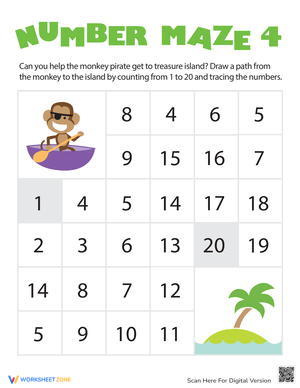
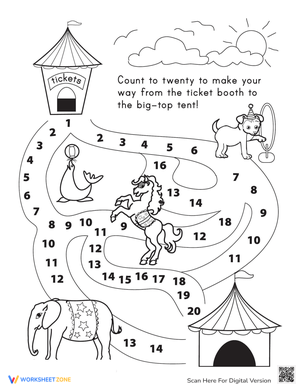
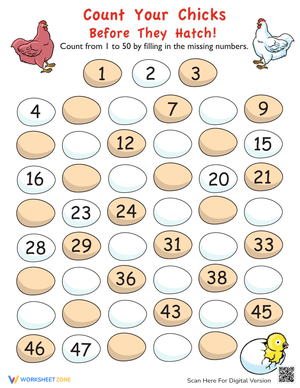
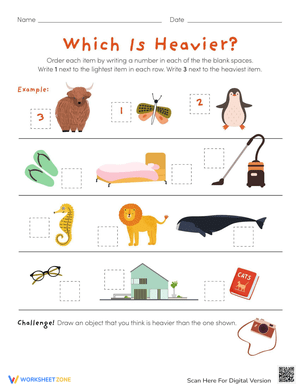
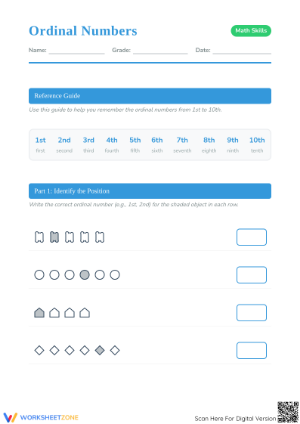
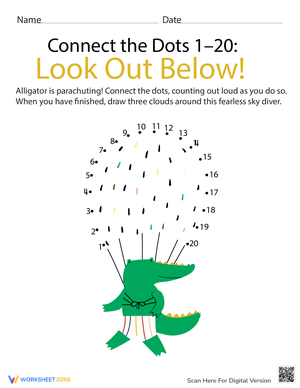
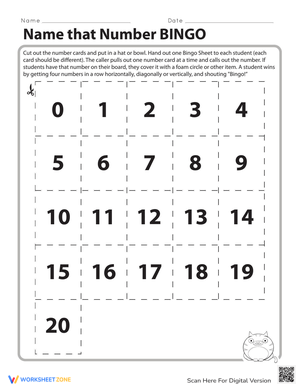
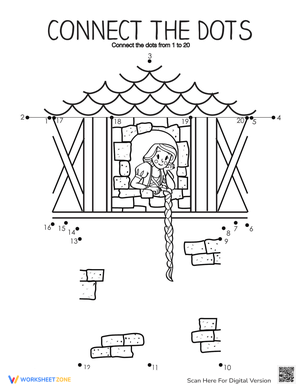
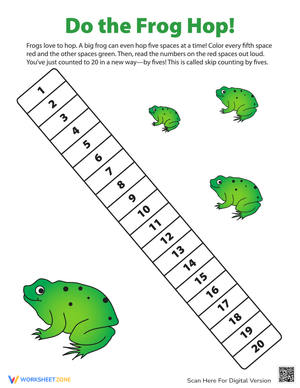
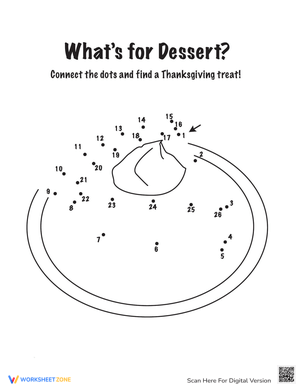
These ordering numbers 0-10 worksheets give kindergarten teachers a focused set of practice activities for one of the year's most consequential skills — getting students to move beyond rote counting and actually compare values. Each worksheet targets a specific aspect of number sequence, from arranging three non-consecutive numbers to working backward from ten.
What's Inside the Set
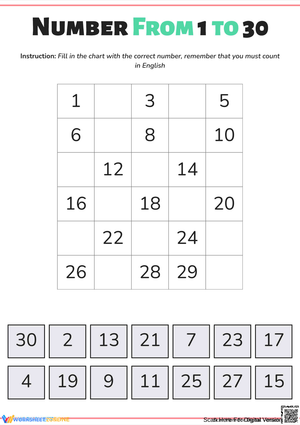
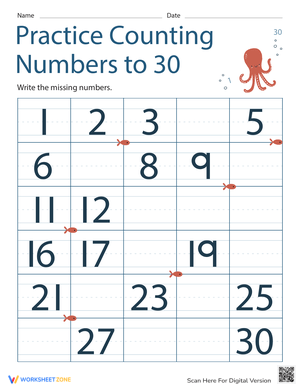
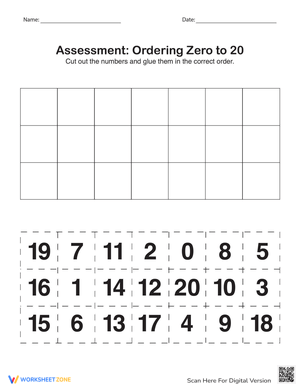
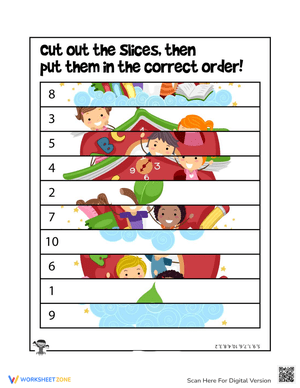
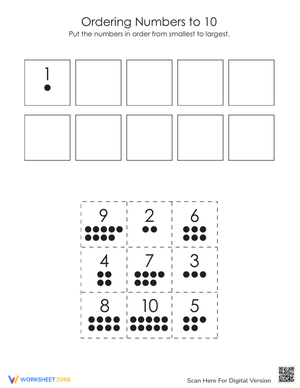
The worksheets cover the full range of sequencing tasks that appear in kindergarten number sense instruction. Students place numbers in ascending order (least to greatest), work through descending sequences, and fill in missing values within a given range. Several worksheets use cut-and-paste formats where students sort number tiles before committing to an arrangement — a structure that reduces the anxiety of "wrong" answers by making the thinking visible and reversible.
Visual scaffolds appear where the abstract numeral alone would stop a student cold. Ten-frames and dot arrays run alongside the numerals on worksheets designed for students still building symbol-to-quantity connections. This lets a child cross-check by counting dots rather than guessing — which is the point at this stage of development.
Standard Alignment
These worksheets align to CCSS.MATH.CONTENT.K.CC.C.7, which requires students to compare two numbers between 1 and 10 presented as written numerals. Ordering extends this standard by asking students to compare and rank three or more numerals simultaneously rather than making a single binary comparison. The CCSS progression places this work in kindergarten specifically because students at this age are consolidating numeral recognition alongside quantity comparison — two skills that ordering tasks require at once, making it an efficient instructional target for this grade band.
Why This Format Matches How Five-Year-Olds Actually Learn This Skill
Ordering numbers is cognitively harder than counting, even though it looks simpler on paper. When a student counts aloud, each number triggers the next through a memorized string. Ordering demands something different: hold three separate values in working memory, compare them simultaneously, and spatially arrange the result. That's a meaningful cognitive load shift, and it explains why a child who counts to ten fluently will still pause and guess when asked whether 7 or 4 comes first in a set of three scrambled numbers.
The worksheet format here supports gradual release. Heavily scaffolded worksheets with number line references at the top allow students to self-monitor without teacher intervention. As students gain fluency, they move to worksheets where the reference strip is absent and the ordering sets grow larger. That progression — from supported to independent — mirrors how number sense actually consolidates rather than jumping straight to unsupported abstract work.
Frequent Student Errors Worth Watching For
The most predictable error isn't confusing large and small — it's treating ordering as a counting task. A student given the numbers 3, 8, and 6 will sometimes write 3, 6, 8 correctly but then write 8, 6, 3 for the descending version only because it reverses that list, not because they understand "greatest to least" as a concept. They've followed a procedure rather than reasoned about magnitude. Worksheets that present descending order sets that can't be solved by simply reversing an ascending answer — introducing a fresh set of three numbers students haven't just ordered — catch this pattern directly.
A second error involves zero. Students regularly omit it or place it last. At five, the idea that zero represents a real quantity that belongs on a number line — and that it is less than one — requires explicit instruction. When ordering numbers 0-10 worksheets include zero in a three-number set, watch whether students treat it as a placeholder or as an actual value with position.
How to Work These Worksheets Into Your Lesson Plans
The most effective placement depends on where students are in the unit. Early in the sequence, use a cut-and-paste worksheet after a concrete activity — the floor number line walk, magnetic tiles on the whiteboard — so the paper task anchors what students just did physically. The transition from body movement to pencil work is smoother when it happens within the same instructional block rather than the next day.
Later in the unit, three-number ordering strips work well as the last eight minutes of math block. Cut the strips apart ahead of time. Students order them independently, you scan the room quickly, and you have real formative data before dismissal — which students handled the zero sets, which reversed descending order without understanding it, which finished in under two minutes and need a challenge. That's more usable information than an end-of-week assessment.
For morning work, laminated worksheets with dry-erase markers let students complete the same set repeatedly with different numbers written in. Rotating the number sets weekly keeps the format familiar while preventing the memorization that sometimes masquerades as mastery.
Frequently Asked Questions
Is this set appropriate for pre-K students who are already counting confidently?
Pre-K students who can count to ten reliably and identify written numerals can engage with the worksheets that use smaller, three-number sets within the 1-5 range. The full 0-10 ordering tasks are generally a better fit once students have consistent numeral recognition across the complete range, which most children develop during kindergarten.
How is ordering different from sequencing, and does this distinction matter instructionally?
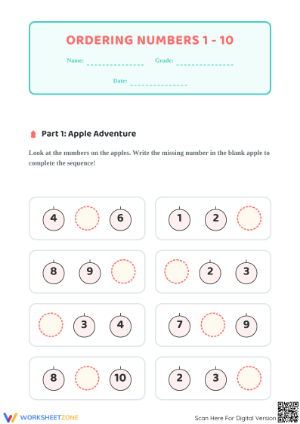
Sequencing — filling in 4, __, 6 — asks students to continue a consecutive pattern they already know. Ordering asks them to rank values that aren't necessarily consecutive: given 2, 9, and 5, which is least? That requires magnitude comparison rather than pattern extension. Both skills matter, but students who can sequence fluently sometimes still struggle with ordering, so treating them as separate instructional targets is worth the effort.
Can these worksheets be used in math centers without teacher supervision?
The cut-and-paste formats and the heavily scaffolded worksheets with built-in number line references work well for independent center use. Worksheets without scaffolds are better suited for small-group instruction where a teacher can ask a student to explain their thinking — especially during the descending-order tasks, where the reasoning behind the arrangement reveals more than the answer itself.













 Interactive Worksheet Maker
 Quiz Maker
 Word Search Maker
 Crossword Puzzle Maker
 Word Scramble Generator
 Sentence Scramble Generator
 Handwriting Worksheet Generator
 Name Tracing Generator
 Fill In The Blank Generator