


























Views
Downloads

Printable Counting Fingers Worksheet | Grade K-1 Aligned
Paste this activity's link or code into your existing LMS (Google Classroom, Canvas, Teams, Schoology, Moodle, etc.).
Students can open and work on the activity right away, with no student login required.
You'll still be able to track student progress and results from your teacher account.
This Grade K-1 counting fingers worksheet helps young learners master number recognition and one-to-one correspondence for numbers 1 through 5. By matching visual finger representations to digits and writing corresponding numerals, students build a foundational understanding of cardinality and quantity. This interactive resource ensures early math success through clear, engaging visual cues.
At a Glance
- Grade: Kindergarten · Subject: Math
- Standard:
K.CC.B.4— Connect counts of fingers to numerals and identify quantities- Skill Focus: Counting fingers and number matching
- Format: 2 pages · 9 tasks · Answer key included · PDF
- Best For: Early numeracy centers and homework
- Time: 10–15 minutes
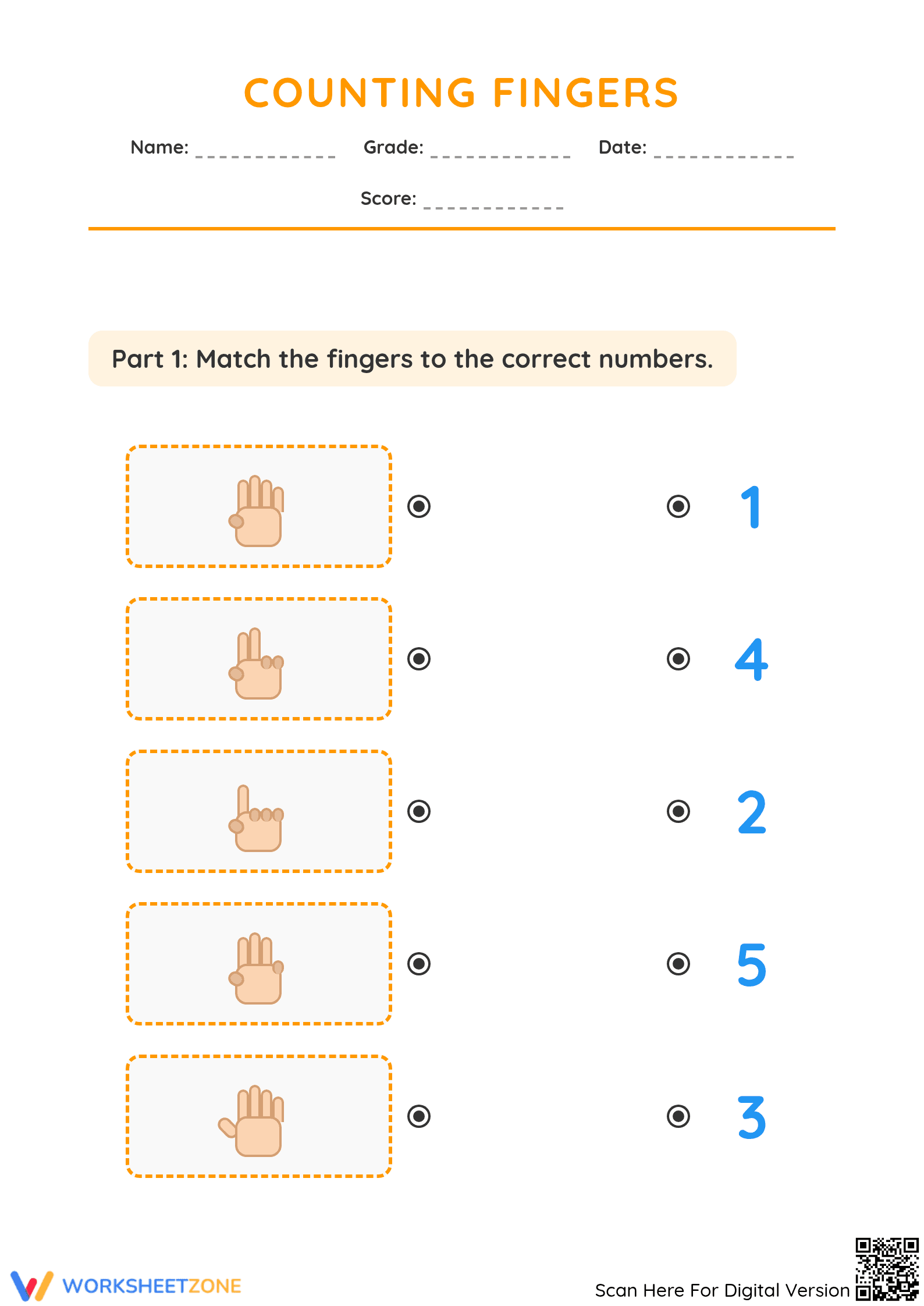
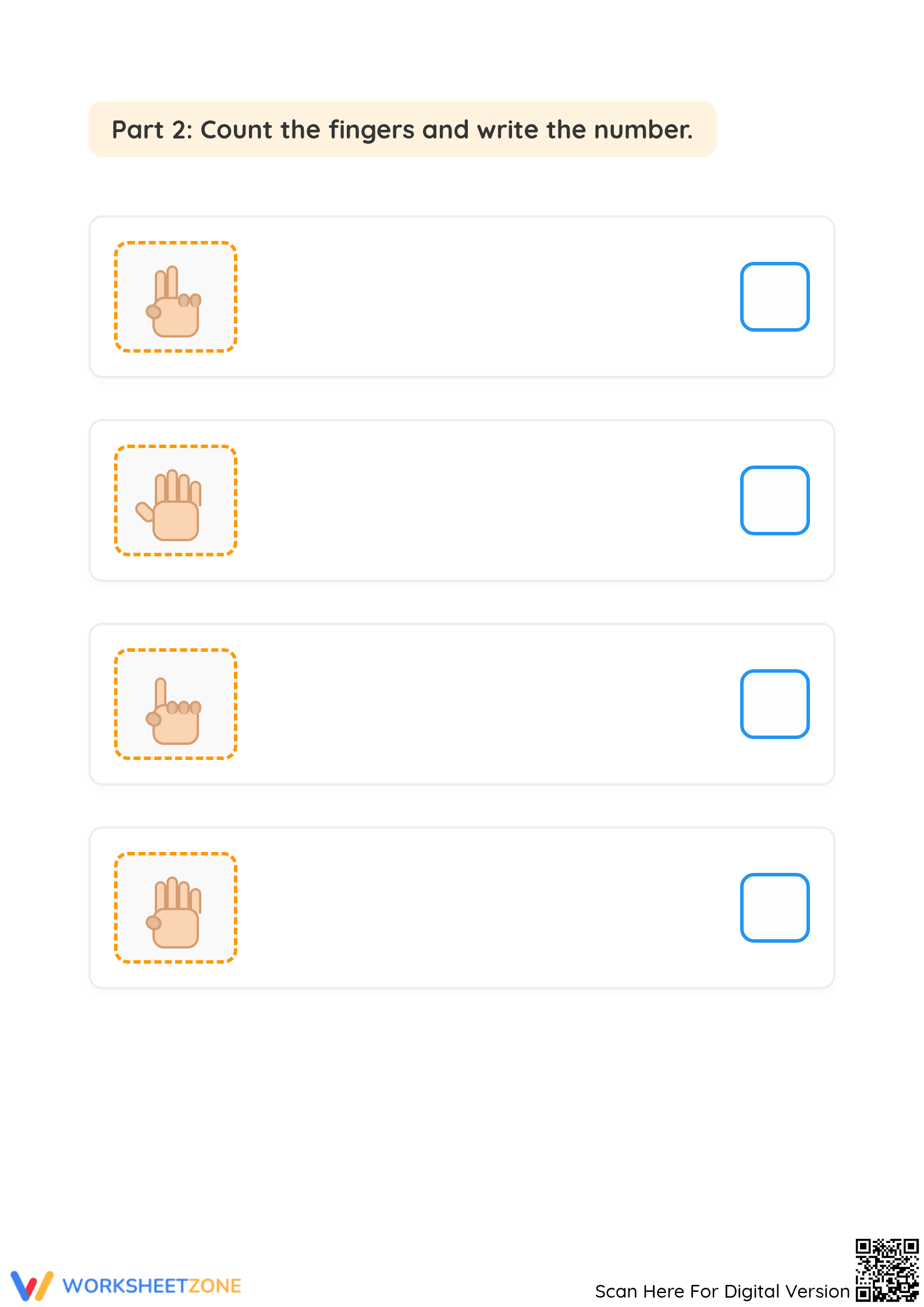
This two-page resource features nine distinct counting tasks designed for clarity and ease of use. Part one includes five matching problems where students draw lines from finger illustrations to their correct numeric symbols. Part two provides four exercises requiring students to count fingers and write the appropriate digit in a designated box. A complete answer key is included for quick verification.
The zero-prep design allows teachers to implement this activity in under two minutes. First, print the two-page PDF (30 seconds). Second, distribute the worksheets to students with pencils (30 seconds). Finally, review the answers as a whole group or individually using the provided key (1 minute). This efficient workflow makes it an ideal choice for morning work or last-minute substitute plans.
This worksheet is aligned to K.CC.B.4, focusing on the fundamental relationship between numbers and quantities. It specifically targets the skill of connecting counting to cardinality, ensuring students understand that the last number name said tells the number of objects counted. This standard code can be copied directly into lesson plans, IEP goals, or district curriculum mapping tools.
Use this worksheet during small-group rotations to observe students' counting strategies, specifically checking if they use one-to-one correspondence correctly. Alternatively, assign it as a quick formative assessment after a direct instruction lesson on counting to five. Teachers should watch for students who might double-count fingers or skip numerals when matching, providing immediate corrective feedback during the task.
This activity is perfectly suited for Kindergarten students and Grade 1 learners requiring additional reinforcement in basic numeracy. The clear visual scaffolds make it accessible for English Language Learners and students with special needs. It pairs naturally with physical counting manipulatives or an anchor chart showing finger counting patterns to provide a multi-sensory learning experience.
The use of finger counting as a bridge to abstract numeric representation is a well-supported pedagogical strategy. Research by Fisher & Frey (2014) emphasizes the importance of visual scaffolding in building mathematical fluency. This worksheet addresses K.CC.B.4 by providing structured practice in matching quantities to numerals, a critical step in developing cardinality. By using familiar hand gestures, the activity reduces cognitive load, allowing students to focus on the counting sequence and symbol recognition. Standardized analysis of early math interventions suggests that consistent exposure to multi-modal representations of number significantly improves long-term retention of basic math facts. This resource provides the necessary repetition and clear feedback loops required for mastery of foundational counting skills, making it a reliable tool for any Kindergarten math curriculum seeking to bridge the gap between concrete and abstract thinking. This worksheet empowers educators to deliver high-quality instruction without extensive preparation.


