These writing numbers 0-10 worksheets give PreK, Kindergarten, and 1st grade teachers a structured path from first pencil contact to independent number production — covering every digit with the directional cues, tracing sequences, and open practice space that early writers actually need. The set is built around one consistent design principle: each worksheet walks students through guided formation before asking them to work without support, so the scaffold drops away gradually rather than all at once.
What Each Worksheet Covers
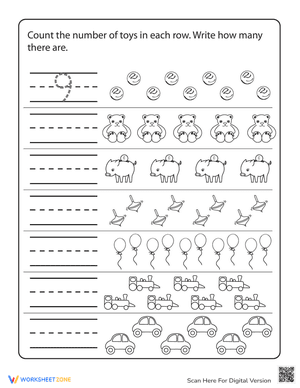
Every worksheet in the set targets a single digit, which keeps cognitive load low enough that a 5-year-old can focus on the stroke rather than the page. Students begin by tracing over dotted numerals with directional arrows and a marked starting point, then move to a tracing row where the model fades, then finish with a blank grid where they write independently. A quantity representation — dots, objects, or a ten-frame depending on the worksheet — sits alongside the numeral throughout, so students are always pairing the written symbol with its meaning rather than practicing handwriting in a math-free vacuum. The set also includes a 0–10 review worksheet where students write each digit once in a sequence, useful for quick checks after the digit-by-digit practice is complete.
The Specific Skills These Worksheets Build
The worksheets develop four skills that operate simultaneously in early number writing, and isolating them on paper helps teachers see where a specific student is stuck.
- Stroke directionality — starting at the correct point and moving in the efficient direction. The arrows on each worksheet make the intended path explicit rather than leaving children to infer it from a static model.
- Numeral proportion — writing a 6, for example, with a loop that closes cleanly rather than spiraling into something closer to a 9. The lined grid on each worksheet gives students a consistent top-line and baseline to work within.
- Symbol-quantity connection — understanding that the mark being made stands for a countable amount. This is where handwriting practice earns its place inside a math block rather than being delegated entirely to ELA time.
- Self-monitoring — after completing a row, students are directed to circle their clearest numeral. That single prompt shifts practice from passive repetition to active evaluation, and it dramatically shortens the window during which reversals persist.
Standard Alignment
The set directly addresses CCSS.Math.Content.K.CC.A.3, which requires Kindergarten students to write numbers from 0 to 20 and represent a number of objects with a written numeral 0–20. The 0–10 focus of these worksheets covers the first half of that standard and represents the portion most teachers address in the first trimester, before extending to the teen numbers. The quantity representations embedded in each worksheet also support K.CC.B.4 — understanding the relationship between numbers and the quantities they represent — because students are counting objects and connecting that count to the symbol they are forming. In PreK, the same worksheets align with early numeracy benchmarks in most state-level pre-kindergarten frameworks that call for recognizing and attempting to write numerals in the context of counting activities.
Frequent Student Errors Worth Watching For
The reversal errors on 3, 5, and 7 are the ones teachers anticipate, but the subtler formation problems are where students quietly develop habits that slow them down in 2nd and 3rd grade. The 4 is a reliable problem: students who learned to draw it as two separate strokes — a diagonal, then a cross — often produce a shape that looks right at large size but collapses into an illegible mark when writing becomes smaller and faster. The worksheets address this by showing the 4 as a three-stroke numeral with a clear sequence, and by including a brief "watch out" note on the sheet directing students to the corner where the two lines meet.
The 8 produces a different category of error. Most young students draw two separate circles stacked on top of each other, which is inefficient and almost always results in a visible seam at the midpoint. The correct stroke is a continuous S-curve that loops back — essentially writing a backward S and closing it. Students who have only ever seen a static 8 on a number chart have no reason to know this, which is why the directional arrow on these worksheets traces the full continuous path rather than indicating two separate circles.
How to Build These Worksheets Into Your Lesson Plans
The most effective placement for this kind of practice is during small-group math rotations rather than whole-class instruction. When the teacher pulls a group for conceptual work — composing and decomposing numbers with manipulatives, say — a second group can work through a number writing worksheet independently or with a paraprofessional who can provide immediate stroke correction. At this age, a brief physical redirect ("put your pencil at the dot and pull down") lands better than a verbal explanation, and having an adult at the table during rotation makes that possible.
Morning entry is another natural fit. A single worksheet on the desk when students arrive gives them a settled, purposeful task during the first eight minutes of the day while attendance and logistics happen. Teachers who use these as morning work report that pairing the worksheet with a quick whole-class chant — saying the stroke description aloud together before students work silently — reduces the number of students who start at the wrong point on the numeral. Laminating the worksheets and sliding them into dry-erase sleeves extends the value considerably; students can practice the same formation repeatedly before a final paper copy goes into the portfolio.
Adjusting the Worksheets for a Range of Learners
For students who are not yet ready to hold a pencil with a functional grip, the worksheets can be used as a pointing-and-tracing task with a finger before any pencil contact happens. This is a legitimate first step, not a workaround — the visual tracking and directional processing are doing real work even without a writing instrument. At the other end, students who have mastered clean formation benefit from a timing component: ask them to write a row of numerals while counting objects aloud, which connects automaticity in writing to fluency in counting and begins building the multi-tasking capacity that math fact practice will eventually require.
For students with fine motor delays, reducing the number of required repetitions per row and enlarging the grid slightly makes the task accessible without changing its cognitive demands. Some teachers print at 115% and find that the extra space is enough to remove the frustration that shuts certain students down before they begin. For English learners, the quantity images on each worksheet carry most of the meaning without relying on printed instructions, so very little modification is needed in terms of language access.
Frequently Asked Questions
Do these worksheets cover 0, or do they start at 1?
The set includes a worksheet for 0. This is worth noting because zero is frequently skipped in early number writing resources despite being a required symbol in K.CC.A.3 and a conceptually important one — students need to understand that zero is a numeral representing a real (empty) quantity, not an absence of mathematics. The zero worksheet includes a quantity representation showing an empty set alongside the numeral formation practice.
How many practice repetitions does each worksheet include per digit?
Each worksheet provides enough repetition to build muscle memory without inducing the kind of fatigue that degrades pencil grip. The sequence runs from fully guided tracing to lightly guided tracing to independent writing, so the reps feel progressively different rather than identical — which matters for keeping 5-year-olds engaged past the first two rows.
What grip and posture setup works best before students start a worksheet?
A quick physical check before pencil hits paper prevents most of the grip problems that accumulate into habits. Students should have their non-dominant hand flat on the paper as an anchor, their pencil held with a tripod grip about an inch above the tip, and their paper tilted slightly — not perfectly vertical — so the writing arm has a natural angle. Thirty seconds of posture setup at the start of a writing block saves considerable correction work later in the year.
Can these be used with 1st graders who missed foundational number writing instruction?
Yes, and without stigma if handled correctly. First graders who reverse numbers or use inefficient strokes benefit from the same directed-arrow format that Kindergarteners use; the content does not read as babyish because the focus is on correctness rather than novelty. Running the worksheets during a pull-small-group session keeps the practice discreet and allows for direct feedback on the specific digits causing problems rather than reteaching the entire 0–10 sequence whole-class.
















 Interactive Worksheet Maker
 Quiz Maker
 Word Search Maker
 Crossword Puzzle Maker
 Word Scramble Generator
 Sentence Scramble Generator
 Handwriting Worksheet Generator
 Name Tracing Generator
 Fill In The Blank Generator