Number 9 sits at an awkward spot in a Pre-K and Kindergarten scope and sequence. It comes right after 8, a number many students already write with some confidence, and right before 10, the milestone that signals a shift into two-digit thinking. Number 9 worksheets give you a dedicated stop on that path so students do not rush past a numeral that is genuinely tricky to form and easy to confuse with 6 when written quickly.
In a typical unit, you will introduce 9 after students can reliably count and represent 8, then use 9 as a bridge before layered practice with 10. Planning it this way keeps your small-group rotations predictable: one week per numeral, with review folded into morning work and calendar time rather than treated as a one-off worksheet page.
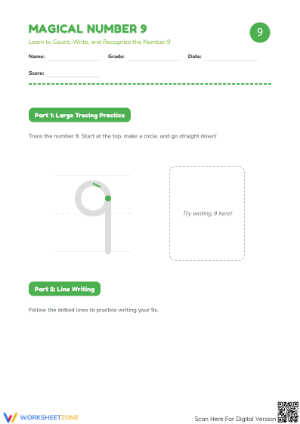
Tracing and Formation Practice for Correct Numeral Writing
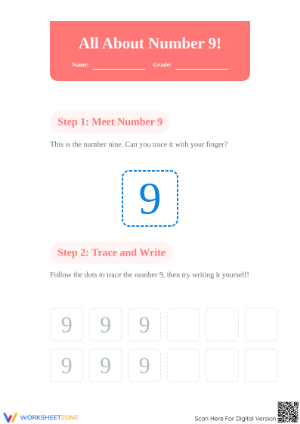
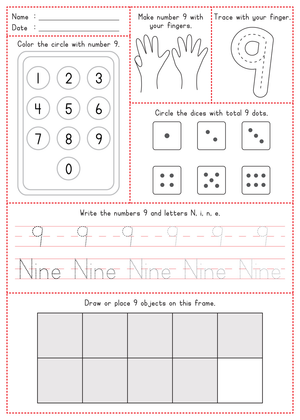
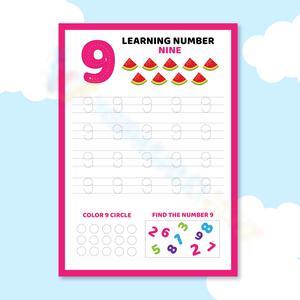
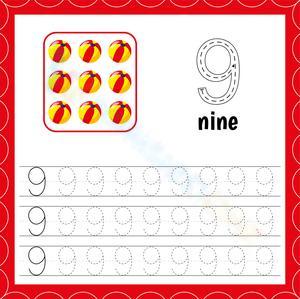
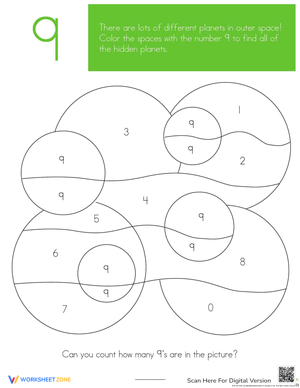
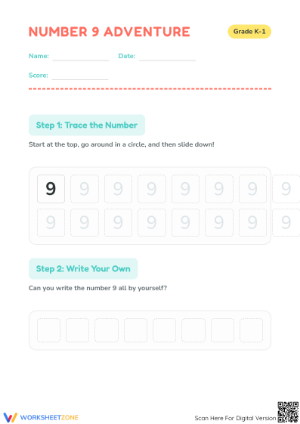
Most number 9 worksheets combine three tasks: tracing the numeral, counting objects, and identifying 9 among distractor numerals. Tracing comes first because fine motor control for 9 is genuinely different from other single-digit numerals. The stroke starts with a small circle at the top and finishes with a long tail dropping straight down, and students who have only practiced straight-line numerals like 1 or 7 often need extra repetitions to get the motion smooth.
Watch specifically for two habitual errors: students who close the top loop into a solid blob instead of a circle, and students who write the tail curving left instead of straight down, which produces a shape closer to a lowercase g. Both errors are correctable with guided tracing over 3-4 sessions, but they tend to stick if left uncorrected for a full week, since motor memory forms quickly at this age.
Use dotted-line tracing sheets for your first exposure, then move to partially faded numerals, and finally to independent writing on a blank line. This gradual release matches how most number 9 worksheets are already sequenced within a packet, so you rarely need to reorder printed pages, just pace them differently for different groups.
Pairing Counting Objects With the Written Numeral
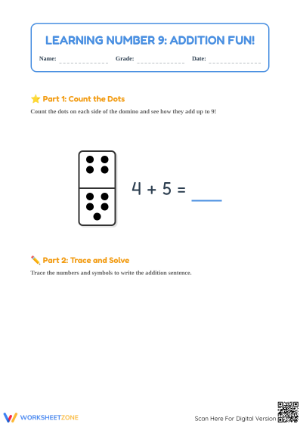
Counting to 9 only becomes meaningful when students connect a set of objects to the written numeral, not just to the number word. Number 9 worksheets that ask students to count a scattered group of 9 apples, then write the numeral in a matching box, directly support this numeral-quantity link. Vary the object arrangement across practice days: a line, a circle, and a scattered array all count as the same quantity, and students who have only counted objects in a row often stumble the first time they see a circular arrangement.
One-to-one correspondence is the skill underneath all of this. If a student points to the same apple twice or skips one while counting, the written numeral at the end will still be wrong even if the tracing looks fine. Watch fingers, not just final answers, during this practice.
Aligning Practice With Counting and Cardinality Standards
CCSS.MATH.CONTENT.K.CC.A.3 requires kindergartners to write numbers from 0 to 20 and represent a count of objects with a written numeral, which is the direct standard behind tracing and writing tasks on number 9 worksheets. CCSS.MATH.CONTENT.K.CC.B.4-5 requires students to count to answer how many for up to 20 objects arranged in a line, array, or circle, which is why varied object arrangements matter more than they might first appear.
These two standards work together: writing the numeral without being able to count a matching set is only half the skill, and counting a set without being able to write the numeral is the other half. Number 9 worksheets that combine both tasks on a single page give you a natural formative check for whether a student has connected them.
Classroom Implementation
Plan for roughly three to four short sessions across a week rather than one long sitting. Start with tracing on day one, add counting-and-matching on day two, mix in distractor identification on day three, and finish with an independent quick check on day four. This spacing matches how motor memory and numeral-quantity connections actually form for 4-6 year olds.
Keep a small set of manipulatives (counters, buttons, or linking cubes) at your small-group table so counting practice is never limited to printed dots on a page. When a student struggles with the worksheet format specifically, moving to physical objects for a session often resolves the confusion faster than repeating the same printed page.
Frequently Asked Questions
1. What grade level are number 9 worksheets appropriate for?
Number 9 worksheets suit Pre-K students beginning number recognition and Kindergarten students working toward writing numerals 0-20 and counting sets of objects. Grade 1 teachers also use them for targeted review with students who need reinforcement before moving to two-digit numbers.
2. How can teachers use number 9 worksheets for intervention with students who struggle with numeral reversals?
Pair tracing practice with verbal cueing about stroke direction, starting with the top circle and finishing with a straight downward tail. Tactile tracing in sand or on textured cards, combined with short daily repetition, corrects reversals faster than worksheet practice alone.
3. How do number 9 worksheets align with kindergarten counting and cardinality standards?
They support CCSS.MATH.CONTENT.K.CC.A.3, which requires writing numbers 0-20 and representing a count with a written numeral, and K.CC.B.4-5, which requires counting up to 20 objects arranged in a line, array, or circle.
4. What is the best way to sequence number 9 practice with numbers 8 and 10?
Introduce 9 once students count and write 8 reliably, then use 9 as a short bridge unit before moving into 10. Keep review of 8 and 9 active during the 10 unit so students do not lose the earlier numerals while learning the new one.













 Interactive Worksheet Maker
 Quiz Maker
 Word Search Maker
 Crossword Puzzle Maker
 Word Scramble Generator
 Sentence Scramble Generator
 Handwriting Worksheet Generator
 Name Tracing Generator
 Fill In The Blank Generator