


























Views
Downloads

Essential Ordinal Numbers Practice | Grade 1 Math Worksheet
Paste this activity's link or code into your existing LMS (Google Classroom, Canvas, Teams, Schoology, Moodle, etc.).
Students can open and work on the activity right away, with no student login required.
You'll still be able to track student progress and results from your teacher account.
Identifying the position of objects is a fundamental skill that bridges counting and spatial reasoning. This printable math worksheet provides a structured environment for Grade 1 students to master ordinal numbers from 1st to 5th. By using clear, colorful visuals, learners can immediately apply their counting skills to determine order and rank in a sequence.
At a Glance
- Grade: Kindergarten · Grade 1
- Subject: Math
- Standard:
CCSS.MATH.CONTENT.K.CC.B.4— Understand that each successive number refers to a quantity that is one larger- Skill Focus: Ordinal numbers 1st to 5th
- Format: 2 pages · 10 problems · Answer key included · PDF
- Best For: Early number sense and position recognition
- Time: 15–20 minutes
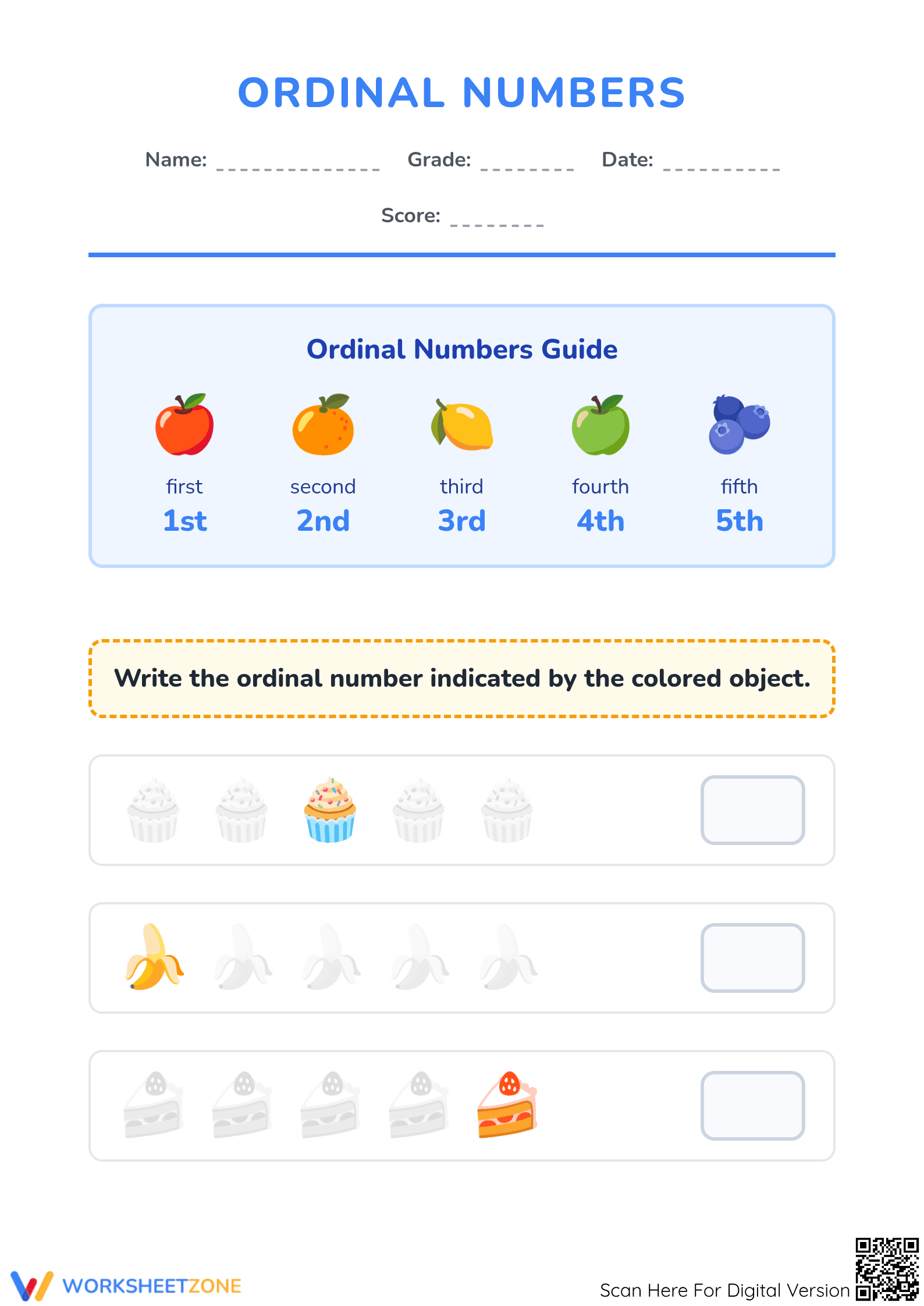
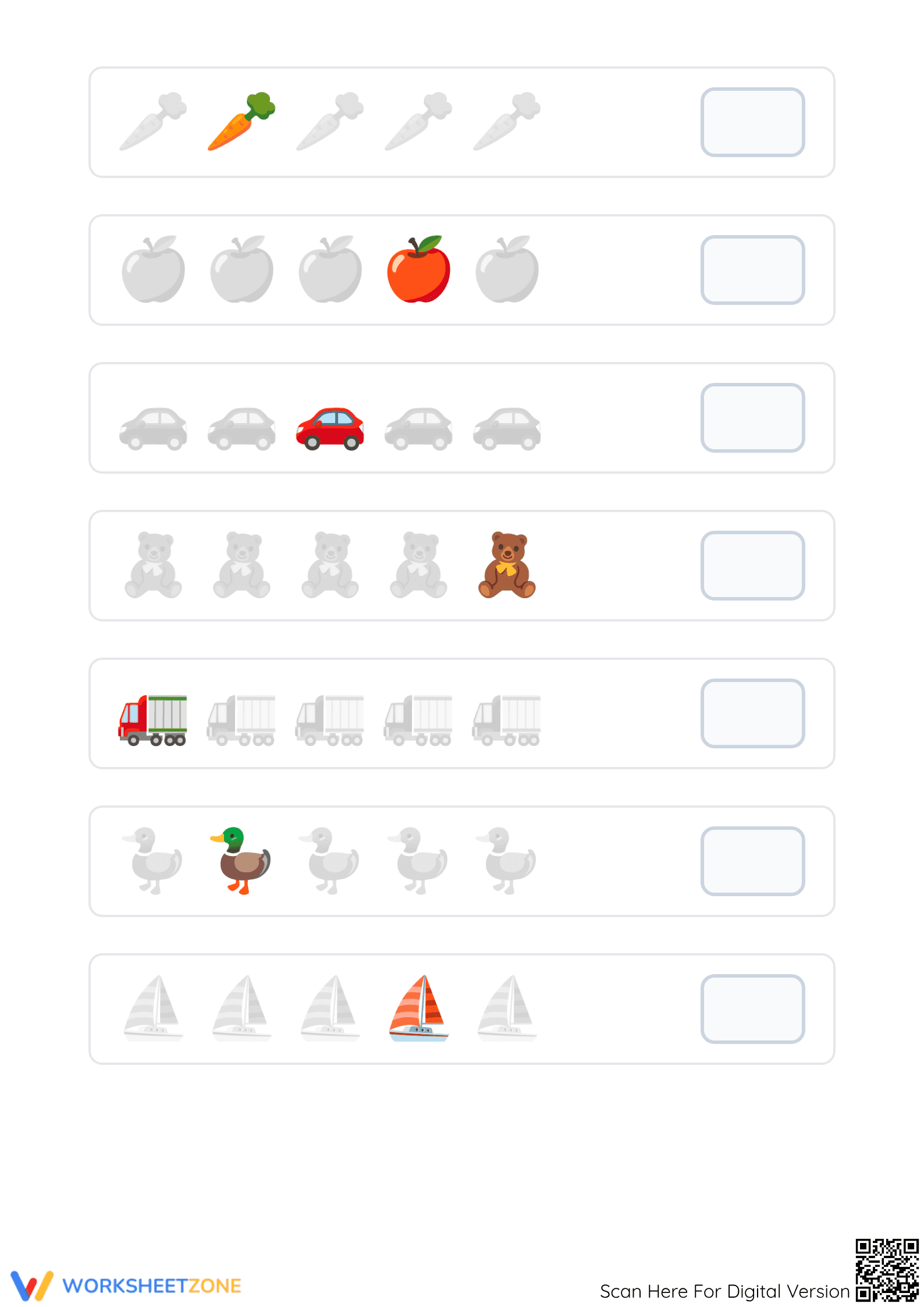
This two-page resource begins with an "Ordinal Numbers Guide" that serves as a visual anchor, pairing fruit icons with their corresponding names and numerical abbreviations. Following the guide, students encounter 10 distinct task rows. In each row, a set of five objects is presented with one colored item. Students must write the correct ordinal number in the box to indicate its position.
Skill Progression
- Guided reference: The top-page guide provides a safety net, allowing students to self-correct by looking back at the fruit labels and identifying the 1st through 5th positions.
- Application: Three initial problems on page one allow for modeling or group work to establish the pattern of identifying the colored object in a set.
- Independent Mastery: Seven additional problems on page two challenge students to apply knowledge, reinforcing the connection between visual position and numerical notation.
Standards Alignment
This activity is aligned with `CCSS.MATH.CONTENT.K.CC.B.4`, which requires students to understand the relationship between numbers and quantities. Ordinality is a specific extension of this standard, helping children comprehend that numbers describe not just "how many," but also "where" in a sequence. This standard code can be copied directly into lesson plans, IEP goals, or district curriculum mapping tools.
How to Use It
Incorporate this worksheet during your direct instruction on number sense or as a dedicated math center activity. To use it as a formative assessment tool, observe whether students count from the left to right or if they struggle with the transition from the cardinal "one" to the ordinal "first." Completion typically takes between 15 and 20 minutes for early learners.
Who It's For
This resource is designed for Kindergarten and Grade 1 students who are beginning to explore number sequencing. It is particularly effective for English Language Learners (ELLs) because the heavy visual scaffolding minimizes the linguistic load. Pair this worksheet with a physical line-up activity or a read-aloud about positions to provide real-world context.
Ordinal number acquisition is a pivotal developmental milestone in early mathematics. Mastering positional language like "first," "second," and "third" is essential for developing number sense and success in measurement. According to Fisher & Frey (2014), visual anchors and structured practice help students transition from rote counting to conceptual understanding of position. This worksheet addresses standard `CCSS.MATH.CONTENT.K.CC.B.4` by requiring students to recognize 1st through 5th positions. By focusing on a small range, cognitive load is managed, letting learners focus on vocabulary and notation. The 10-task practice set ensures repetition for retention, while the visual guide supports independent work. This approach aligns with evidence-based strategies for gradual release and instructional scaffolding.


