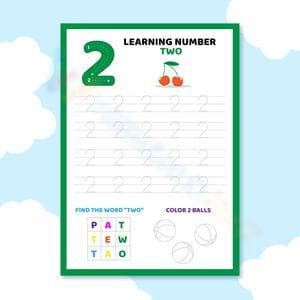
These number 2 worksheets give Pre-K and Kindergarten teachers a focused set of resources for the moment when students stop pointing at objects and start connecting a quantity to a written symbol. That transition — spoken word to numeral to counted group — is where early numeracy either takes hold or gets shaky, and each worksheet in this set targets one part of that connection directly.
What Students Practice Across the Set
The worksheets cover three distinct skill areas, and it matters that they stay distinct. Tracing and formation practice builds the motor pathway for writing the numeral — the curved top, the diagonal slide, the flat base. Counting and cardinality work asks students to identify groups of two, color exactly two items from a larger collection, or draw two objects in a blank field. A third strand ties the symbol to the quantity explicitly: students see the numeral and count out a matching group, or see a group and write the numeral beside it.
Each worksheet focuses on one of these strands rather than mixing all three on the same page. That keeps cognitive load manageable for four- and five-year-olds who are still developing the working memory to hold a formation rule, a counting sequence, and a writing task simultaneously.
Standard Alignment
These worksheets align with two Kindergarten standards from the Common Core State Standards for Mathematics. CCSS K.CC.A.3 requires students to write numbers from 0 to 20 and represent a number of objects with a written numeral — the formation and symbol-to-quantity worksheets address this directly. CCSS K.CC.B.4 connects counting to cardinality, specifically the understanding that the last number named in a count tells the total quantity. The counting worksheets build toward this understanding by asking students to identify groups of exactly two rather than simply reciting a number sequence.
In classroom terms, K.CC.A.3 tends to show up in whole-group and small-group instruction through the fall of Kindergarten, with independent practice following once the class has had multiple guided exposures. K.CC.B.4 is harder to assess with a worksheet alone — you also need to watch students count — but the cardinality tasks here give you a written artifact that shows whether a student understands the symbol-to-quantity relationship, which is a reasonable proxy for the standard.
Frequent Student Errors Worth Watching For
The reversal problem gets the most attention — students write the 2 so it curves the wrong direction, producing something closer to a backward S — but the more instructionally useful error is the stroke-order breakdown. Many students who can produce a recognizable 2 are starting at the bottom and working up, or drawing the horizontal base first. That matters because the wrong stroke order creates hesitations and lifts that slow handwriting fluency down the road. Watching where the pencil starts, not just what the finished numeral looks like, tells you much more about what a student actually knows.
On the cardinality side, watch for students who can point to a group of two and say "two" but cannot write the numeral beside it — and the reverse, students who write a clean 2 but count out three objects without noticing the mismatch. Those two errors indicate different gaps. The first is a symbol-retrieval problem; the second is a cardinality problem. These worksheets surface both patterns clearly enough that a quick scan of student work during a center rotation tells you which intervention each child needs.
How to Build These Worksheets Into Your Lesson Plans
The tracing worksheets work best as a warm-up before any pencil-and-paper math activity — about five minutes while students are settling after morning meeting, before the lesson proper begins. Repetition in short bursts builds the motor memory faster than one long tracing session per week.
The counting and cardinality worksheets fit naturally into a three-station math rotation. At one station students work through a counting worksheet independently. At a second station they use manipulatives — counting bears, cubes, or tiles — to build groups of two before touching the paper. At a third station they work with a partner or small group under teacher direction. Running the worksheet station independently frees you to do targeted instruction at the manipulatives station, which is where the real diagnostic work happens anyway.
For intervention, the formation worksheets laminate well. A student who needs extra stroke-order practice can use a dry-erase marker to trace the same worksheet repeatedly across a week without burning through paper. That also makes it easy to observe the stroke sequence up close — something a completed worksheet cannot show you.
Adapting the Set for Mixed-Ability Classrooms
For students who need more support, use only the tracing worksheets with the largest numeral guides, and pair those with a physical walk-through of the stroke: tap the top of the 2, slide the pencil down to the curve, then sweep straight across. Verbal cues said aloud while tracing — "up to the bump, slide down, walk across" — give students an auditory scaffold that reinforces the motor sequence.
For students who can already write the numeral independently, redirect them to the cardinality strand: worksheets that ask them to represent a quantity two different ways, or to spot the error in a set where three objects are labeled with a 2. That keeps the challenge live without jumping ahead to the number 3 before the rest of the class is ready. The worksheets in this set support both adjustments without requiring you to prepare separate materials from scratch.
Frequently Asked Questions
Are these worksheets appropriate for Pre-K, or are they designed for Kindergarten?
The formation and large-guide tracing worksheets are appropriate for Pre-K students, particularly in the second half of the year when fine motor control is more developed. The cardinality and symbol-to-quantity worksheets are better suited to Kindergarten, where the Common Core standards formally introduce written numeral representation. Many teachers use the tracing worksheets in Pre-K as an introduction and then revisit the full set at the start of Kindergarten to consolidate the skill before moving to higher numbers.
What do I do when a student consistently reverses the 2?
First, confirm that the student is starting at the correct point — the top of the curve — rather than at the base. Most reversals originate from starting on the wrong side. A small green dot at the starting position on the worksheet is often enough to redirect the pencil. If the stroke direction itself is reversed, have the student trace a correctly formed 2 with one finger before picking up the pencil. Reversals are developmentally typical through about age seven, so the goal is consistent gentle correction, not remediation.
How many worksheets should a student complete in a single session?
One worksheet per session is enough for most Pre-K and Kindergarten students. Pushing through multiple worksheets in one sitting produces diminishing returns — fine motor fatigue sets in quickly at this age, and the quality of the last attempt is almost always worse than the first. If a student finishes early, redirect to a manipulative task or a paired activity rather than a second worksheet.
















 Interactive Worksheet Maker
 Quiz Maker
 Word Search Maker
 Crossword Puzzle Maker
 Word Scramble Generator
 Sentence Scramble Generator
 Handwriting Worksheet Generator
 Name Tracing Generator
 Fill In The Blank Generator