


























Views
Downloads

Back to School I Spy Numbers 1-10 | Essential Math
Paste this activity's link or code into your existing LMS (Google Classroom, Canvas, Teams, Schoology, Moodle, etc.).
Students can open and work on the activity right away, with no student login required.
You'll still be able to track student progress and results from your teacher account.
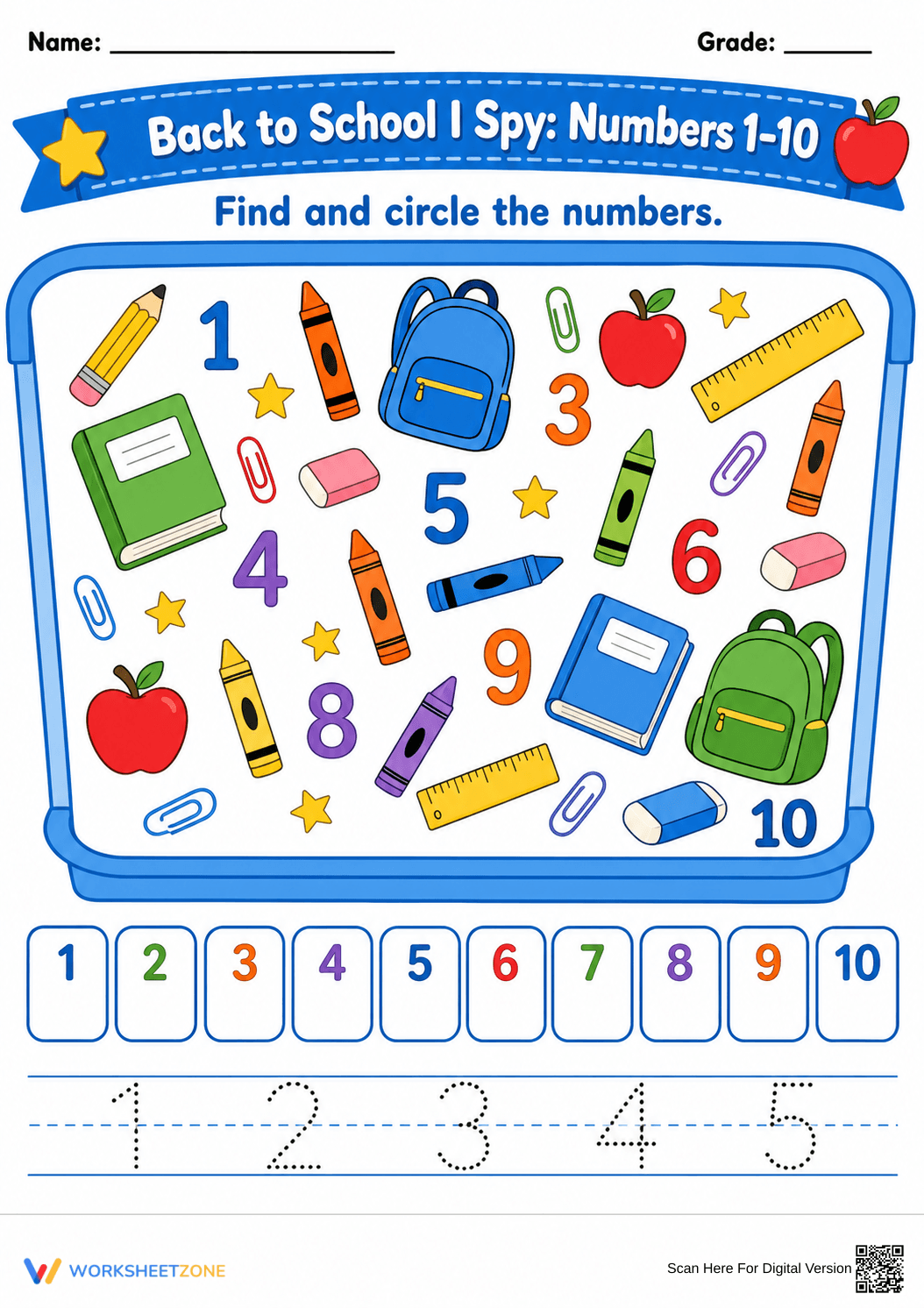
This Back to School I Spy worksheet provides PreK and Kindergarten students with a focused way to practice number recognition and fine motor control. By searching for numerals 1-10 hidden among familiar classroom objects, learners build visual discrimination skills essential for early numeracy. The integrated tracing component ensures students connect visual identification with written formation.
At a Glance
- Grade: Kindergarten · Subject: Math
- Standard:
K.CC.A.3— Write numbers from 0 to 20 and represent objects with numerals- Skill Focus: Number recognition 1–10
- Format: 1 page · 25 tasks · Answer key included · PDF
- Best For: Morning work and math centers
- Time: 15–20 minutes
This single-page PDF features a vibrant "classroom supply bin" filled with 2D vector illustrations like backpacks, crayons, and books. Students must locate 10 distinct numerals hidden within the scene. The layout includes a 10-box checklist for tracking progress and a dedicated handwriting row for tracing numbers 1 through 5 on primary ruled lines.
Zero-Prep Workflow
- Print: Generate the single-page PDF in color or grayscale (1 minute).
- Distribute: Hand out sheets during transitions or as a standalone math center activity (1 minute).
- Review: Use the included answer key for rapid visual checking or peer-grading sessions (1 minute).
This process requires under 3 minutes of total preparation time, making it an ideal solution for emergency sub plans or morning work.
Standards Alignment
The primary focus is CCSS.MATH.CONTENT.K.CC.A.3, which requires students to write numbers and represent quantities. By finding the numbers in a field of objects and then tracing them, students practice the specific motor patterns required for numeral formation. This standard code can be copied directly into lesson plans, IEP goals, or district curriculum mapping tools.
How to Use It
Use this worksheet as a "hook" at the start of a math lesson to gauge prior knowledge of numeral shapes. Alternatively, assign it as a quiet-time activity for students who finish their primary assignments early. Teachers should observe students as they search to identify those struggling with visual tracking or those who confuse similar-looking numbers like 6 and 9.
Who It's For
This resource is tailored for Pre-K and Kindergarten students beginning their numeracy journey. It is also highly effective for English Language Learners (ELLs) who benefit from the visual-to-symbol connection and for students in occupational therapy who need to practice controlled pencil movements within the tracing section. Pair this with a physical number line for additional support.
Fisher & Frey (2014) emphasize that visual anchors and scaffolded tasks are critical for early cognitive development. This worksheet aligns with those findings by combining visual search tasks with direct motor practice. The inclusion of the CCSS.MATH.CONTENT.K.CC.A.3 standard ensures students engage in the foundational requirement to write numbers and represent quantities. Visual discrimination, as exercised here, is a prerequisite for reading fluency and mathematical symbol recognition. By integrating a checklist and a tracing row, the resource supports executive functioning through task persistence and self-monitoring. This multi-modal approach is recognized in the RAND AIRS 2024 report as an effective strategy for early childhood intervention, ensuring students bridge the gap between abstract concepts and concrete written representation. This specific activity provides the repetition necessary for mastery in early math environments.


