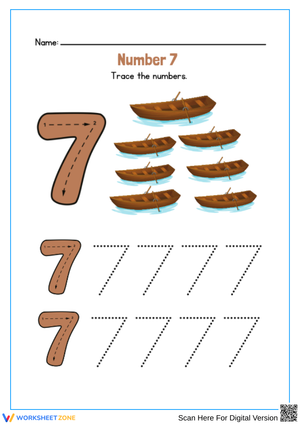
These number 7 worksheets give kindergarten and first-grade teachers a focused set of practice tools that move students from first recognition of the digit through confident independent writing and counting. The set covers numeral identification, formation practice, one-to-one correspondence, ten-frame work, and tally mark representation — each on its own worksheet so teachers can assign exactly what a student needs on a given day.
What Students Practice Across the Set
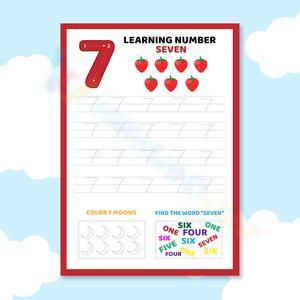
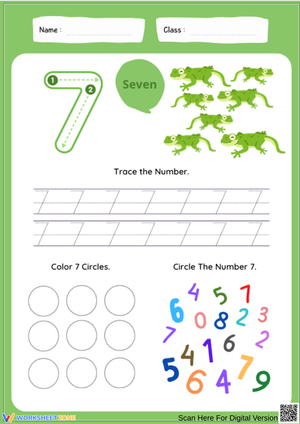
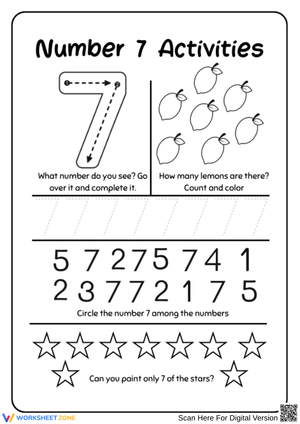
Recognition comes first. One worksheet presents a mixed grid of digits where students circle every instance of 7, which forces visual discrimination against neighbors like 1 and 4. A second asks students to color only the objects grouped in sets of seven — five apples and two more, seven stars, seven animals — so the numeral, the word seven, and the counted quantity all land together. From there, worksheets shift to ten-frame and tally mark representations, where 7 appears as a full top row of five dots plus two on the bottom, and as a bundle of four vertical marks crossed with a diagonal slash plus two singles. Students who can read a ten-frame without counting one by one are building the subitizing foundation that makes later addition fluent rather than labored.
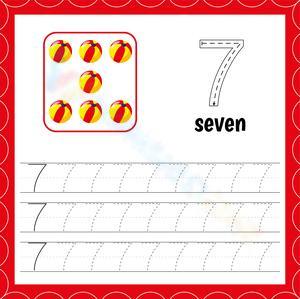
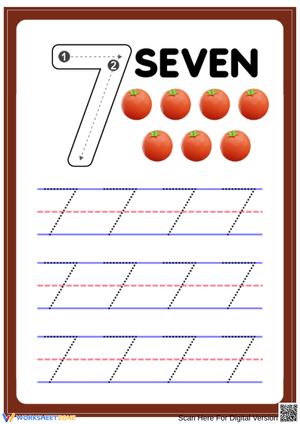
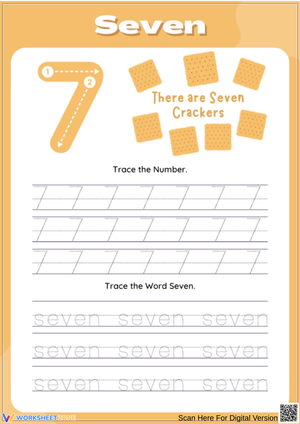
Formation worksheets follow a clear scaffold: large dotted numerals with directional arrows give way to smaller guidelines with fewer cues, and finally to blank lines where students write independently. The diagonal stroke is where most students stall — the horizontal bar goes down cleanly, then the pencil needs to hold a steady angle toward the lower left. The worksheets flag that transition point explicitly with an arrow at the bend, which is more useful than a dotted line that obscures where the direction actually changes.
Standard Alignment
These worksheets align to CCSS.MATH.CONTENT.K.CC.A.3 (write numbers 0–20; represent a number of objects with a written numeral) and CCSS.MATH.CONTENT.K.CC.B.4 (understand the relationship between numbers and quantities; connect counting to cardinality). In classroom sequencing, K.CC.A.3 is typically introduced after students have stable recognition of digits and are building writing fluency — usually mid-year in kindergarten. K.CC.B.4 runs alongside counting practice from early in the year, but the cardinality piece (understanding that the last number named tells the total) often consolidates later, making these worksheets useful for reinforcement into late fall and early spring.
Building These Worksheets Into Lesson Plans
The recognition and formation worksheets work well as a Monday warm-up at the start of a number-focused week. Five minutes of independent work before the lesson proper gives the teacher a real-time read on where individual students are, without the social pressure of a whole-class moment. The counting and ten-frame worksheets fit better mid-week, after students have handled the digit enough to focus on quantity rather than the shape of the numeral itself.
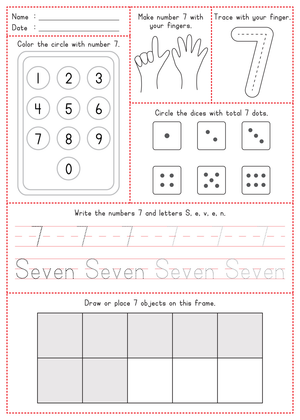
During small-group rotations, the drawing worksheet — where students produce seven objects in an empty box — functions as a formative probe without looking like an assessment. The teacher can observe the count in real time: does the student lose track? Does she re-count? Does he draw a cluster and then try to count a tangled group? Those sixty seconds of observation yield more diagnostic information than a circled answer ever would. Save the tally mark worksheet for the end of the week, when students are ready to see 7 represented through a different notation system.
Laminating one copy of each formation worksheet lets students practice with dry-erase markers for multiple rounds without consuming paper. This is especially practical for students who need five or six repetitions before the stroke sequence becomes automatic — those students rarely need the same number of repetitions on recognition tasks, so laminated copies let the teacher customize practice volume without preparing separate materials.
Adjusting the Worksheets for a Range of Learners
Students who are still developing fine motor control do better when the formation worksheet is enlarged to 120% before printing. Larger lines reduce the precision demand on the grip so the student can focus on stroke direction rather than staying inside a narrow space. Placing a small sticky-dot sticker at each starting point gives a tactile cue that arrows alone don't provide.
Students who have formation under control but need a counting challenge can extend the ten-frame worksheet by writing a number sentence below the filled frame: 5 + 2 = 7. That move doesn't require a different worksheet — it's a verbal prompt from the teacher while the student is already working. At the other end, students who are not yet reading the ten-frame as a chunk can use physical counters on top of the printed dots before they mark the worksheet. The concrete-representational-abstract sequence applies here: the student places a counter, says the number name, places another, and so on, until the visual matches the count. The printed worksheet becomes the representational layer that bridges the concrete manipulation to the abstract numeral.
Frequently Asked Questions
How do I know whether a student is ready for the tally mark worksheet?
If the student can look at a ten-frame filled with seven dots and say "seven" without counting each dot individually, they are likely ready for tally marks. If they still count one by one, the ten-frame isn't functioning as a visual chunk yet, and adding a second notation system will create confusion rather than flexibility. Spend more time with the ten-frame worksheet first.
What should I do when a student consistently writes the 7 reversed or slanted?
Verbal cues anchored to the motor sequence help more than arrows alone. A phrase like "across the sky and down from heaven" — spoken while the student watches a modeled stroke — gives the stroke an auditory and rhythmic anchor that a dotted line can't provide. Have the student say the cue aloud while writing, not after. The self-talk slows the movement enough for the student to feel the direction before committing the stroke.
Do these worksheets work for students who are ahead and already writing 7 accurately?
The formation worksheets won't challenge them, but the ten-frame and counting worksheets still carry value. A student who writes 7 fluently may not yet have an automatic sense of 7 as five-and-two, which matters when she hits addition in first grade. The counting-with-drawing worksheet also functions as a cardinality check that is worth running even for students whose penmanship is already solid.













 Interactive Worksheet Maker
 Quiz Maker
 Word Search Maker
 Crossword Puzzle Maker
 Word Scramble Generator
 Sentence Scramble Generator
 Handwriting Worksheet Generator
 Name Tracing Generator
 Fill In The Blank Generator