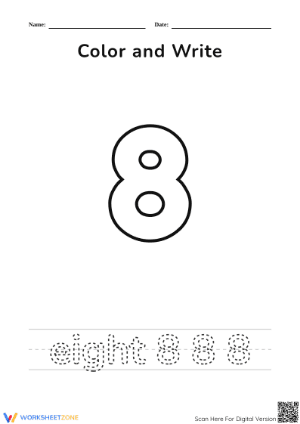
These number 8 worksheets give preschool and kindergarten teachers a focused set of practice pages covering numeral formation, counting, and early number sense — all built around the specific demands the numeral 8 places on young learners. Writing an 8 is genuinely harder than writing most single-digit numerals; it requires a continuous looping stroke that challenges the bilateral coordination young students are still developing, and that difficulty shows up in student work in predictable ways.
What Students Practice Across the Set
Each worksheet targets one of four interconnected skills. Tracing and independent writing pages focus on numeral formation — students follow dotted paths with directional arrows, then reproduce the numeral in blank boxes without the guide. Counting and cardinality pages present groups of exactly eight objects (spiders, flowers, linking cubes) and ask students to count and mark the set, reinforcing that the final number spoken names the whole quantity. Ten-frame pages show 8 filled in a 2-by-5 grid, making the relationship between 8 and 10 visual and immediate. Number recognition pages — find-and-color or simple maze formats — build the visual discrimination students need to distinguish 8 from 0, 6, and 9, which beginning readers and counters frequently confuse at the glance level.
Cut-and-paste worksheets round out the set. Students cut out exactly eight objects and arrange them in a designated space, which adds scissor practice and spatial organization on top of the counting work. These tend to work well in centers because the physical manipulation slows students down enough that they count more carefully than they do on a coloring page.
Standard Alignment
These worksheets align primarily with CCSS.MATH.CONTENT.K.CC.A.3, which requires kindergartners to write numbers from 0 to 20 and represent a number of objects with a written numeral. The counting and cardinality work also connects to K.CC.B.4 (understanding the relationship between numbers and quantities) and K.CC.B.5 (counting to answer "how many" questions about sets up to 20). In classroom terms, these worksheets fit naturally into the Counting and Cardinality unit that most kindergarten programs place in the fall, typically after students have solid footing with numerals 1 through 7 and before the class moves into teen numbers.
Mistakes Students Make That These Worksheets Help You Catch
The single most common formation error is drawing two separate circles stacked on top of each other rather than one continuous stroke. Students who do this have usually seen the 8 as a finished shape — two loops — without watching it being formed. The worksheet's directional arrows and numbered stroke sequence interrupt that misconception early. A second error is starting at the bottom and working upward, which produces a numeral that looks roughly correct but becomes increasingly unstable as letter sizes shrink in later grades. Look for the starting dot on completed tracing pages; students who ignore it and start from the bottom will show a characteristically different curve direction in the upper loop.
On counting pages, the recurring error is not miscounting from 1 to 8 but rather recounting already-marked objects. Students who haven't yet internalized one-to-one correspondence will circle or color an object, lose track, and circle it again. Pages that use a clear left-to-right object arrangement — rather than scattered clusters — make this error visible in the work and easier to address in a follow-up conversation.
How to Build These Worksheets Into Your Lesson Plans
The most effective sequence we see in practice is trace-build-write. Students begin with a tracing worksheet, then leave the paper to build an 8 with playdough or wiki sticks on a desk mat, then return to the worksheet and write the numeral independently in the open practice rows. That three-step loop engages visual, tactile, and motor memory in sequence, and the transition back to paper after the physical build tends to produce cleaner, more deliberate strokes than tracing alone.
During math centers, pair counting worksheets with a small bin of manipulatives — counting bears or dot stickers work well. Students complete the worksheet, then build a physical set of eight to verify their answer. The concrete-to-representational connection this creates is worth the extra setup, particularly for students who rush the counting task on paper.
For the seven or eight minutes at the end of a lesson before transitions, a single tracing or find-and-color worksheet functions well as a quiet independent closer. It keeps students productively engaged while you circulate and collect completed work, and a fast review of those pages before the next morning gives you a clear picture of who needs another day with guided support before moving to 9.
Frequently Asked Questions
What's the best way to use these worksheets in a small-group pull-out?
Sit with four to six students and work through a tracing worksheet together, narrating each stroke aloud as you model it on your own copy. Phrases like "curve down and to the left, then loop back up and close" give students verbal anchors they can repeat independently. Watch for the two-circles error and the bottom-start error during guided practice — both are easier to correct in the moment than after students have reinforced the wrong pattern across a full worksheet.
At what point in the kindergarten year do these worksheets fit best?
Most kindergarten sequences introduce 8 in the first quarter after students have worked through 1 to 7. The worksheets work best when students already recognize the quantity eight from counting experiences — games, songs, physical counts — so the worksheet practice is reinforcing a concept that exists concretely rather than introducing it in the abstract. If a student can count out eight bears but can't write the numeral, that's the exact profile these tracing and writing pages are built for.
Do these worksheets work for preschool students, or are they calibrated for kindergarten?
The tracing and counting pages work well in preschool for students who have solid number sense through 5 and are beginning to extend that to higher single digits. The ten-frame and number discrimination pages are better suited to kindergarten, where students have the instructional context to make sense of the frame structure and the visual comparison tasks. For a mixed-age PreK–K center, the counting and color pages are the most accessible starting point across both groups.
















 Interactive Worksheet Maker
 Quiz Maker
 Word Search Maker
 Crossword Puzzle Maker
 Word Scramble Generator
 Sentence Scramble Generator
 Handwriting Worksheet Generator
 Name Tracing Generator
 Fill In The Blank Generator