


























Views
Downloads


Carbon Cycle Diagram Worksheet | Grade 8 Essential
Paste this activity's link or code into your existing LMS (Google Classroom, Canvas, Teams, Schoology, Moodle, etc.).
Students can open and work on the activity right away, with no student login required.
You'll still be able to track student progress and results from your teacher account.
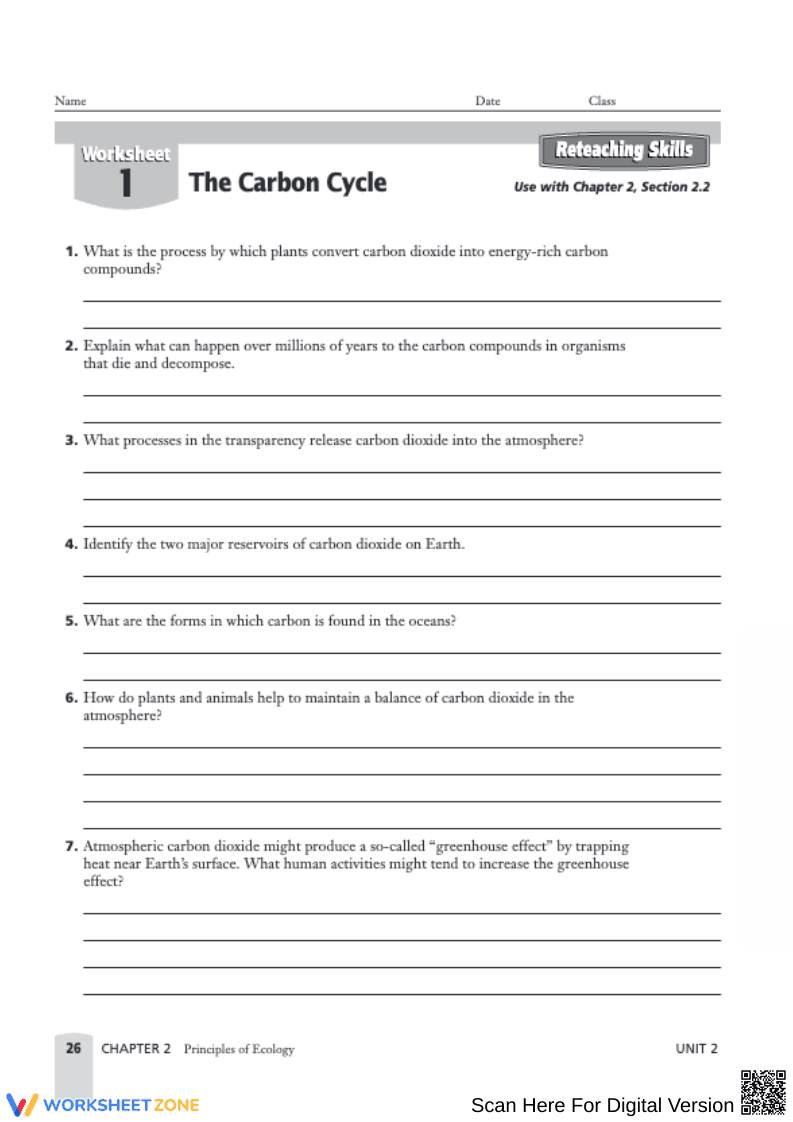
This Grade 8 carbon cycle worksheet provides a comprehensive visual and analytical framework for students to trace the movement of carbon through Earth's systems. By analyzing a detailed diagram, learners identify the biological and chemical processes that drive the cycle, including photosynthesis, respiration, and combustion. This resource ensures students understand how matter is conserved while changing form across different reservoirs.
At a Glance
- Grade: 8 · Subject: Science
- Standard:
MS-LS2-3— Develop a model to describe the cycling of matter among ecosystem parts- Skill Focus: Biogeochemical cycle analysis
- Format: 2 pages · 7 problems · Answer key included · PDF
- Best For: Mid-unit review or emergency sub plans
- Time: 20–30 minutes
The resource consists of two distinct components: a high-quality reference diagram and a structured question set. The diagram illustrates the complex interactions between industry, agriculture, aquatic life, and the atmosphere. The accompanying worksheet features 7 open-ended questions that require students to extract information from the visual model, explain long-term carbon storage in fossil fuels, and identify the human activities contributing to the greenhouse effect.
The zero-prep workflow for this resource is designed for maximum efficiency. First, print the two-page PDF, ensuring each student receives both the reference diagram and the question sheet. Second, distribute the materials as a silent starter or independent practice session. Finally, review the seven analytical questions using the provided diagram as a visual key to clarify misconceptions about carbon reservoirs. This is an ideal solution for unexpected absences or transition periods.
This resource is specifically aligned to MS-LS2-3: "Develop a model to describe the cycling of matter and flow of energy among living and nonliving parts of an ecosystem." It focuses on the cycling of matter by highlighting how carbon atoms move between the atmosphere and organisms. It also supports MS-ESS3-5 regarding human-induced climate change. Both standard codes can be copied directly into lesson plans, IEP goals, or district curriculum mapping tools.
Use this worksheet as a formative assessment after an initial lecture on biogeochemical cycles. As students work, circulate to observe if they can distinguish between respiration and photosynthesis on the diagram. It also serves as an excellent review tool before a unit test on ecology. Expected completion time ranges from 20 to 30 minutes depending on whether students work independently or in pairs.
This worksheet is designed for Grade 7 and 8 science students, particularly those in general education or integrated science tracks. The visual nature of the diagram provides essential scaffolding for English Language Learners (ELLs) and students with IEPs who benefit from non-linguistic representations. It pairs naturally with an anchor chart on the greenhouse effect or a direct instruction lesson on cellular respiration.
The carbon cycle is a fundamental concept in middle school ecology, requiring students to transition from simple food chains to complex biogeochemical cycles. According to Fisher & Frey (2014), the use of visual models paired with text-based analysis questions facilitates the gradual release of responsibility, allowing students to move from identifying components to explaining systemic interactions. This worksheet aligns with MS-LS2-3 by requiring students to develop a mental model of how matter cycles through the atmosphere, biosphere, and hydrosphere. Research from the NAEP indicates that students who engage with multi-modal representations of scientific cycles demonstrate higher retention of abstract concepts like the greenhouse effect and fossil fuel impacts. By providing a clear visual anchor, this resource supports diverse learners in mastering the mechanics of the carbon cycle, ensuring they are prepared for high school biology and environmental science curricula.


