


























Views
Downloads

Essential Decimals & Fractions Practice | Grade 4-5 Math
Paste this activity's link or code into your existing LMS (Google Classroom, Canvas, Teams, Schoology, Moodle, etc.).
Students can open and work on the activity right away, with no student login required.
You'll still be able to track student progress and results from your teacher account.
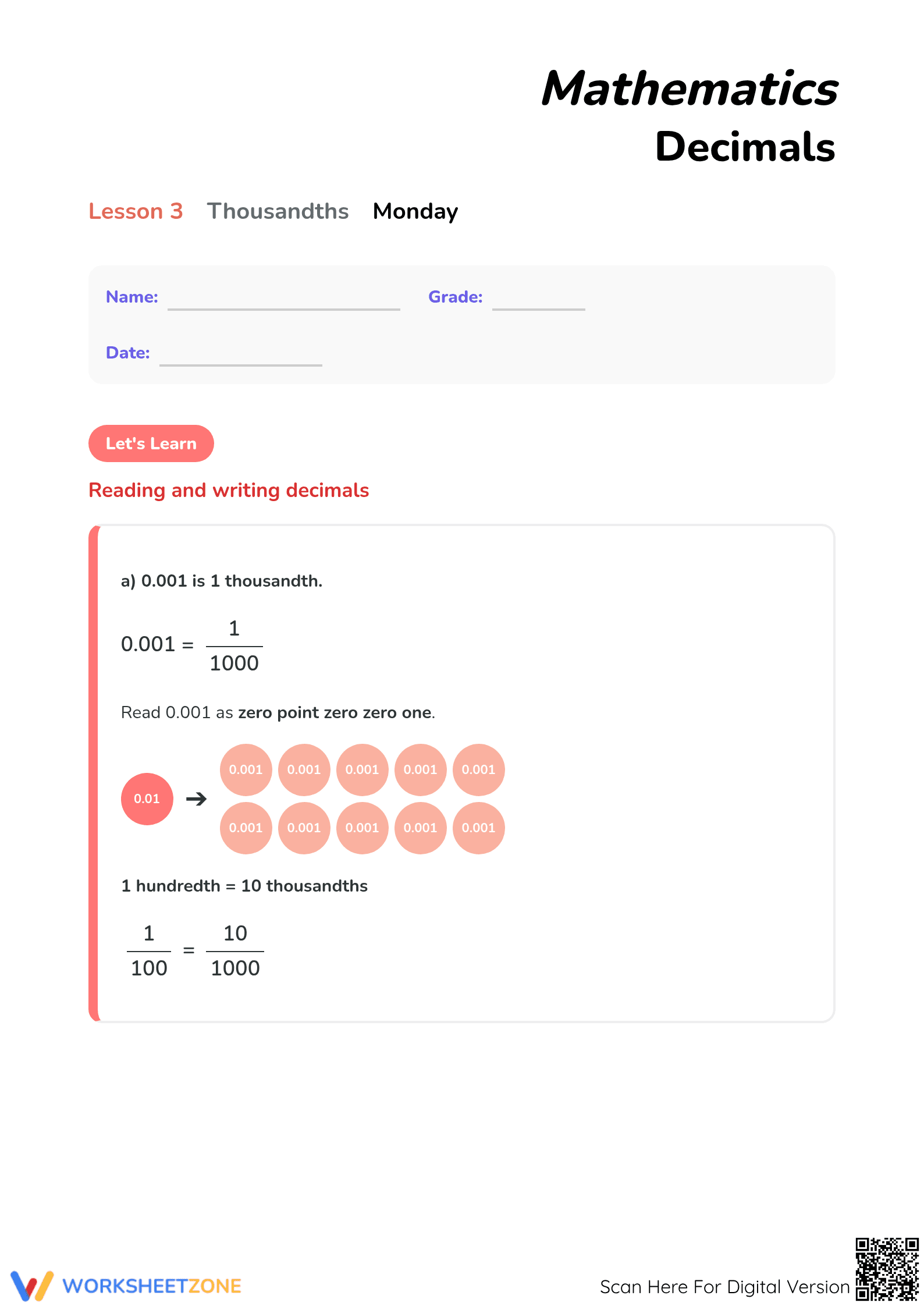
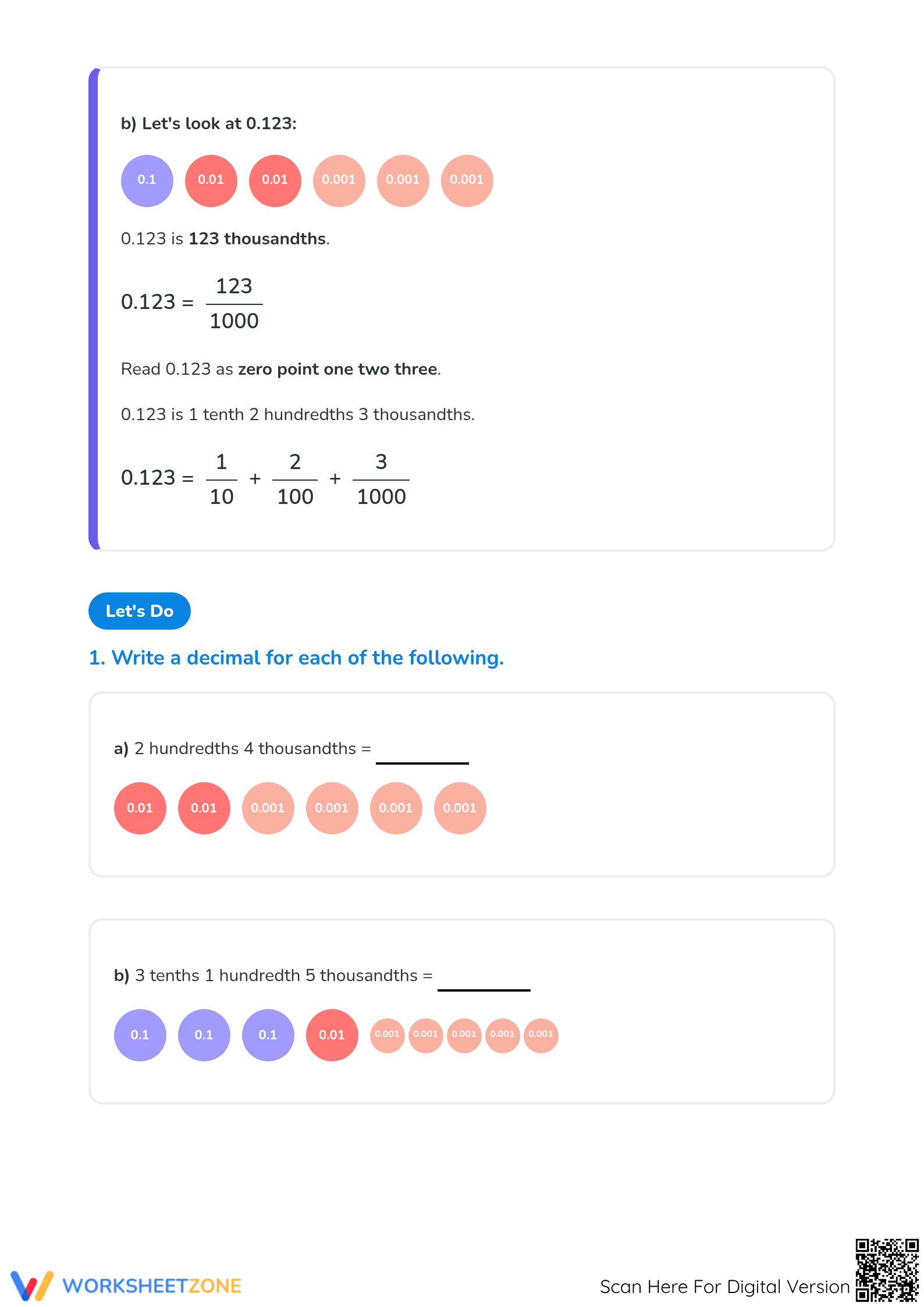
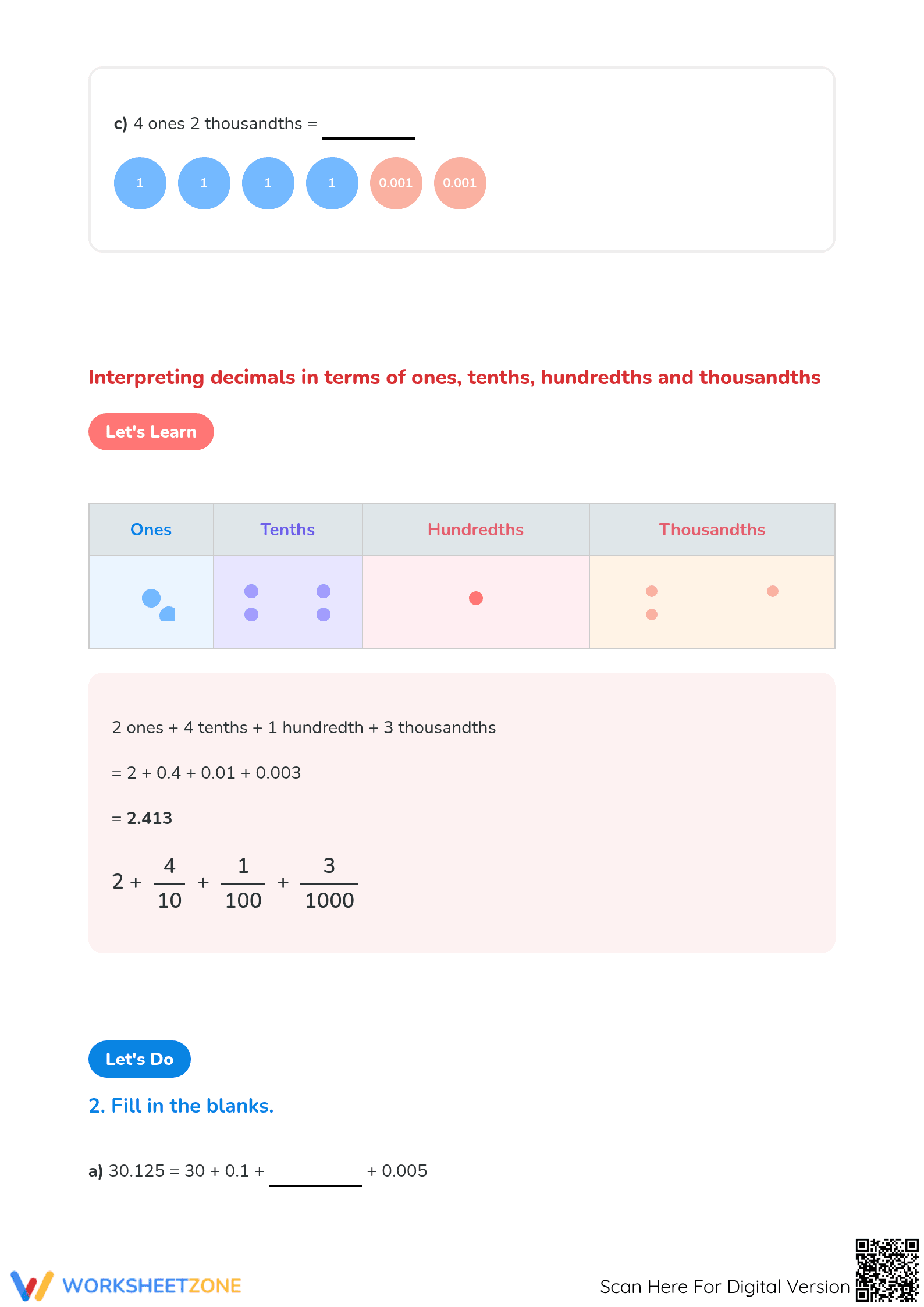
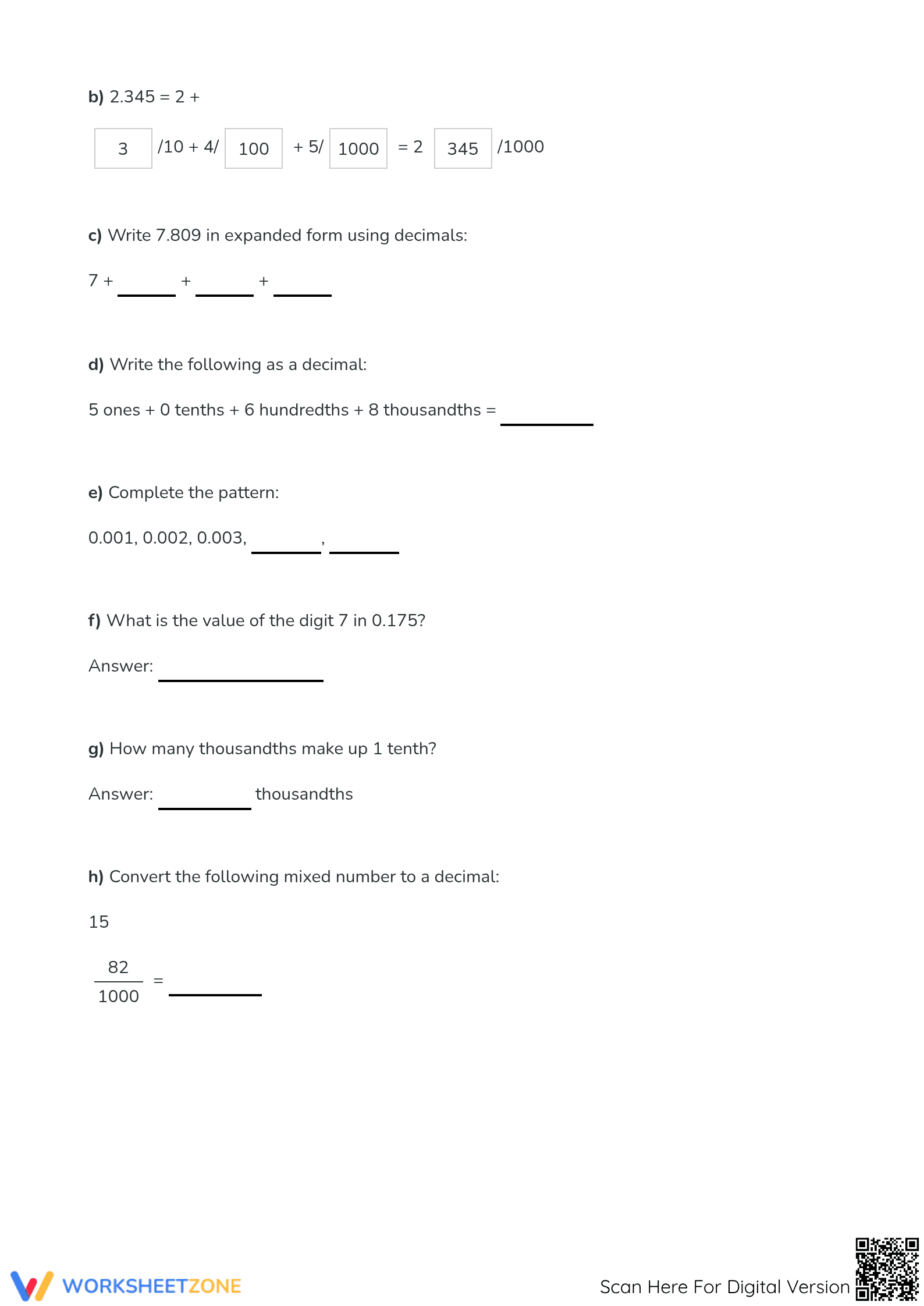
This comprehensive decimals and fractions worksheet for Grades 4 and 5 provides students with structured practice to master decimal representation. By connecting visual models to numeric forms, learners build a robust conceptual foundation before advancing to conversions and comparisons. Students will successfully bridge the gap between fractions and decimals through 41 targeted exercises.
At a Glance
- Grade: 4–5 · Subject: Math
- Standard:
CCSS.MATH.CONTENT.5.NBT.A.3— Read, write, and compare decimals to thousandths using base-ten numerals and number names- Skill Focus: Decimal Place Value and Conversions
- Format: 4 pages · 41 problems · Answer key included · PDF
- Best For: Independent practice or homework reinforcement
- Time: 45–60 minutes
This four-page PDF contains ten sections (A-J) to scaffold learning. It begins with visual identification of shaded parts, transitions into writing decimals in words and figures, and progresses to place value analysis. The second half focuses on converting between fractions and decimals, comparing values, ordering sequences, and applying skills to word problems. A full answer key is included.
Skill Progression
- Guided Practice: Students begin with 12 problems using visual grids to ground decimal concepts in concrete imagery, ensuring a solid start.
- Supported Practice: 14 tasks require students to manipulate digits and place values, providing clear headers to reduce cognitive load during expansion.
- Independent Practice: The packet concludes with 15 problems involving ordering and word problems that require students to synthesize multiple decimal concepts.
This sequence follows a gradual-release model, moving from teacher-led identification to independent student application of complex numeric principles.
Standards Alignment
The primary alignment is `CCSS.MATH.CONTENT.5.NBT.A.3`, which requires students to read, write, and compare decimals to the thousandths place. Additionally, it supports `CCSS.MATH.CONTENT.4.NF.C.6` by emphasizing decimal notation for fractions with denominators of 10 or 100. Both standard codes can be copied directly into lesson plans, IEP goals, or district curriculum mapping tools.
How to Use It
This resource is ideal after a lesson on decimal place value. Assign the first two pages during class to monitor naming and identification, then provide the final two pages as independent homework to assess conversions. For formative assessment, observe students during the ordering section to see if they correctly align decimal points. Completion usually takes 45 to 60 minutes.
Who It's For
Designed for students in Grades 4 and 5, this worksheet serves general education classrooms and provides essential scaffolding for students needing numeric support. It pairs naturally with decimal square manipulatives or anchor charts visualizing the relationship between tenths, hundredths, and thousandths.
According to RAND AIRS 2024, high-quality instructional materials that integrate multiple representations—such as the visual, verbal, and numeric forms found in this decimals worksheet—significantly improve long-term retention of mathematical concepts in upper elementary students. This resource specifically targets CCSS.MATH.CONTENT.5.NBT.A.3 by providing 41 structured problems that emphasize the reciprocal relationship between fractions and decimals. Research from Fisher & Frey (2014) highlights that the gradual release of responsibility, moving from visual identification to complex word problem application, is critical for students to achieve fluency in mathematical notation. By providing a comprehensive answer key and standard-aligned tasks, this worksheet ensures that teachers can deliver effective, research-backed practice that meets rigorous district expectations for mathematical mastery. Furthermore, the inclusion of multi-page practice sets allows for the sustained engagement necessary to move from introductory identification to independent application of abstract decimal place value principles in varied contexts.


