




























Views
Downloads

Essential Decimal Models Worksheet | Grade 4 Math

Paste this activity's link or code into your existing LMS (Google Classroom, Canvas, Teams, Schoology, Moodle, etc.).
Students can open and work on the activity right away, with no student login required.
You'll still be able to track student progress and results from your teacher account.
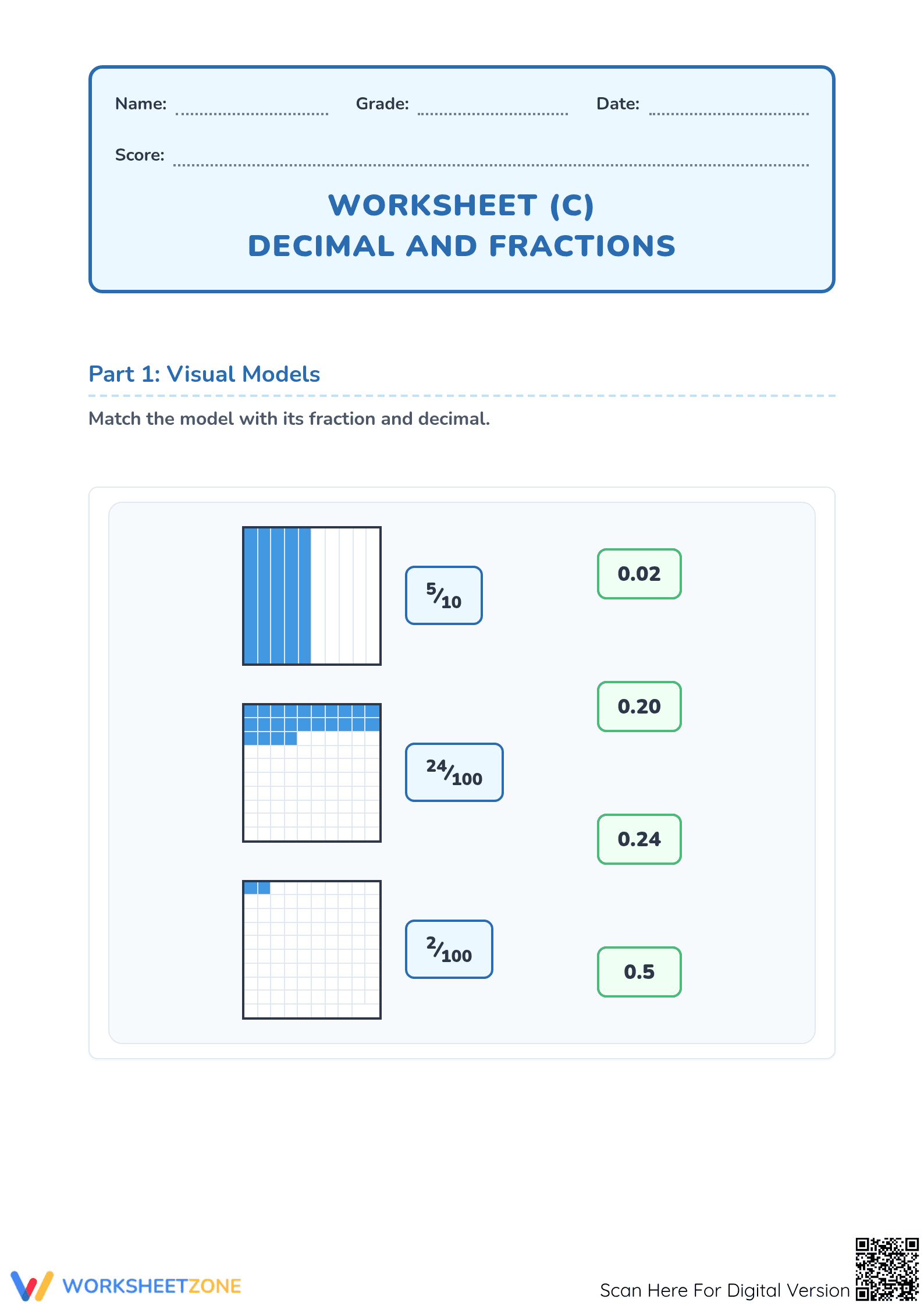
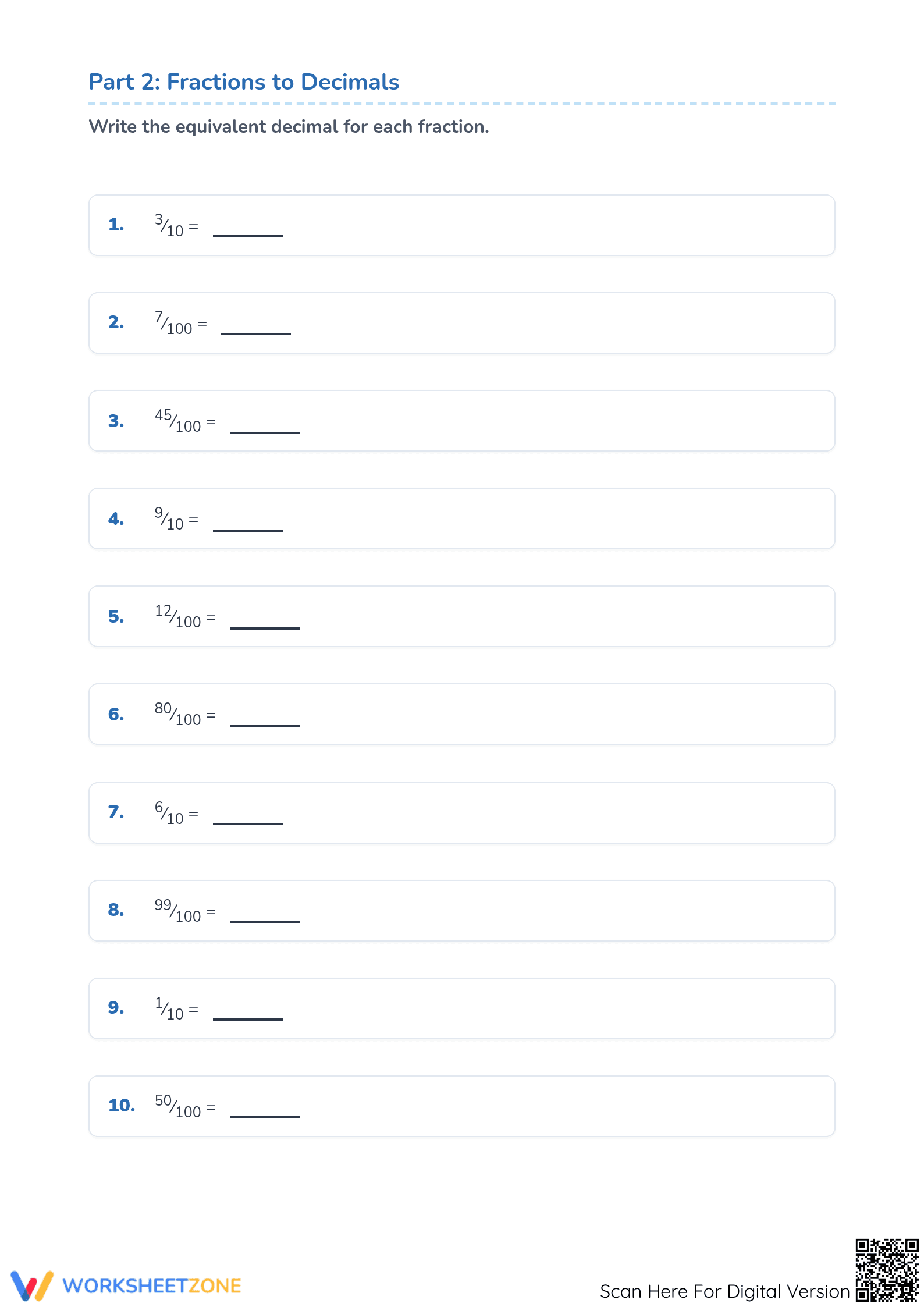
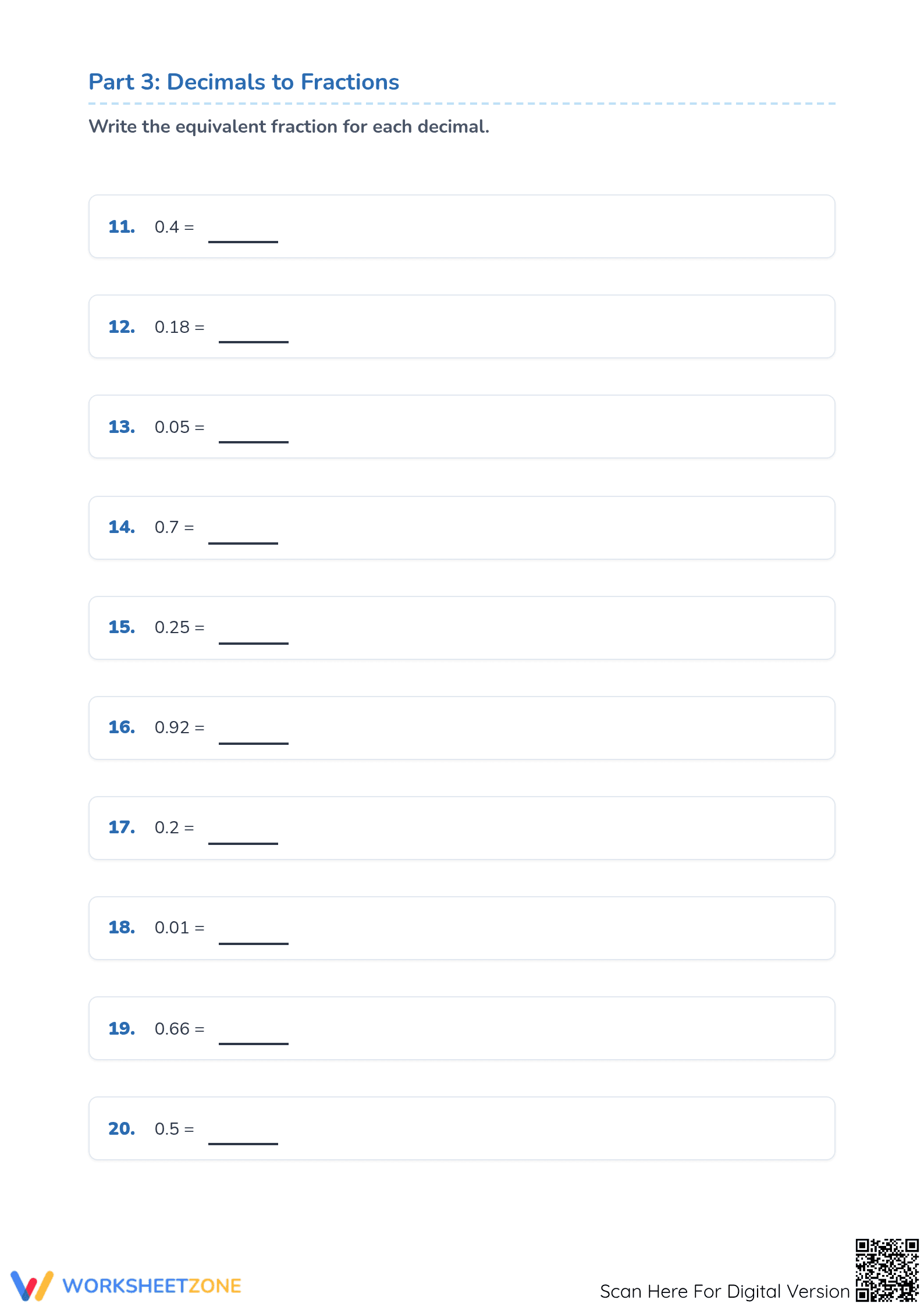
This essential Grade 4 decimal models worksheet provides a structured approach to understanding the relationship between visual grids, fractions, and decimal notation. Students practice matching shaded tenths and hundredths models to their numerical counterparts, ensuring a deep conceptual grasp of place value. By linking visual cues to abstract symbols, this resource builds mathematical confidence and accuracy.
At a Glance
- Grade: 4 · Subject: Math
- Standard:
CCSS.MATH.CONTENT.4.NF.C.6— Use decimal notation for fractions with denominators 10 or 100- Skill Focus: Decimal models and fraction conversion
- Format: 4 pages · 24 problems · Answer key included · PDF
- Best For: Reinforcing visual representation of decimals
- Time: 25–35 minutes
What's Inside
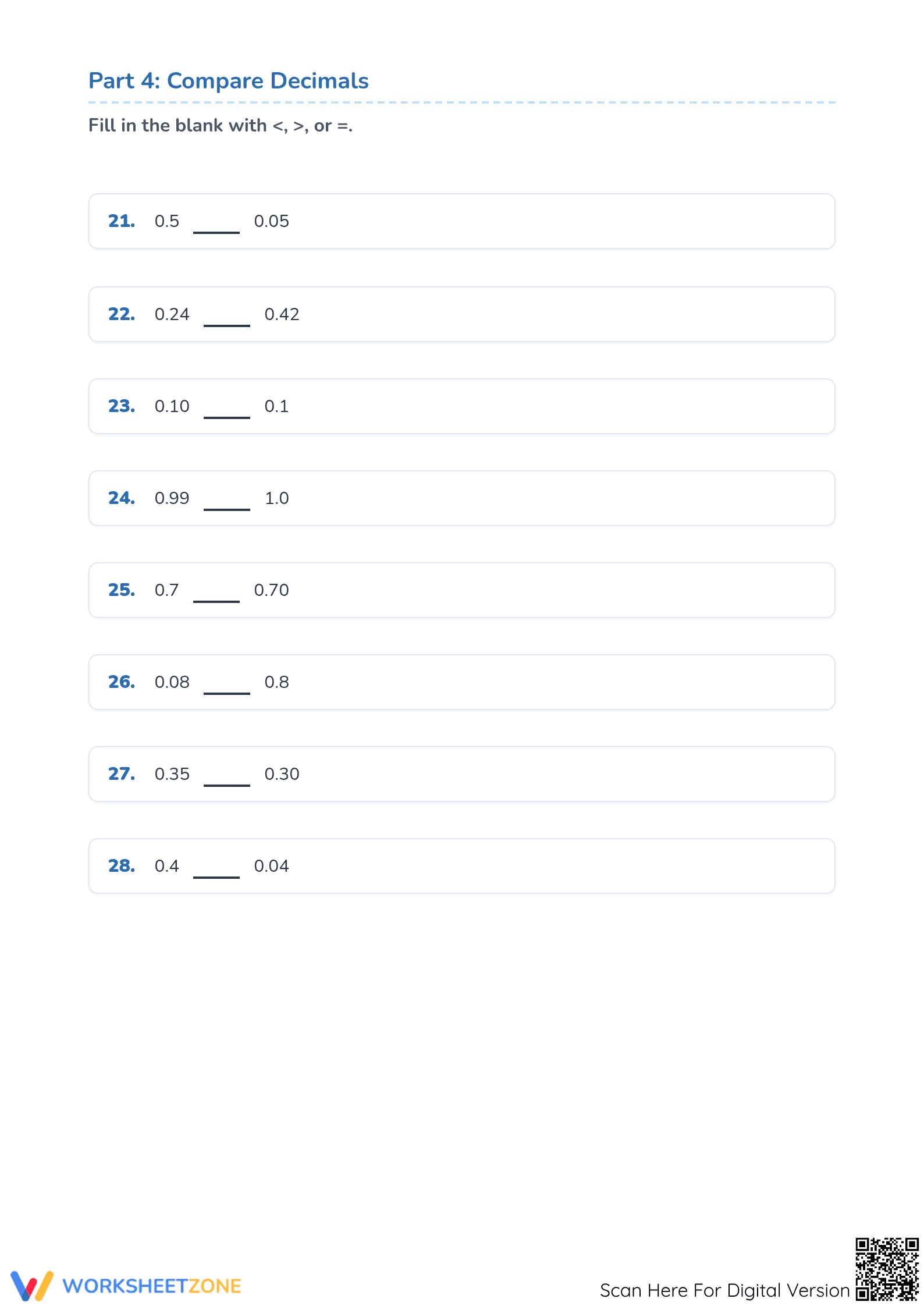
The packet contains four full pages of practice, featuring a total of 24 distinct matching tasks. Each page presents six high-quality visual models—including base-ten blocks and grid squares—paired with a mix of fractions and decimal numbers. A comprehensive answer key is provided, allowing for quick grading or student self-correction during independent work periods or rotations.
Skill Progression
- Guided Practice: The initial pages focus on matching simple tenths models to their corresponding decimals, providing a clear entry point for learners.
- Supported Practice: The middle section introduces hundredths grids, requiring finer visual discrimination of shaded regions to identify the correct fraction.
- Independent Practice: The final tasks challenge students to convert between all three forms—models, fractions, and decimals—without scaffolds, ensuring procedural fluency.
This sequence follows a gradual-release model, moving from visual recognition to abstract mathematical representation.
Standards Alignment
Primary alignment is to CCSS.MATH.CONTENT.4.NF.C.6. Students must use decimal notation for fractions with denominators 10 or 100. This worksheet also supports 4.NF.C.5 by emphasizing the equivalence of tenths and hundredths through visual area models. Both standard codes can be copied directly into lesson plans, IEP goals, or district curriculum mapping tools.
How to Use It
Assign this worksheet during the "You Do" phase of a lesson on decimal introduction to assess individual student progress. It also serves as an effective formative-assessment tool; teachers can observe whether students misinterpret hundredths models as tenths, providing immediate corrective feedback. Expect most Grade 4 learners to complete the four-page set within 30 minutes.
Who It's For
Designed primarily for Grade 4 students, this resource is also suitable for Grade 5 or 6 learners requiring intervention or place-value review. It pairs naturally with a math passage on the metric system or direct instruction using physical base-ten blocks to bridge the gap between concrete manipulatives and paper-based representations.
According to the RAND AIRS 2024 report on mathematical instructional materials, the integration of multiple representations—specifically area models, fractions, and decimals—is a key predictor of long-term success in rational number operations. This worksheet leverages that research by forcing students to reconcile visual shaded regions with their abstract numerical equivalents. By explicitly linking CCSS.MATH.CONTENT.4.NF.C.6 standards to visual tenths and hundredths grids, the resource helps prevent common misconceptions regarding place value and decimal magnitude. Research indicates that students who master these visual conversions in Grade 4 are significantly more likely to succeed with decimal arithmetic and fraction operations in middle school. This printable tool provides the repetitive, high-quality practice necessary for students to move beyond surface-level memorization toward a robust, citatable understanding of how decimals function within our base-ten system.


