




























Views
Downloads

Essential Fractions and Decimals Worksheet — Grade 5 Aligned

Paste this activity's link or code into your existing LMS (Google Classroom, Canvas, Teams, Schoology, Moodle, etc.).
Students can open and work on the activity right away, with no student login required.
You'll still be able to track student progress and results from your teacher account.
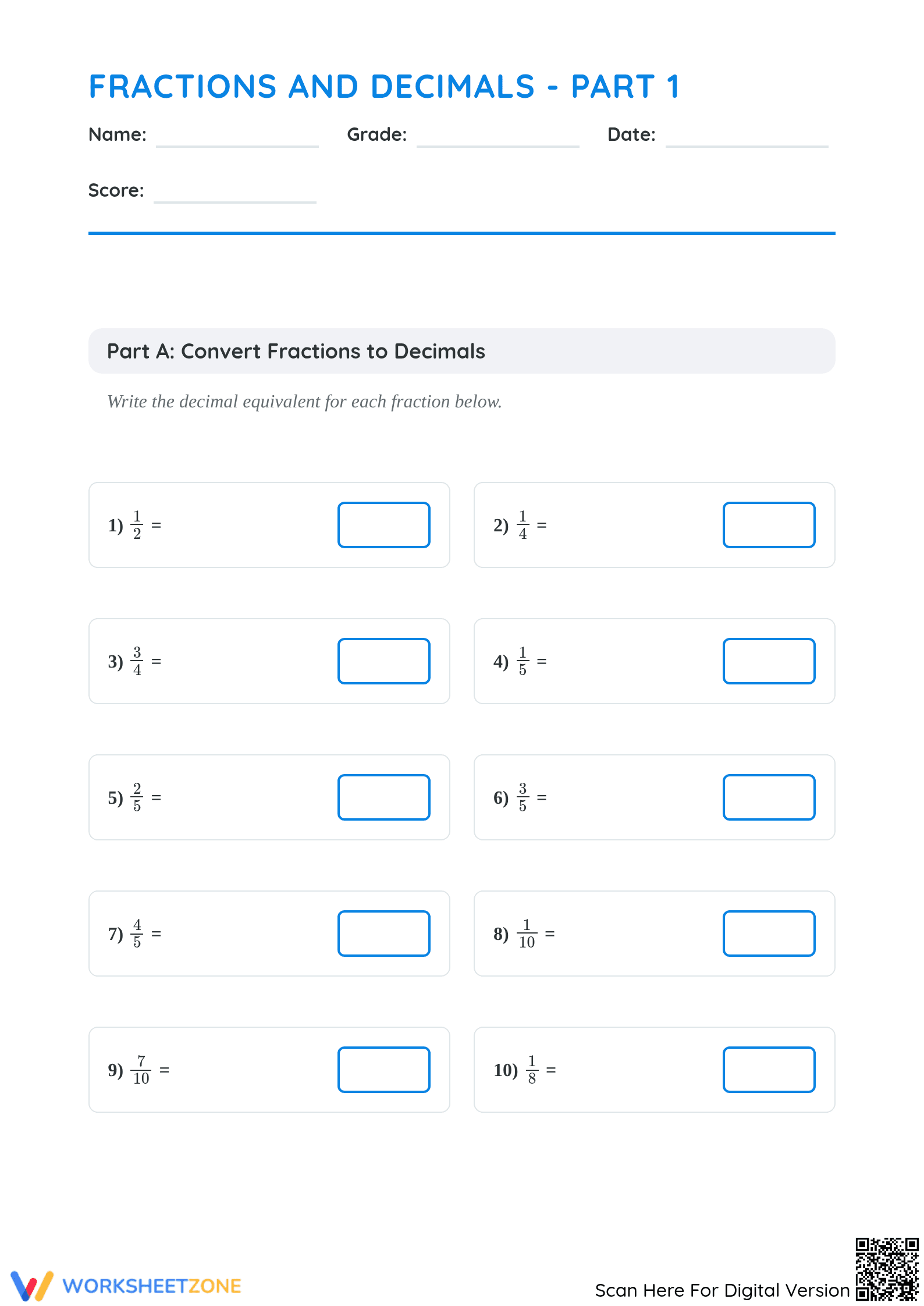
This Grade 5 math worksheet provides a comprehensive review of fraction and decimal equivalence. Students practice converting simple fractions to decimals, translating decimals back into fractions in simplest form, and handling mixed number conversions. The resource culminates in real-world word problems, ensuring students can apply these numerical relationships to practical scenarios with confidence and accuracy.
At a Glance
- Grade: 5 · Subject: Decimals
- Standard:
CCSS.MATH.CONTENT.5.NF.B.3— Convert between fractions and decimals to solve real-world problems- Skill Focus: Multi-format numerical conversion
- Format: 3 pages · 24 problems · Answer key included · PDF
- Best For: Mid-unit formative assessment or sub plans
- Time: 25–35 minutes
What's Inside
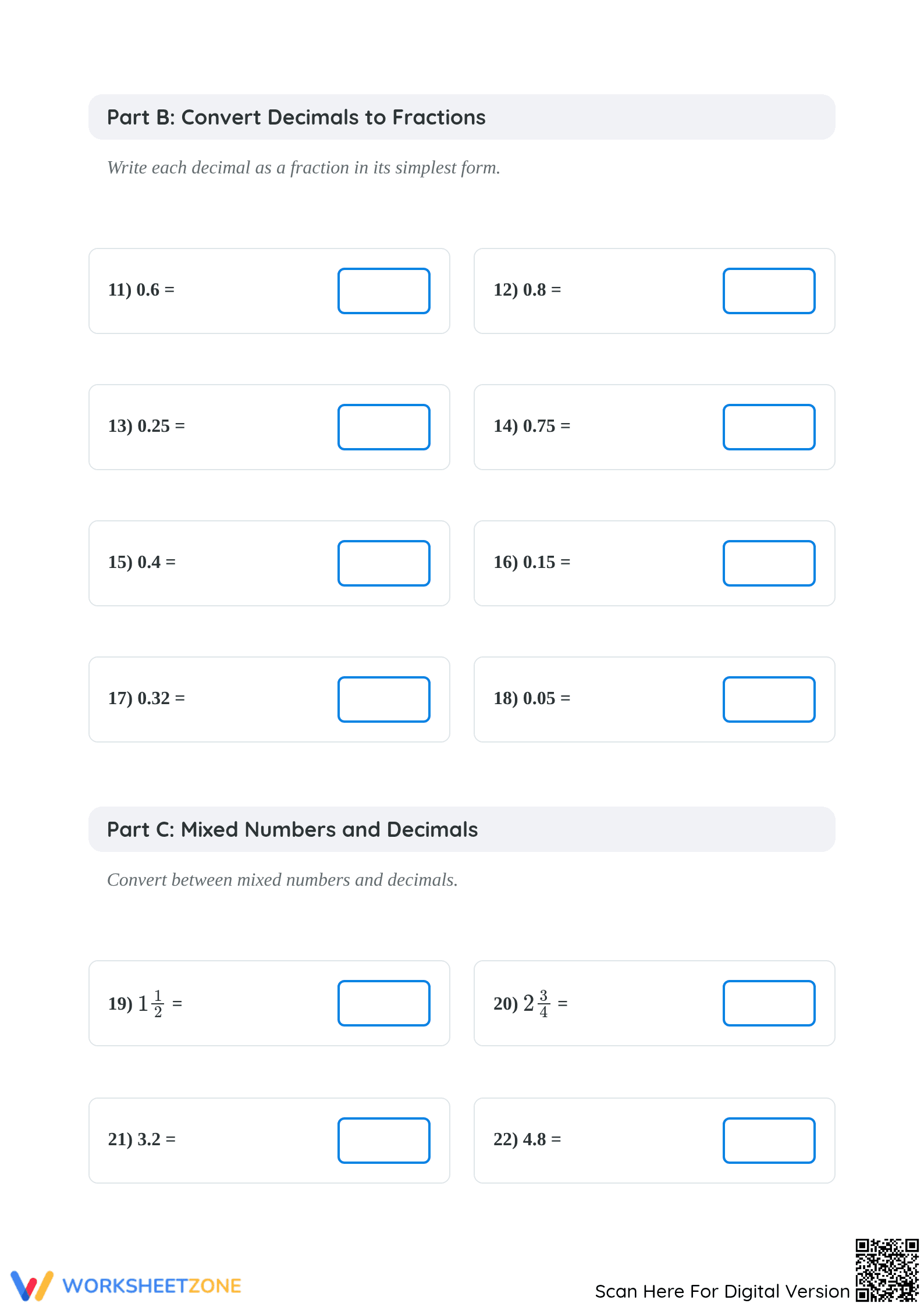
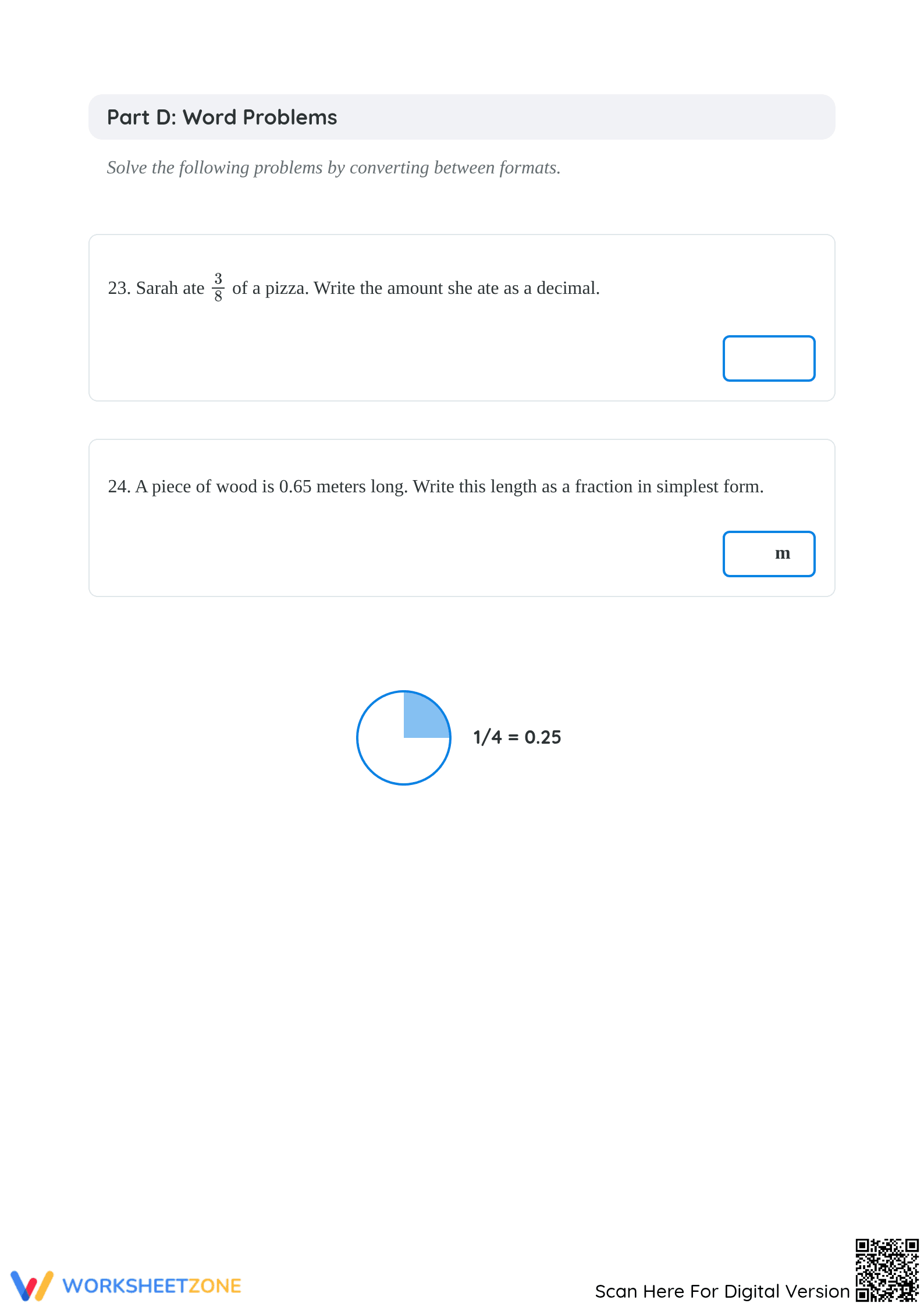
The three-page PDF is organized into four distinct modules to facilitate targeted practice. Part A features 10 fraction-to-decimal conversions, while Part B offers 8 decimal-to-fraction tasks requiring simplification. Part C introduces 4 mixed number challenges, and Part D provides 2 contextual word problems. The layout includes clear workspaces for each calculation and a complete answer key for rapid teacher review or student self-correction.
Zero-Prep Workflow
Teachers can integrate this resource into their instruction in under two minutes. Simply print the three-page sequence and distribute it to students for immediate engagement. The structured formatting allows students to move through the progression independently, while the provided answer key enables a five-minute whole-class review session. This streamlined process makes the worksheet an ideal choice for emergency sub plans or last-minute classroom transitions.
Standards Alignment
The primary focus aligns with `CCSS.MATH.CONTENT.5.NF.B.3`, which requires students to interpret fractions as division and solve problems involving the conversion of numerical formats. It also supports `CCSS.MATH.CONTENT.4.NF.C.6` by reinforcing decimal notation for denominators. Both standard codes can be copied directly into lesson plans, IEP goals, or district curriculum mapping tools to ensure instructional compliance and tracking.
How to Use It
Deploy this worksheet during the final phase of a gradual release model to monitor individual student progress. It functions effectively as a formative assessment after introducing terminating decimals like halves, quarters, and eighths. For a differentiated approach, observe students during the mixed number section to identify those who may need additional scaffolding with whole-number placement before moving toward more complex word problem applications.
Who It's For
This resource is designed for fifth-grade students mastering base-ten relationships and numerical fluency. It is particularly beneficial for learners requiring structured practice with simplifying fractions or those transitioning from visual models to abstract calculation. The worksheet pairs naturally with a decimal place value anchor chart or a short introductory passage on the historical development of the metric system.
According to the RAND AIRS 2024 study, supplemental materials bridging the gap between fraction concepts and decimal applications improve student performance on standardized assessments. This worksheet addresses the cognitive load of multi-step conversions by partitioning tasks into scaffolded sections. By mastering the transition between formats through these 24 problems, students develop the numerical flexibility required for algebraic thinking. The word problems reinforce the plain-English understanding of how these values represent parts of a whole. Researchers suggest consistent exposure to diverse mathematical formats reduces anxiety and increases retention. This printable resource serves as a vital tool for ensuring all learners meet the demands of CCSS.MATH.CONTENT.5.NF.B.3 and establish a firm foundation for future quantitative success.


