




























Views
Downloads
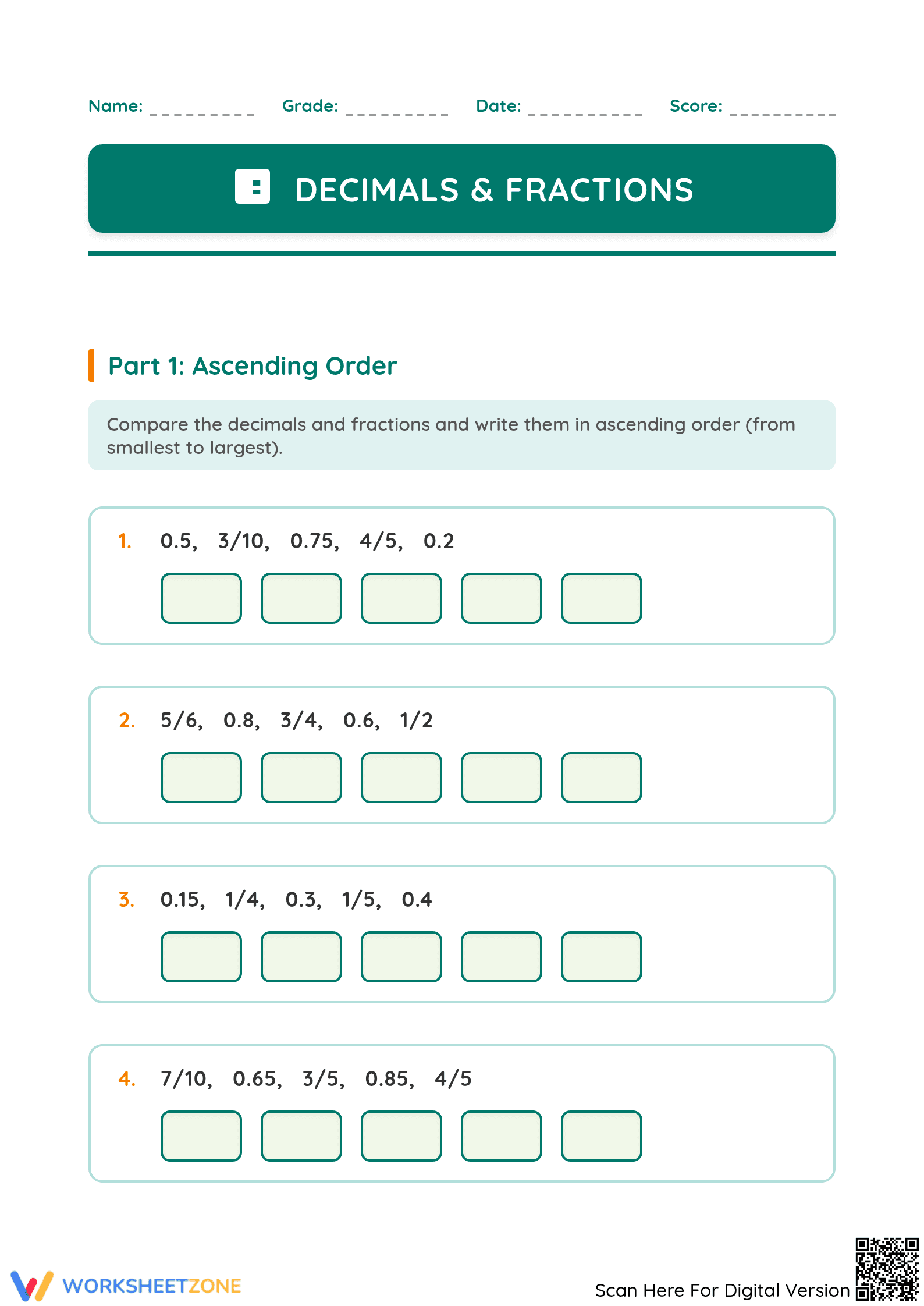
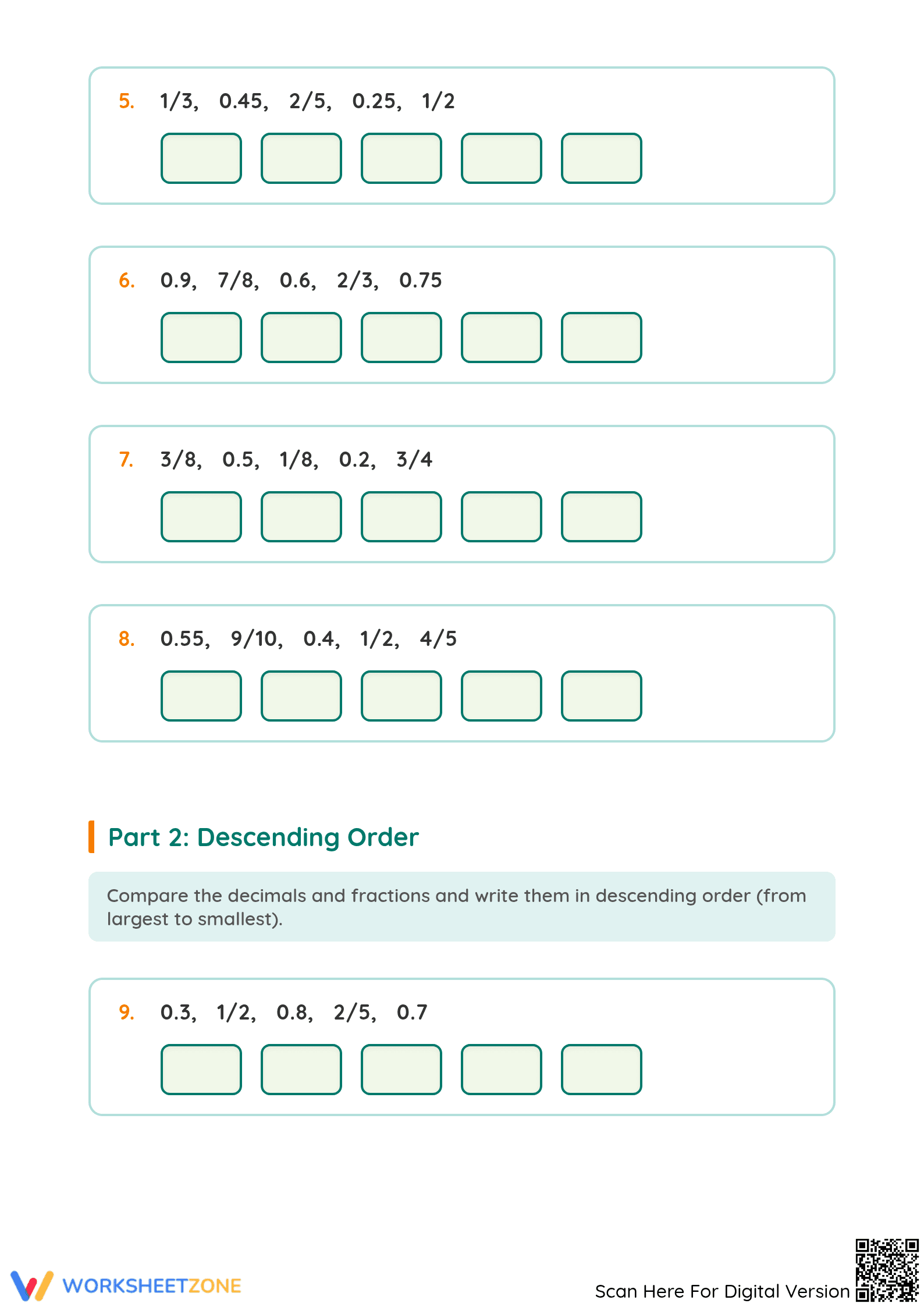
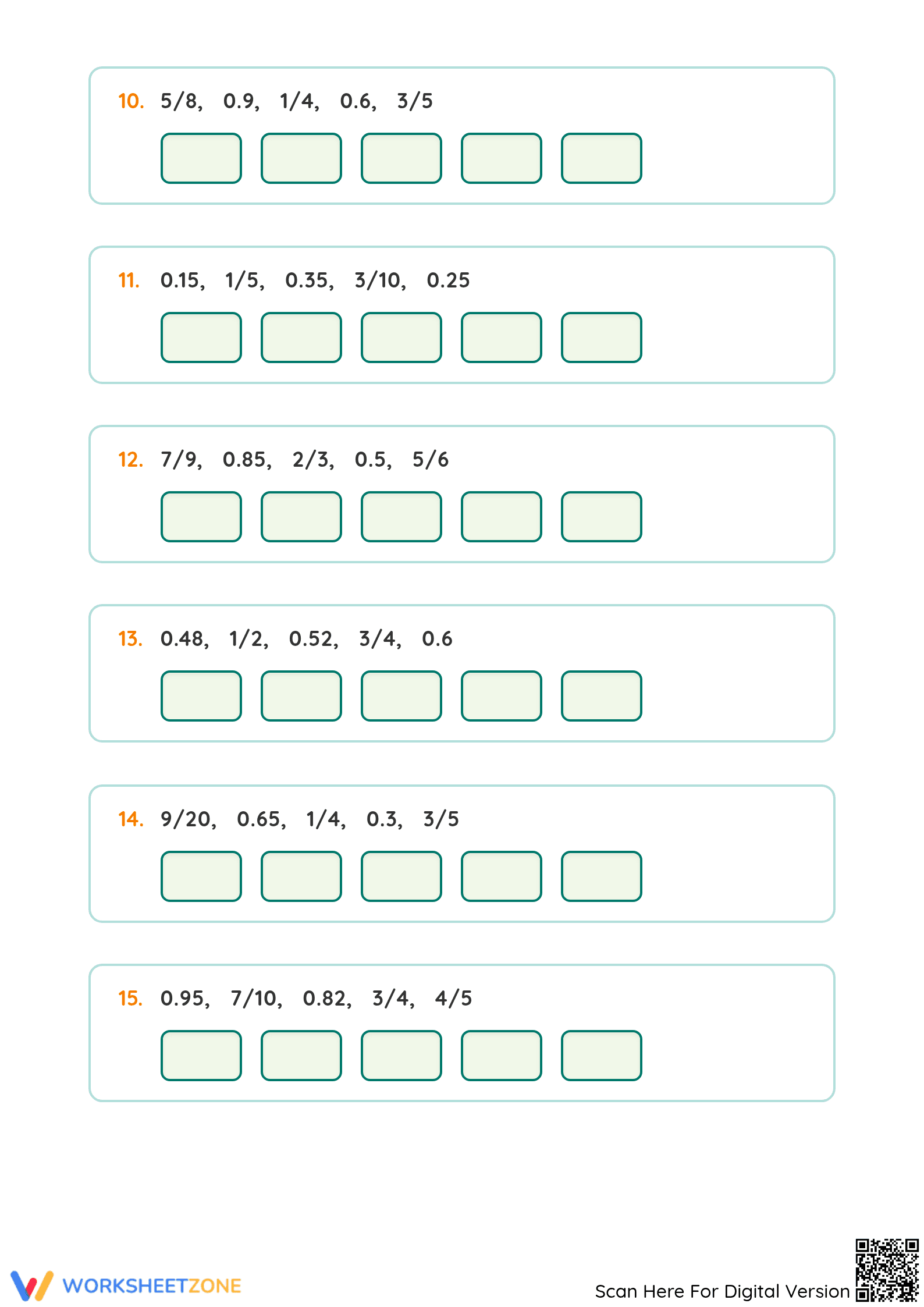
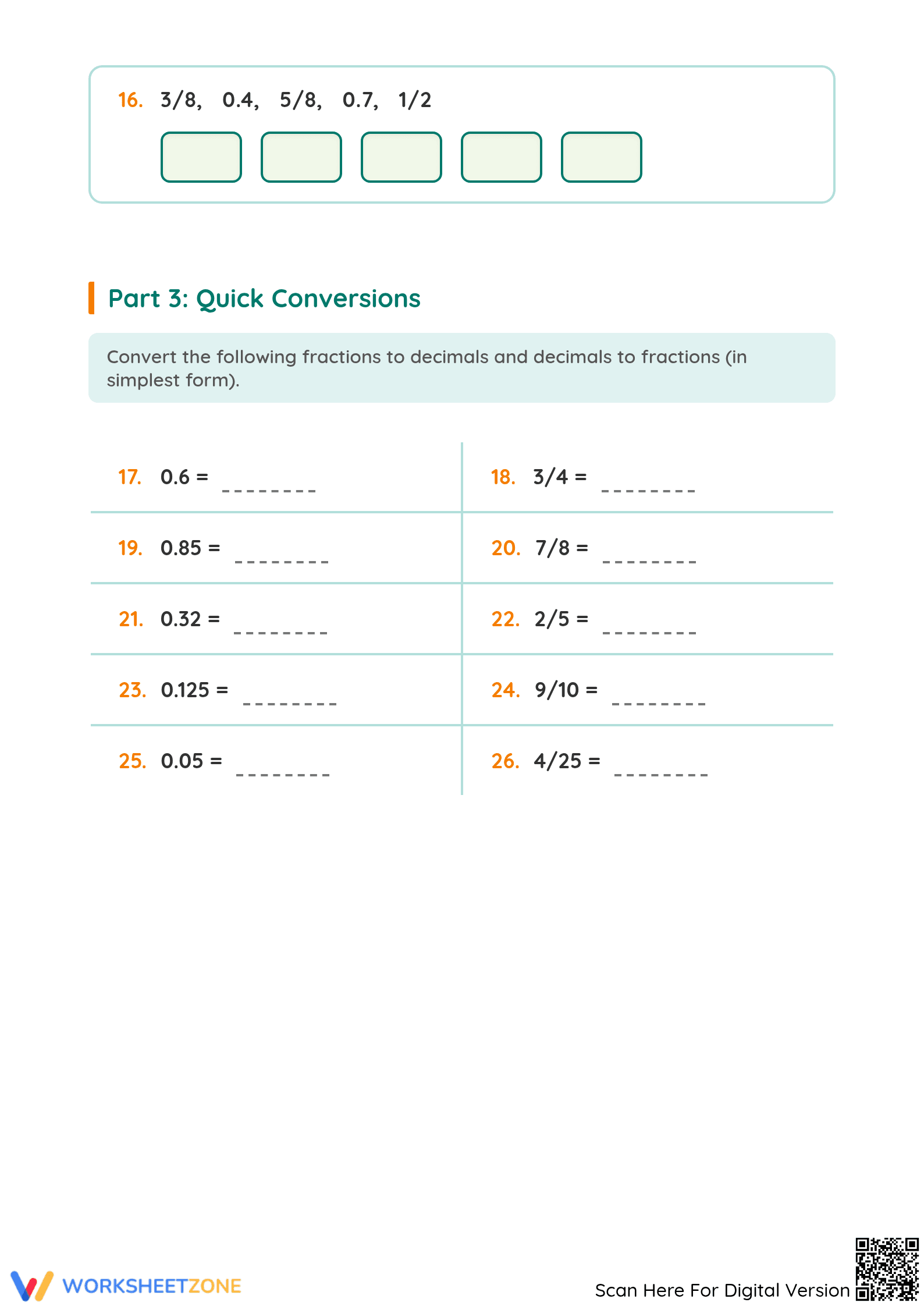

Essential Decimals and Fractions Worksheet | Grade 5 Math

Paste this activity's link or code into your existing LMS (Google Classroom, Canvas, Teams, Schoology, Moodle, etc.).
Students can open and work on the activity right away, with no student login required.
You'll still be able to track student progress and results from your teacher account.
Converting between decimals and fractions is a foundational skill for middle school math success. This Grade 5 worksheet provides structured practice to help students visualize the relationship between base-ten fractions and their decimal equivalents. Students will gain confidence in translating numerical values across different formats while reinforcing their understanding of place value.
At a Glance
- Grade: 5 · Subject: Math
- Standard:
CCSS.MATH.CONTENT.4.NF.C.6— Use decimal notation for fractions with denominators 10 or 100- Skill Focus: Decimal and Fraction Conversion
- Format: 4 pages · 32 problems · Answer key included · PDF
- Best For: Individual practice and small group reinforcement
- Time: 25–40 minutes
This comprehensive 4-page PDF contains 32 unique problems focusing on the critical bridge between fractions and decimals. The first two pages focus on changing fractions with denominators of 10 and 100 into decimals, ensuring students grasp the tenths and hundredths place. The subsequent pages reverse the process, requiring students to write decimals as fractions in simplest form. A complete answer key is provided for immediate grading or student self-check.
Skill Progression
- Guided Practice: The worksheet begins with 8 problems using visual placeholders and explicit 10/100 denominators to anchor the conversion concept.
- Supported Practice: Students move to 12 problems that require identifying place value without direct visual hints, focusing on accurate decimal point placement.
- Independent Practice: The final 12 problems challenge students to convert decimals back to fractions and simplify results, reinforcing divisional logic and equivalence.
This progression follows the instructional model of gradual release, ensuring students master the conversion logic before working independently.
Standards Alignment
This resource is primarily aligned to CCSS.MATH.CONTENT.4.NF.C.6: "Use decimal notation for fractions with denominators 10 or 100." It also supports 5th-grade standards by reinforcing the decimal place value concepts necessary for multi-digit operations and comparison. Both standard codes can be copied directly into lesson plans, IEP goals, or district curriculum mapping tools.
How to Use It
Assign this worksheet as a direct follow-up to a lesson on place value. Use the first page as a guided "do-now" activity to check for misconceptions about the decimal point's location. During completion, observe students to see if they correctly identify hundredths versus tenths—a common error point that this worksheet specifically targets. The expected completion time for the full set is approximately 30 minutes.
Who It's For
This is designed for Grade 5 students mastering base-ten concepts. It is excellent for RTI Tier 2 intervention or as a self-contained homework assignment. Pair this with a decimal grid anchor chart for students who need additional visual support for fractional equivalence and place value visualization.
Standard CCSS.MATH.CONTENT.4.NF.C.6 requires students to fluently transition between fractional and decimal notations, a bridge essential for understanding the real number system. Research from Fisher & Frey (2014) emphasizes that scaffolded practice in representational shifts—like fraction-to-decimal conversion—significantly reduces cognitive load during later complex problem-solving. By providing 32 targeted problems across 4 pages, this worksheet ensures the repetition needed to move these skills from short-term memory to automaticity. The inclusion of an answer key supports immediate feedback, which NAEP identifies as a critical factor in improving student performance in 4th and 5th-grade mathematics. This structured approach helps teachers identify specific place-value gaps before students advance to decimal operations involving multiplication and division in higher grades.


