




























0
Views
0
Downloads

0.0
0
Save
0 Likes
Share
Converting Fractions to Decimals Worksheet
0 Views
0 Downloads

Paste this activity's link or code into your existing LMS (Google Classroom, Canvas, Teams, Schoology, Moodle, etc.).
Students can open and work on the activity right away, with no student login required.
You'll still be able to track student progress and results from your teacher account.
Information
Description
What It Is:
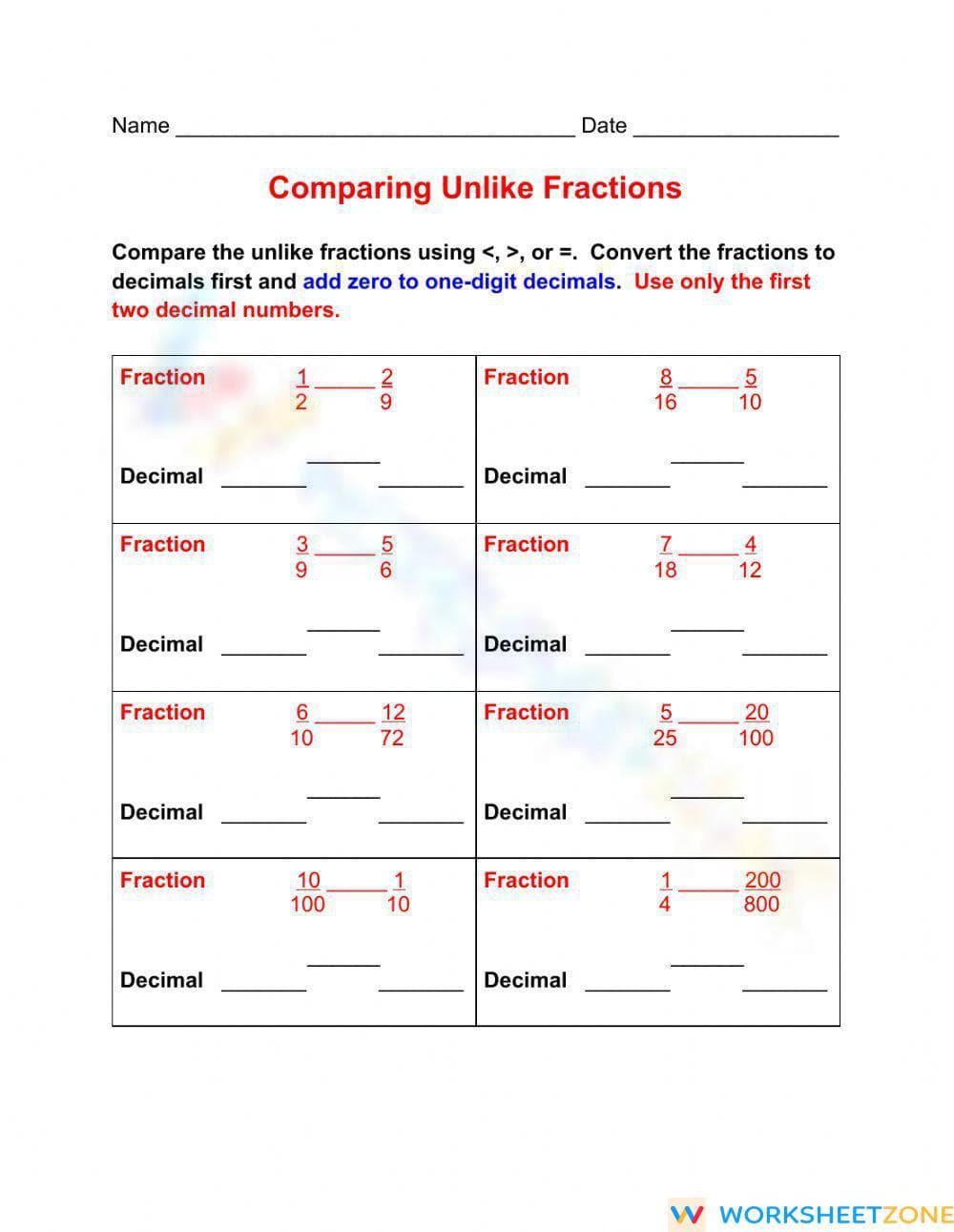
This is a math worksheet titled 'Comparing Unlike Fractions.' It presents pairs of unlike fractions and requires the student to convert each fraction to a decimal (using only the first two decimal numbers, adding a zero to one-digit decimals if needed). The student then compares the decimal equivalents and indicates whether the first fraction is less than (<), greater than (>), or equal to (=) the second fraction. There are eight pairs of fractions to compare. Examples include 1/2 vs 2/9, 8/16 vs 5/10, and 1/4 vs 200/800.
Grade Level Suitability:
This worksheet is suitable for grades 4-6. It requires understanding of fractions, decimals, and comparing numbers. The conversion of fractions to decimals might be challenging for younger students, making it more appropriate for upper elementary or early middle school.
Why Use It:
This worksheet reinforces the concepts of fractions, decimals, and comparison. It helps students understand the relationship between fractions and decimals and provides practice in converting between the two. It also develops critical thinking skills as students analyze and compare the values.
How to Use It:
Students should first convert each fraction to a decimal, showing their work if necessary. They should then compare the two decimals and write the appropriate symbol (<, >, or =) in the space provided between the decimal equivalents. It may be helpful to review fraction-to-decimal conversion techniques before assigning the worksheet.
Target Users:
This worksheet is designed for students in grades 4-6 who are learning about fractions, decimals, and comparing numbers. It can be used as a classroom activity, homework assignment, or review exercise. It is also helpful for students who need extra practice with fraction-to-decimal conversions.
This is a math worksheet titled 'Comparing Unlike Fractions.' It presents pairs of unlike fractions and requires the student to convert each fraction to a decimal (using only the first two decimal numbers, adding a zero to one-digit decimals if needed). The student then compares the decimal equivalents and indicates whether the first fraction is less than (<), greater than (>), or equal to (=) the second fraction. There are eight pairs of fractions to compare. Examples include 1/2 vs 2/9, 8/16 vs 5/10, and 1/4 vs 200/800.
Grade Level Suitability:
This worksheet is suitable for grades 4-6. It requires understanding of fractions, decimals, and comparing numbers. The conversion of fractions to decimals might be challenging for younger students, making it more appropriate for upper elementary or early middle school.
Why Use It:
This worksheet reinforces the concepts of fractions, decimals, and comparison. It helps students understand the relationship between fractions and decimals and provides practice in converting between the two. It also develops critical thinking skills as students analyze and compare the values.
How to Use It:
Students should first convert each fraction to a decimal, showing their work if necessary. They should then compare the two decimals and write the appropriate symbol (<, >, or =) in the space provided between the decimal equivalents. It may be helpful to review fraction-to-decimal conversion techniques before assigning the worksheet.
Target Users:
This worksheet is designed for students in grades 4-6 who are learning about fractions, decimals, and comparing numbers. It can be used as a classroom activity, homework assignment, or review exercise. It is also helpful for students who need extra practice with fraction-to-decimal conversions.


