


























Views
Downloads



Printable Simplify Fractions Worksheet | Grade 4-6 Math
Paste this activity's link or code into your existing LMS (Google Classroom, Canvas, Teams, Schoology, Moodle, etc.).
Students can open and work on the activity right away, with no student login required.
You'll still be able to track student progress and results from your teacher account.
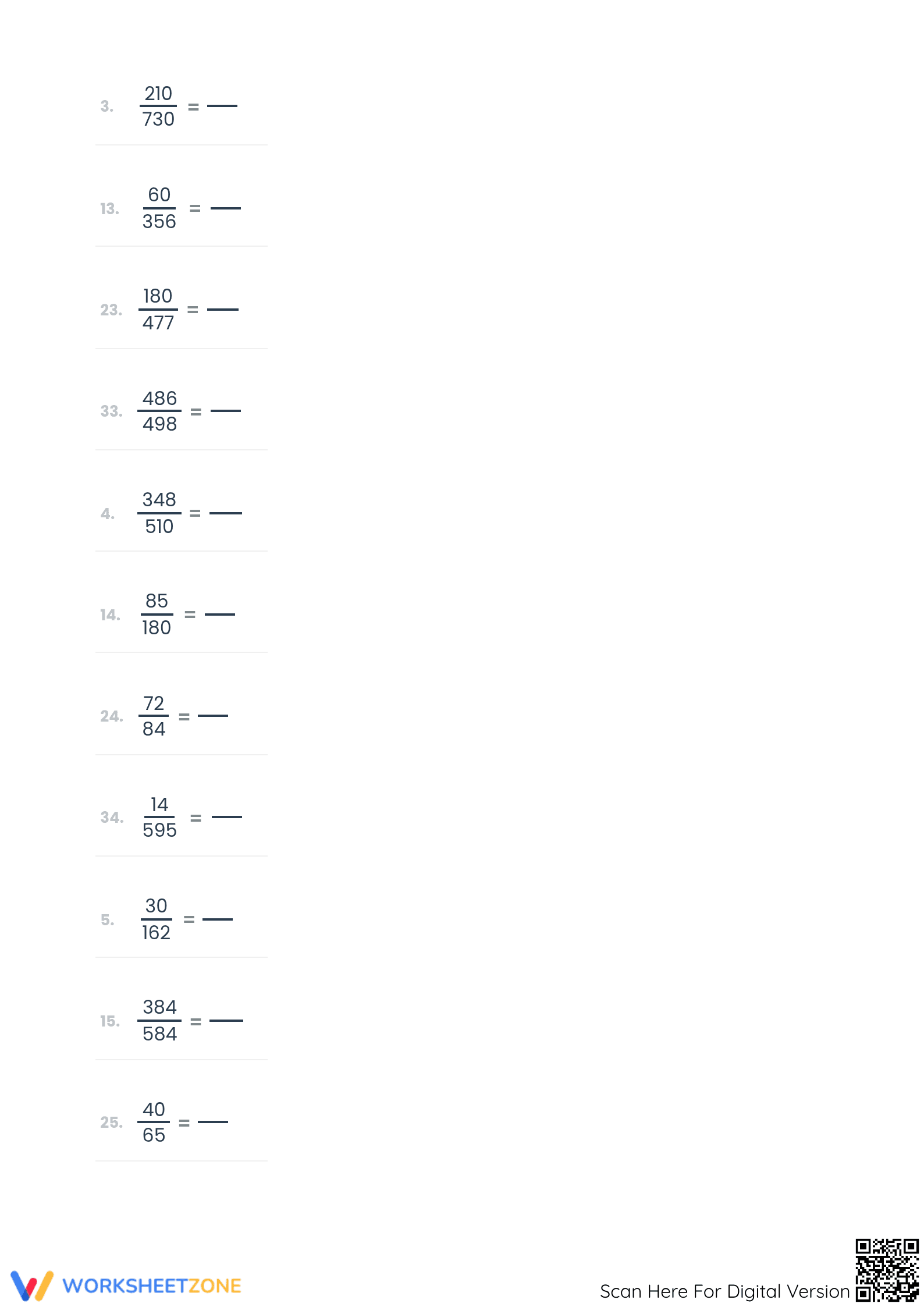
This comprehensive simplifying fractions worksheet provides students with intensive practice in reducing proper fractions to their most basic forms. By mastering the ability to identify greatest common factors, learners develop the fluency required for complex algebraic operations and proportional reasoning. This set focuses on the procedural mastery of fraction equivalence through repeated numerical division.
At a Glance
- Grade: 4–6 · Subject: Math · Fractions
- Standard:
CCSS.MATH.CONTENT.4.NF.A.1— Explain why fractions are equivalent by using numerical methods to reduce terms- Skill Focus: Simplifying proper fractions to lowest terms
- Format: 4 pages · 40 problems · Answer key included · PDF
- Best For: Intensive skill drills and homework
- Time: 25–40 minutes
This four-page PDF document features 40 vertically aligned fraction simplification problems, ranging from standard denominators to more complex numerical pairs that require multiple steps of division. Each page is clearly numbered and formatted with ample whitespace for student calculations. A complete answer key is included, providing the final reduced fraction for every problem to facilitate rapid grading and student self-correction.
To implement this zero-prep workflow, follow these three steps: First, use the single-click PDF download to generate all four pages of the student packet and the corresponding answer key in under 30 seconds. Second, provide students with the pages as a comprehensive 40-question review or as discrete 10-question daily warm-ups throughout a fraction unit. Third, utilize the included answer key for immediate review. Total teacher preparation time remains under two minutes, making this an ideal resource for emergency sub plans or last-minute lesson extensions.
Standards Alignment: CCSS.MATH.CONTENT.4.NF.A.1 states that students should understand how a fraction is equivalent to another by using numerical division. This resource focuses on the numerical application of this principle, requiring students to find common factors to reach the simplest form. Both standard codes can be copied directly into lesson plans, IEP goals, or district curriculum mapping tools.
Instructional use cases include a Formative Drill: Assign one page (10 problems) at the end of a direct instruction session on greatest common factors. Observe students as they work to identify if they are simplifying in one step or through repeated division, which indicates their level of multiplication table fluency. Alternatively, use it for Assessment Prep: Assign the full 40-problem set as a cumulative review before a unit test on fraction equivalence to strengthen pattern recognition across varied denominators.
This resource is designed for upper elementary and middle school students who have a foundational understanding of equivalent fractions but require repetitive practice to build speed and accuracy. It is highly effective for students on IEPs who need high-volume, low-distraction practice, and pairs naturally with a fraction tiles anchor chart or a multiplication table for scaffolding during the independent practice phase.
According to an EdReports 2024 analysis, high-quality mathematics instructional materials must balance conceptual understanding with procedural fluency to ensure long-term retention of algebraic foundations. This worksheet addresses the procedural demand of CCSS.MATH.CONTENT.4.NF.A.1, requiring students to systematically reduce fractions to their simplest terms through division of common factors. Repeated exposure to these numerical relationships is essential; Fisher & Frey (2014) highlight that gradual release of responsibility in mathematics starts with high-volume, structured practice that allows students to internalize the logic of equivalence. By completing 40 targeted problems, learners move beyond surface-level recognition of fractions and develop the mental math shortcuts necessary for future success in ratio and proportion units. The inclusion of a full answer key supports immediate feedback, a critical component in preventing the fossilization of calculation errors during independent practice.


