


























Views
Downloads


Essential Simplify Fractions (Hard) Worksheet | Grade 4-8
Paste this activity's link or code into your existing LMS (Google Classroom, Canvas, Teams, Schoology, Moodle, etc.).
Students can open and work on the activity right away, with no student login required.
You'll still be able to track student progress and results from your teacher account.
Master the art of reducing complex numerical expressions with this comprehensive fractions practice resource. Students will learn to identify common factors and divide both numerator and denominator to reach the most reduced form of proper fractions. This structured exercise ensures students develop the numerical fluency required for advanced algebraic operations and higher-level mathematics.
At a Glance
- Grade: 4–8 · Subject: Math · Fractions
- Standard:
CCSS.MATH.CONTENT.4.NF.A.1— Explain why a fraction is equivalent to another by using numerical factors- Skill Focus: Simplifying proper fractions to simplest form
- Format: 5 pages · 31 problems · Answer key included · PDF
- Best For: Independent practice and skills reinforcement
- Time: 30–45 minutes
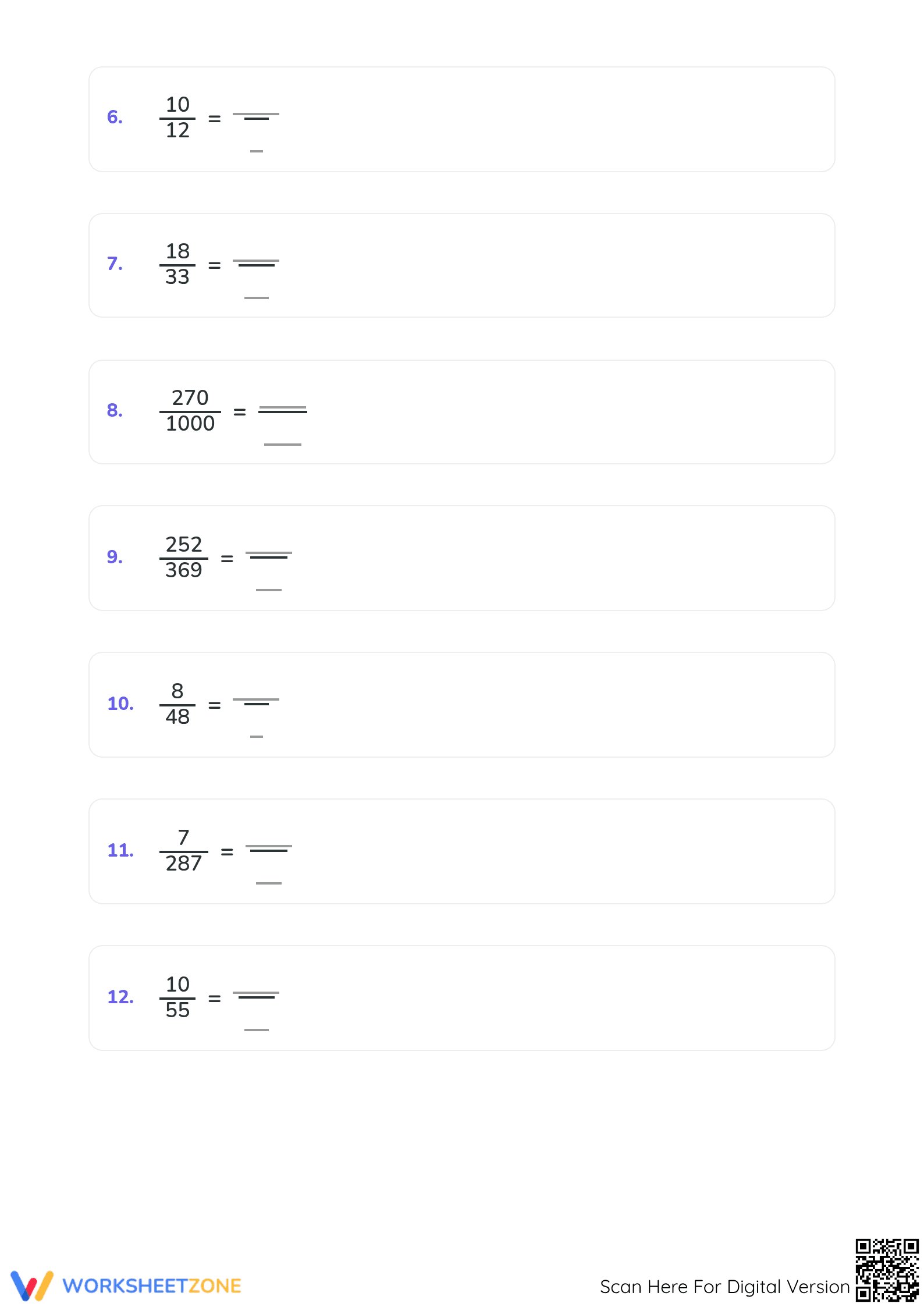
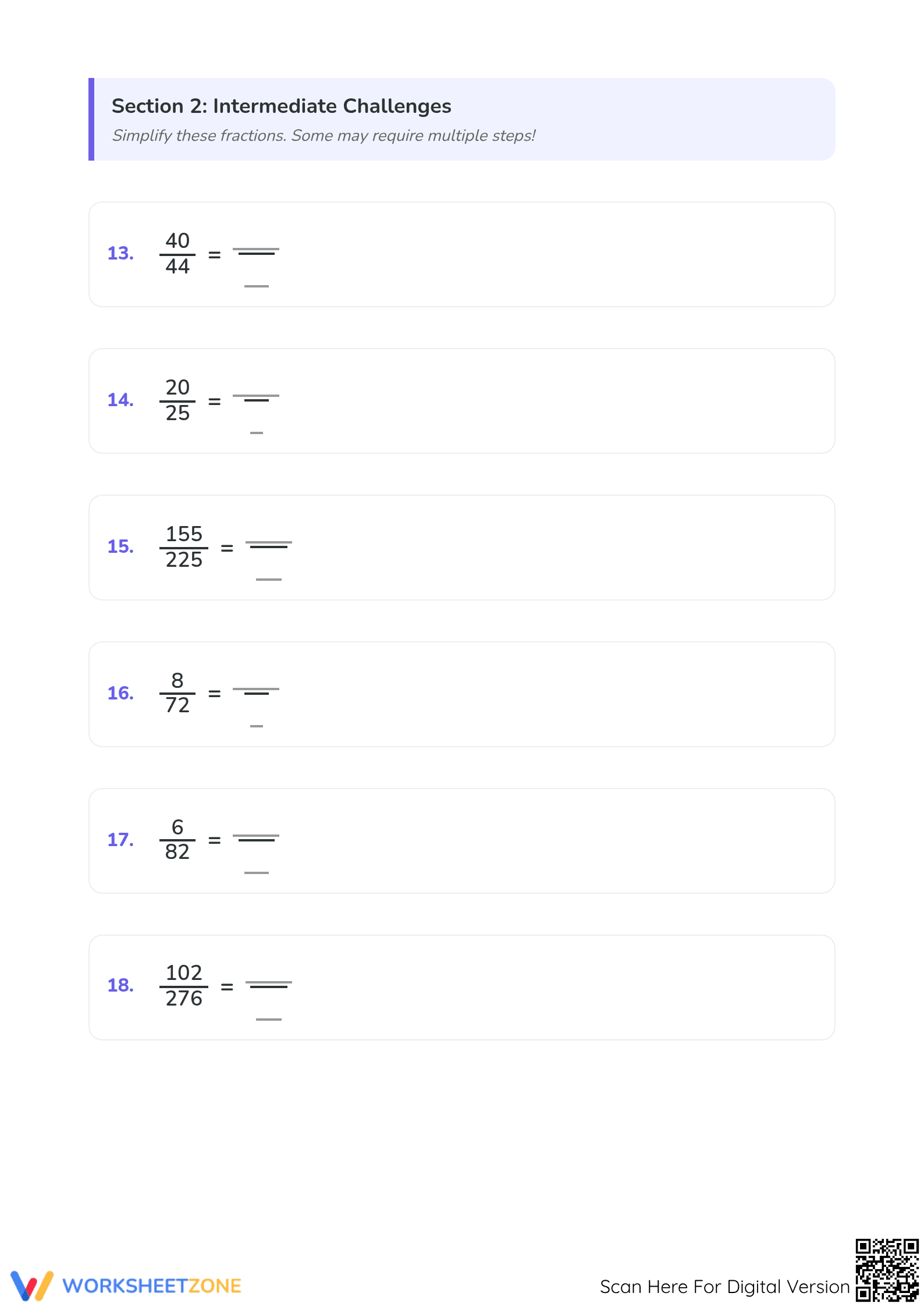
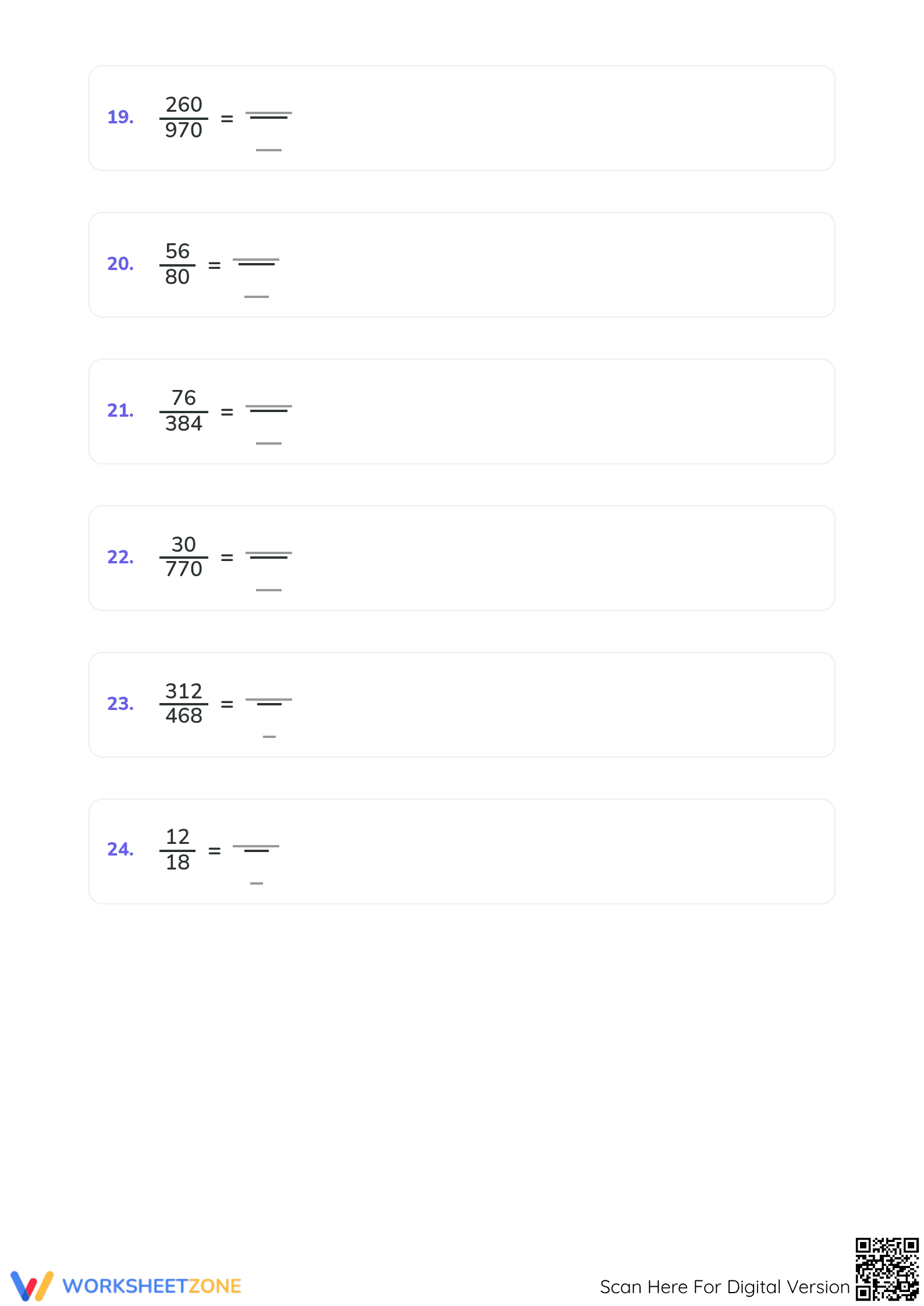
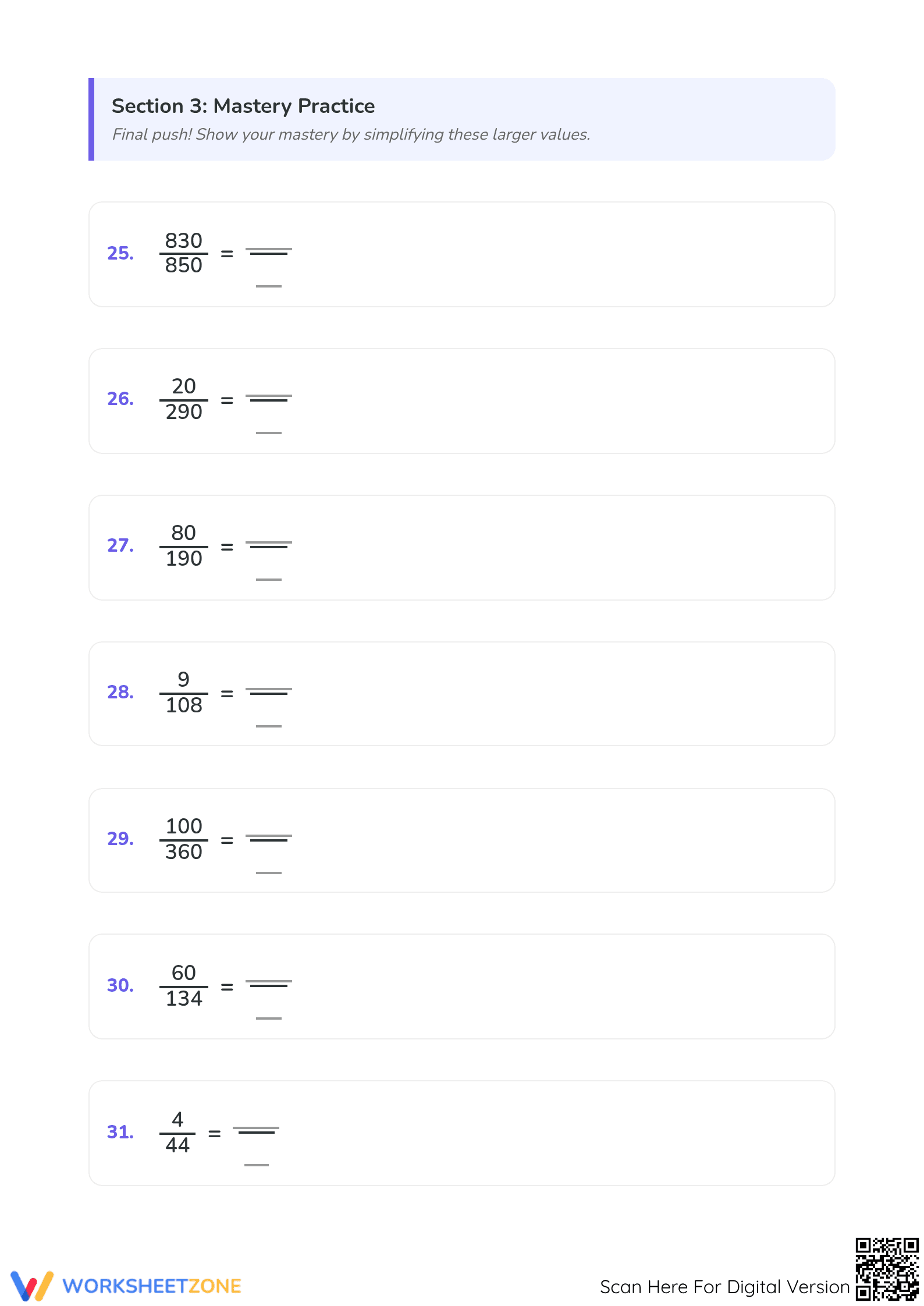
This five-page PDF features 31 unique simplification challenges organized into three distinct sections of increasing difficulty. The worksheet includes ample white space for student calculations and a clear, professional layout that minimizes visual distraction. A complete answer key is provided, allowing for rapid grading or student self-correction during independent study or homework sessions.
Skill Progression
- Guided Practice: Section 1 provides 12 core simplification tasks using common denominators to build initial confidence and procedural accuracy.
- Supported Practice: Section 2 introduces 12 intermediate challenges requiring multiple steps or larger factor identification to reach the simplest form.
- Independent Practice: Section 3 features 7 mastery problems with large three-digit values designed to test student stamina and factor-finding speed.
This gradual-release structure follows the proven instructional model of scaffolded difficulty, moving students from basic recognition to complete mastery of equivalent fractions.
Standards Alignment
This worksheet primarily aligns with CCSS.MATH.CONTENT.4.NF.A.1, which focuses on explaining equivalent fractions by using numerical factors and visual models. It also supports 5th-grade requirements for finding common denominators. Educators can directly integrate this standard code into lesson plans, IEP goals, or curriculum mapping tools, ensuring alignment with evidence-based instructional goals.
How to Use It
Best used after direct instruction on Greatest Common Factors (GCF). Assign Section 1 as an in-class check; with 80% accuracy, students can advance to intermediate and mastery sections for independent practice or homework. Observe student methods (single-step GCF vs. multi-step division) for targeted feedback. Expect completion in 30-45 minutes, varying by student speed.
Who It's For
Ideal for Grades 4-8 students who have basic fraction recognition but require intensive practice with numerical reduction. It's particularly effective for middle schoolers preparing for pre-algebra. Supplement with a GCF anchor chart or multiplication table to support those still building multiplication and division fact fluency.
Mastery of fraction simplification is a critical gateway skill for success in middle school mathematics and beyond. Research, such as RAND AIRS 2024 findings, indicates that early fluency in equivalent fractions and numerical reduction correlates with significantly higher performance in algebraic rational expressions and proportional reasoning. This worksheet provides essential high-repetition practice with non-trivial values, extending beyond basic fractions to complex three-digit numerators and denominators. Through 31 progressively difficult problems, students advance from rote application to a deeper structural understanding of number relationships. Aligned with CCSS.MATH.CONTENT.4.NF.A.1, this practice supports evidence-based instructional goals for mathematical proficiency. Educators can effectively use this tool to ensure long-term retention of fraction operational skills.


