


























Views
Downloads
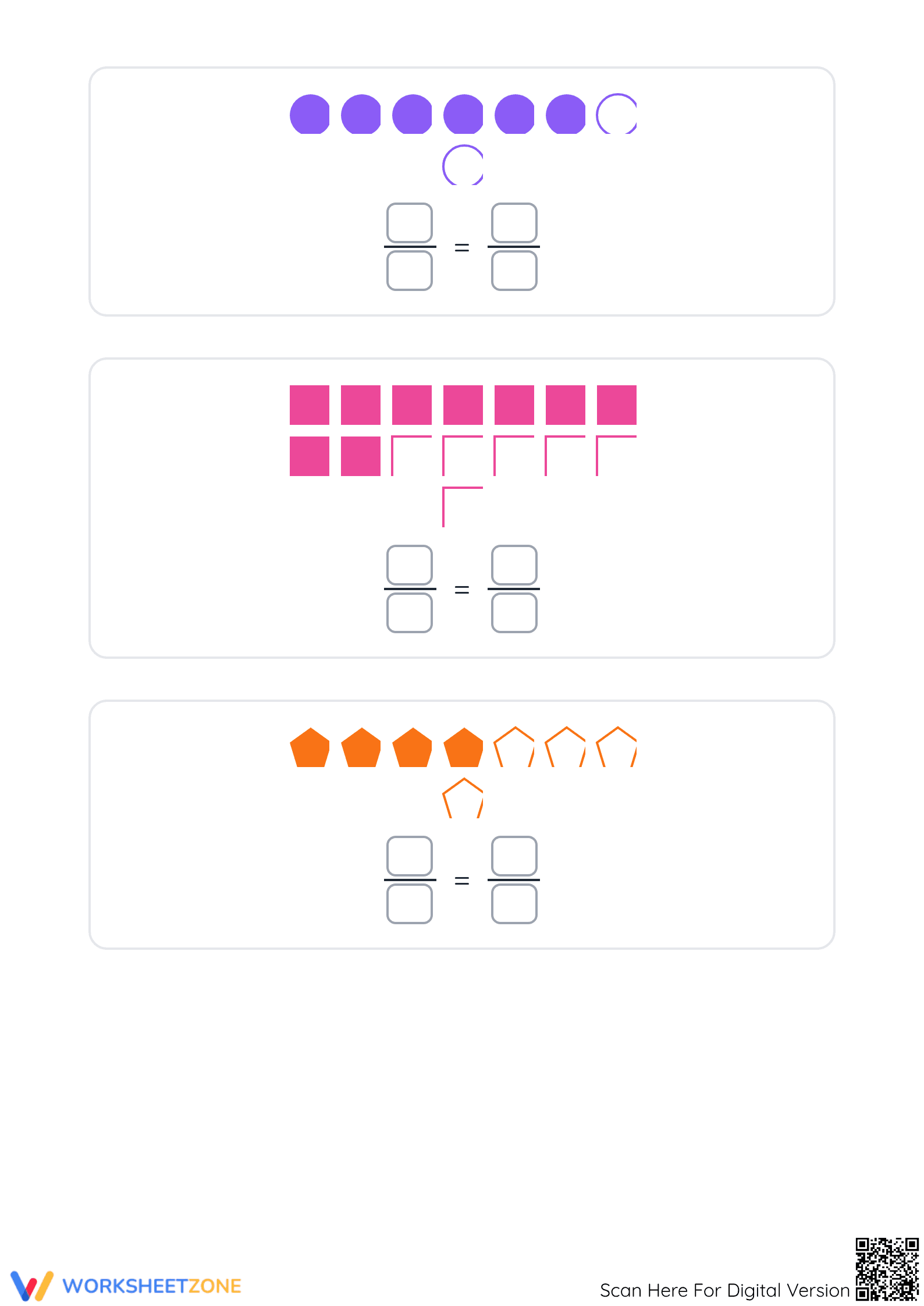

Printable Modeling Fractions and Simplification Worksheet
Paste this activity's link or code into your existing LMS (Google Classroom, Canvas, Teams, Schoology, Moodle, etc.).
Students can open and work on the activity right away, with no student login required.
You'll still be able to track student progress and results from your teacher account.
Master the art of representing and reducing fractions. Students identify fractions as parts of a set before simplifying them to their lowest terms. This dual-task approach ensures that learners understand fraction notation and the underlying concept of equivalence and numerical relationships.
At a Glance
- Grade: 4 · Subject: Math
- Standard:
CCSS.MATH.CONTENT.4.NF.A.1— Explain why fractions are equivalent by using visual fraction models and groups- Skill Focus: Modeling fractions and simplification
- Format: 5 pages · 15 problems · Answer key included · PDF
- Best For: Small group instruction and independent practice
- Time: 25–35 minutes
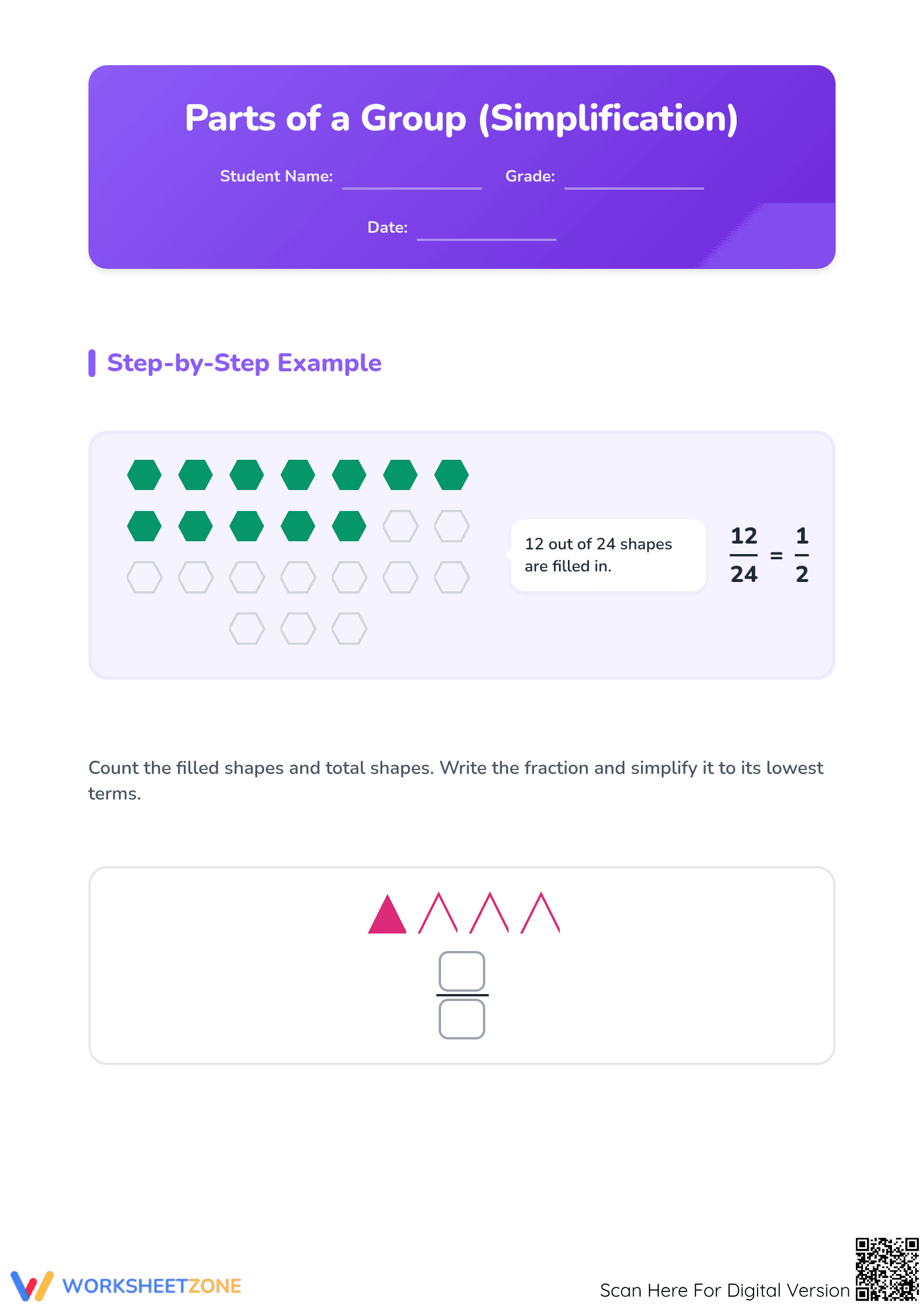
This 5-page PDF contains 15 practice problems building fluency in fractional modeling. Each page features clear geometric icons in distinct sets. A step-by-step example anchors learning by showing a group of 24 shapes, illustrating the path from 12/24 to 1/2. Subsequent pages provide space for students to write both the initial and simplified fractions.
Skill Progression
- Guided practice: The first page begins with a worked example that serves as a visual anchor, followed by a supported problem with 4 shapes to build confidence.
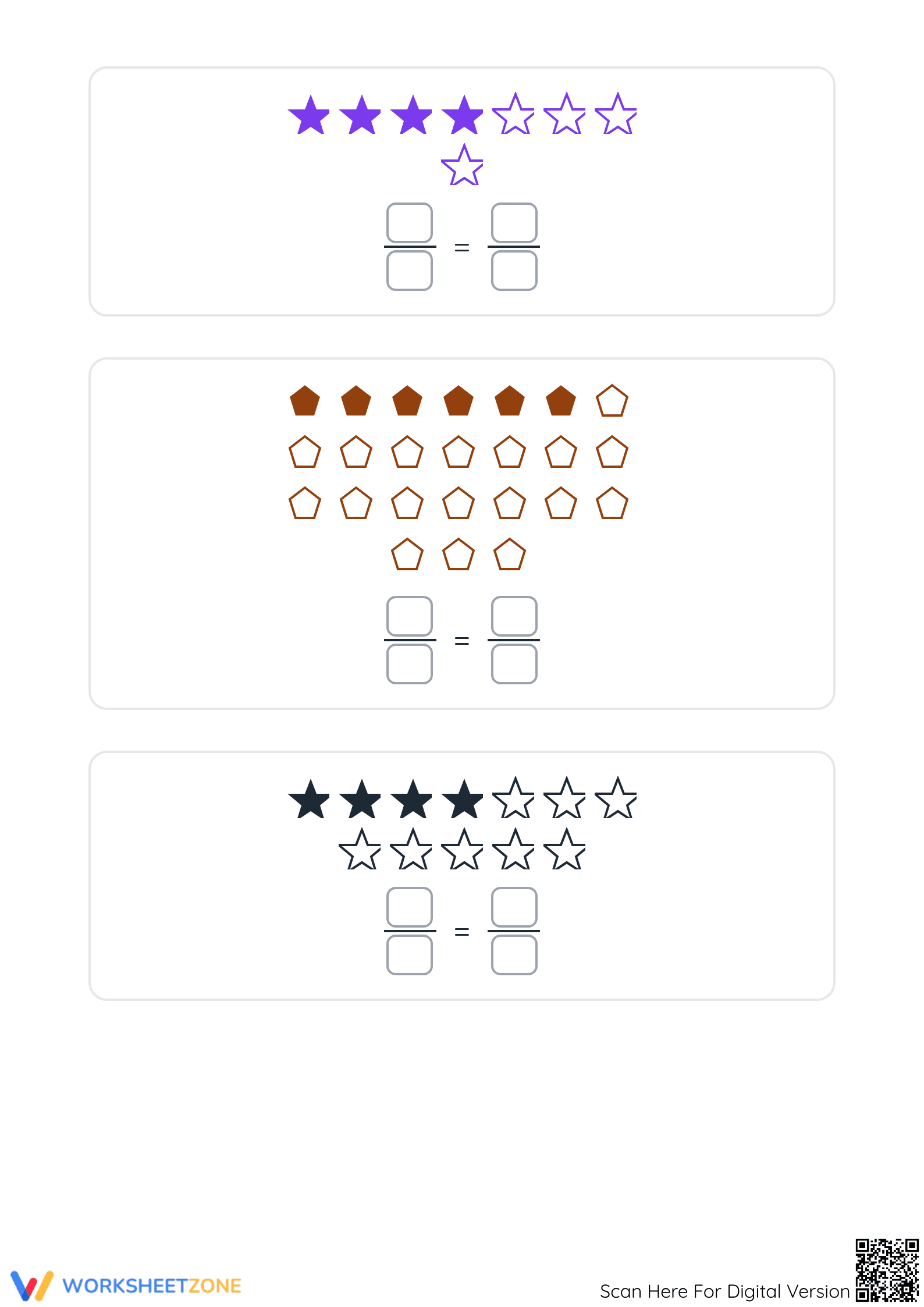
- Supported practice: Middle pages increase the set size, featuring up to 20 shapes per group, requiring students to count accurately before applying division rules for simplification.
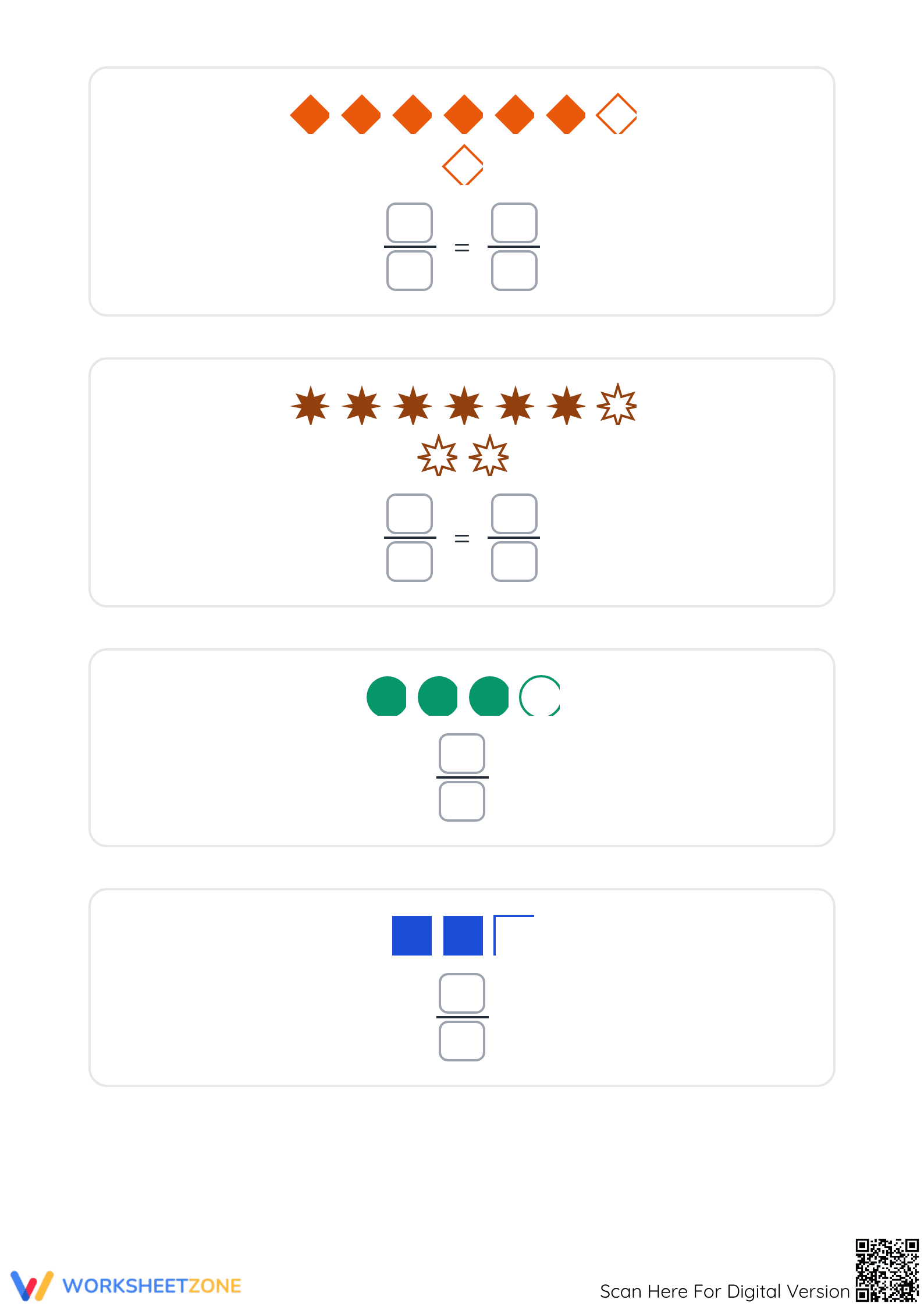
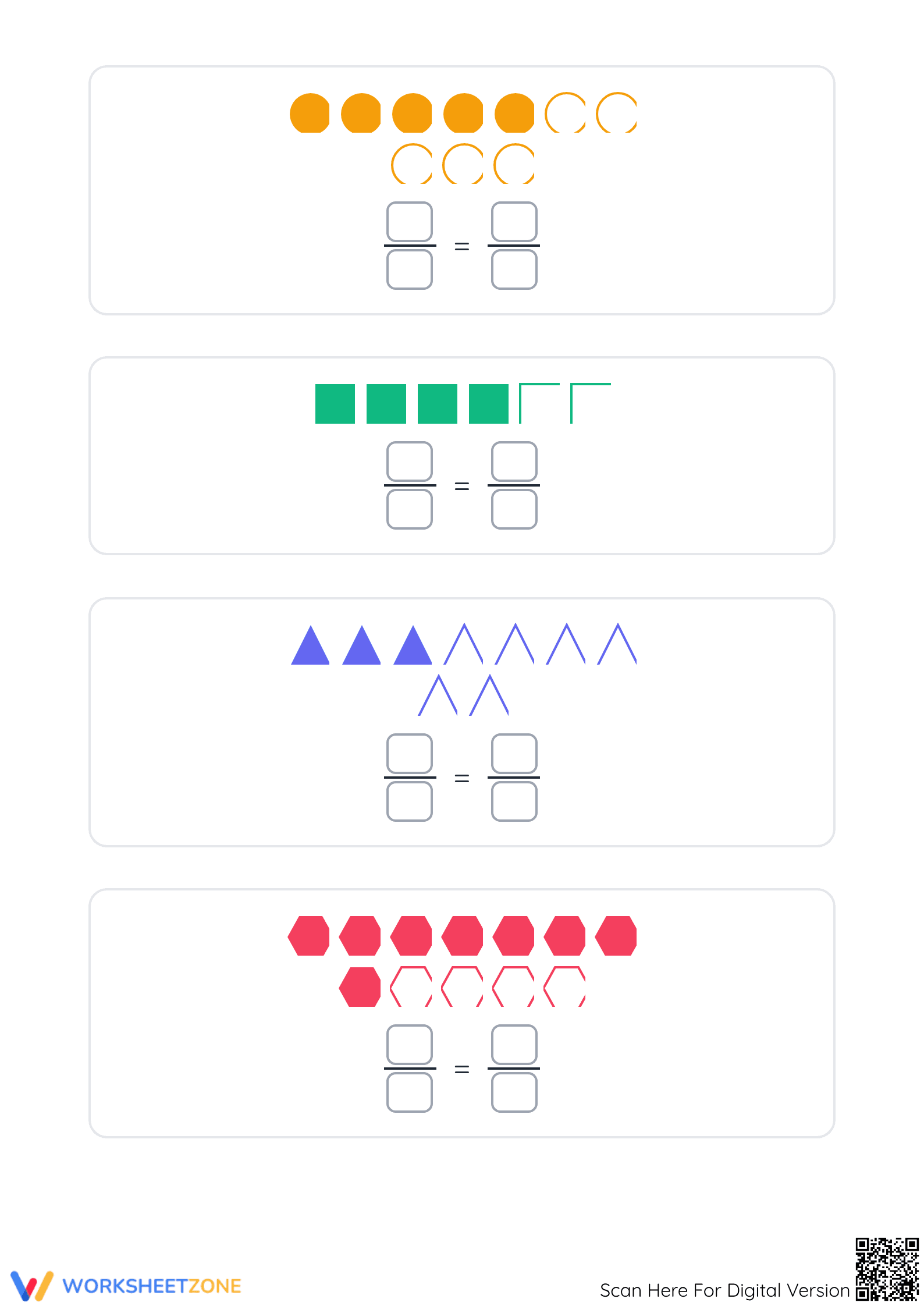
- Independent practice: The final pages remove scaffolding, challenging students to identify complex fractional relationships within larger groups of shapes autonomously.
The progression follows a gradual-release model, moving from small, easily countable groups to more complex sets that require strong division skills.
Standards Alignment
The focus is CCSS.MATH.CONTENT.4.NF.A.1. Students explain why a fraction a/b is equivalent to (n × a)/(n × b) using visual models. By simplifying groups, students prove numerical relationships between numerator and denominator. This standard code can be copied into lesson plans, IEP goals, or district curriculum mapping tools.
How to Use It
This worksheet is ideal for the "We Do" phase of direct instruction or as a formative assessment after a lesson on equivalent fractions. Teachers should observe students as they count the shapes to ensure they are including the entire set in the denominator. This intervention point allows for immediate correction of common errors. Most students will complete the entire 5-page sequence in approximately 30 minutes.
Who It's For
This resource is designed for Grade 4 students, though it provides remediation for Grade 5 or 6. It is effective for visual learners who benefit from concrete representations. Pair this with pattern blocks for extra support.
The transition from concrete counting to abstract simplification represents a critical cognitive leap in mathematical development for elementary students. According to Fisher & Frey (2014), visual modeling is absolutely essential for students to internalize the concept of equivalence before they move to purely algorithmic procedures involving division. This worksheet provides the critical visual scaffolding necessary for students to see that 12 out of 24 is the same fractional "part" as 1 out of 2. Research from the NAEP consistently shows that students who use pictorial representations for fractions perform significantly higher on standardized assessments involving rational number comparison and operations. By grounding the process of simplification in a countable group of shapes, this resource aligns with the "Concrete-Representational-Abstract" sequence of instruction favored by modern pedagogy. Educators can rely on this 15-problem set to provide the significant volume of practice needed to achieve procedural fluency while maintaining deep conceptual integrity for learners in Grades 4 and above.


