


























Views
Downloads
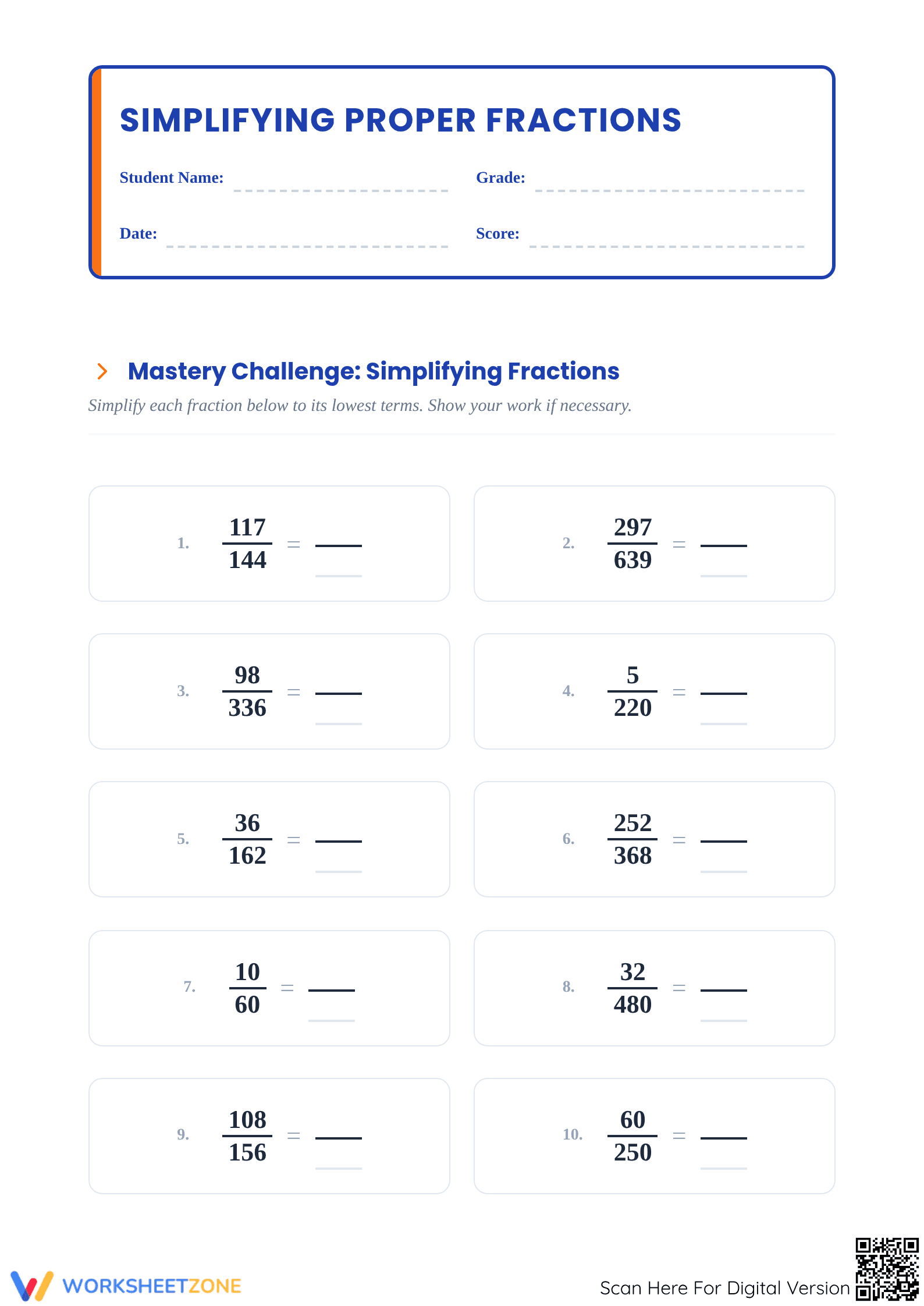


Printable Simplifying Fractions Worksheet | Grade 5-8 Math
Paste this activity's link or code into your existing LMS (Google Classroom, Canvas, Teams, Schoology, Moodle, etc.).
Students can open and work on the activity right away, with no student login required.
You'll still be able to track student progress and results from your teacher account.
Fluency in simplifying fractions is a critical milestone for middle school mathematics, serving as the gateway to complex algebraic expressions and ratio reasoning. This comprehensive 40-problem worksheet challenges students to reduce proper fractions to their simplest form. By mastering this essential skill, learners significantly reduce mathematical frustration and improve their overall accuracy in advanced computations.
At a Glance
- Grade: 5–8 · Subject: Math (Fractions)
- Standard:
CCSS.MATH.CONTENT.4.NF.A.1— Explain fraction equivalence by using numerical rules to simplify terms- Skill Focus: Simplifying proper fractions to lowest terms
- Format: 4 pages · 40 problems · Answer key included · PDF
- Best For: Mastery-level independent practice and skill reinforcement
- Time: 30–45 minutes
What's Inside
This four-page resource features 40 problems in a 'Mastery Challenge' layout. It ranges from basic two-digit simplifications to complex three-digit fractions requiring robust divisibility rule knowledge. A complete answer key is included for quick grading or self-correction. Each page is numbered and clearly organized to help students manage their multi-step calculations effectively.
Skill Progression
- Guided practice: Problems 1-10 use familiar two-digit values to reinforce the fundamental simplification algorithm with minimal friction.
- Supported practice: Problems 11-30 introduce three-digit values, requiring more deliberate common factor identification and mental math.
- Independent practice: Problems 31-40 present high complexity, ensuring students reach total mastery before progressing to operations.
This worksheet follows a gradual-release model, moving students from familiar factors to larger, more intimidating values that build numerical stamina and confidence.
Standards Alignment
This resource is primarily aligned with CCSS.MATH.CONTENT.4.NF.A.1, which requires students to explain why a fraction is equivalent to another by using numerical rules to simplify terms. It also supports CCSS.MATH.CONTENT.5.NF.A.1 by providing the necessary computational foundation for adding and subtracting fractions. Both standard codes can be copied directly into lesson plans, IEP goals, or district curriculum mapping tools.
How to Use It
Use this worksheet as a formal assessment at the conclusion of a unit on fraction equivalence to verify mastery. Alternatively, assign individual pages as daily warm-up tasks to maintain procedural fluency throughout the year. During instruction, observe how students handle the transition to three-digit numbers to identify who may need additional support with divisibility rules. Expect students to spend approximately 30 to 45 minutes to complete the full 40-problem set.
Who It's For
This practice set is ideal for Grade 5 through Grade 8 students who have already been introduced to the concept of greatest common factors. It is particularly effective for learners who require extra repetition to achieve automaticity. Pair this worksheet with a divisibility rules anchor chart or a direct instruction lesson on prime factorization to provide students with a complete toolkit for success.
According to the RAND AIRS 2024 report, proficiency in fraction operations is a primary predictor of success in secondary algebra and higher-level mathematics. This worksheet addresses the foundational skill of simplifying proper fractions, which aligns with CCSS.MATH.CONTENT.4.NF.A.1. By requiring students to identify the greatest common factor across 40 distinct problems involving two and three-digit numerators and denominators, the resource facilitates the procedural fluency described in EdReports 2024 evaluations of high-quality instructional materials. The inclusion of complex values ensures that learners apply robust division strategies rather than rote memorization. This mastery-level practice is essential for reducing cognitive load during subsequent multi-step calculations, such as adding or multiplying fractions with unlike denominators. Teachers can integrate this printable PDF into their curriculum as a reliable tool for both skill acquisition and formative assessment, ensuring students meet rigorous national standards for mathematical precision and numerical reasoning.


