


























Views
Downloads




Essential Worksheet: Simplifying Proper Fractions, Grade 4
Paste this activity's link or code into your existing LMS (Google Classroom, Canvas, Teams, Schoology, Moodle, etc.).
Students can open and work on the activity right away, with no student login required.
You'll still be able to track student progress and results from your teacher account.
Simplifying Fractions Mastery
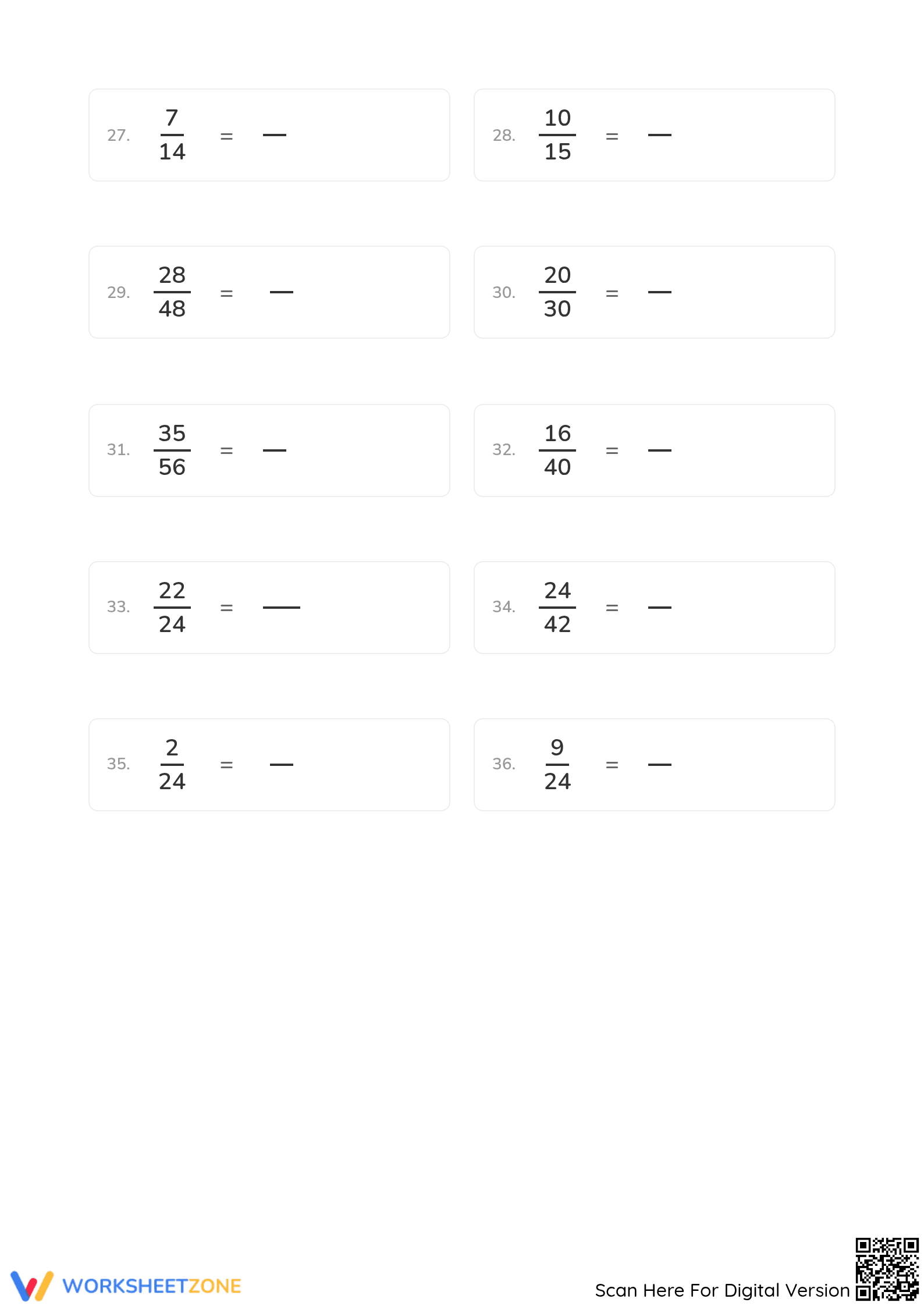
Master the essential skill of simplifying proper fractions with this comprehensive 5-page practice set. Designed for Grade 4 and 5 students, this resource focuses on reducing fractions to their simplest form using the Greatest Common Factor (GCF). Students will move from basic recognition to advanced mastery, ensuring they have the fluencies required for more complex operations.
At a Glance
- Grade: 4 · Subject: Math — Fractions
- Standard:
CCSS.MATH.CONTENT.4.NF.A.1— Explain fraction equivalence and generate simplest forms using numerical operations.- Skill Focus: Simplifying Proper Fractions via Greatest Common Factor (GCF)
- Format: 5 pages · 46 problems · Answer key included · PDF
- Best For: Small group intervention and independent skills practice
- Time: 30–45 minutes
This 5-page PDF contains 46 carefully structured problems divided into four distinct phases. The set includes a 'Quick Practice' section for initial assessment, 'Developing Skills' for building procedural depth, a 'Fraction Challenge' for applying GCF strategies to larger numbers, and a 'Final Mastery' check. A full answer key is provided to facilitate rapid grading and student self-reflection.
Skill Progression
The instructional design follows a gradual-release methodology across three levels of support. This ensures that learners build confidence before tackling high-stakes assessments.
- Guided Practice: The first 12 problems offer 'Quick Practice' to reinforce the basic concept of division within fractions using small denominators and intuitive ratios.
- Supported Practice: Problems 13 through 24 introduce the GCF strategy explicitly, prompting students to identify the largest common divisor to achieve the simplest form accurately.
- Independent Practice: The final sections present complex challenges and mastery checks that require students to work autonomously without scaffolding or visual prompts.
Standards Alignment
This resource is primarily aligned with `CCSS.MATH.CONTENT.4.NF.A.1`, which requires students to explain why a fraction is equivalent to another by using numerical operations. Specifically, students learn to generate the simplest form of a proper fraction. It also supports Grade 5 mastery of `CCSS.MATH.CONTENT.5.NF.A.1` by providing prerequisite fluency. Both standard codes can be copied directly into lesson plans or IEP goals.
How to Use It
Utilize this worksheet during the independent practice phase of a lesson on equivalent fractions to measure student mastery. It works exceptionally well as a multi-day packet or as a rotation station in a blended learning environment. For a formative observation, watch students during Part 2 to see if they are identifying the greatest common factor correctly.
Who It's For
This set is ideal for general education students in Grades 4 and 5, as well as middle school students requiring tier 2 intervention for fraction fluency. It naturally pairs with an anchor chart demonstrating the GCF division method or a direct instruction lesson. The clear layout makes it accessible for students with processing delays who benefit from consistent formatting.
According to the RAND AIRS 2024 report on mathematics education, procedural fluency in fraction simplification is a critical predictor of later success in algebraic reasoning. This worksheet aligns with CCSS.MATH.CONTENT.4.NF.A.1, focusing on the fundamental skill of reducing fractions to their simplest form using the Greatest Common Factor (GCF). By engaging in the 46 scaffolded problems provided, students develop a conceptual understanding of equivalence rather than relying on rote memorization. Research by Fisher & Frey (2014) emphasizes the importance of gradual release models, which this resource supports through its progression from quick practice to final mastery challenges. Educators can utilize this data-driven tool for targeted intervention or robust assessment. The inclusion of a comprehensive answer key ensures immediate feedback, a factor known to significantly enhance learning outcomes in middle-elementary mathematics according to recent NAEP analysis of instructional materials. This summary reflects the core pedagogical value of the resource.


