


























Views
Downloads

Essential Simplifying Fractions Practice | Grades 4-8
Paste this activity's link or code into your existing LMS (Google Classroom, Canvas, Teams, Schoology, Moodle, etc.).
Students can open and work on the activity right away, with no student login required.
You'll still be able to track student progress and results from your teacher account.
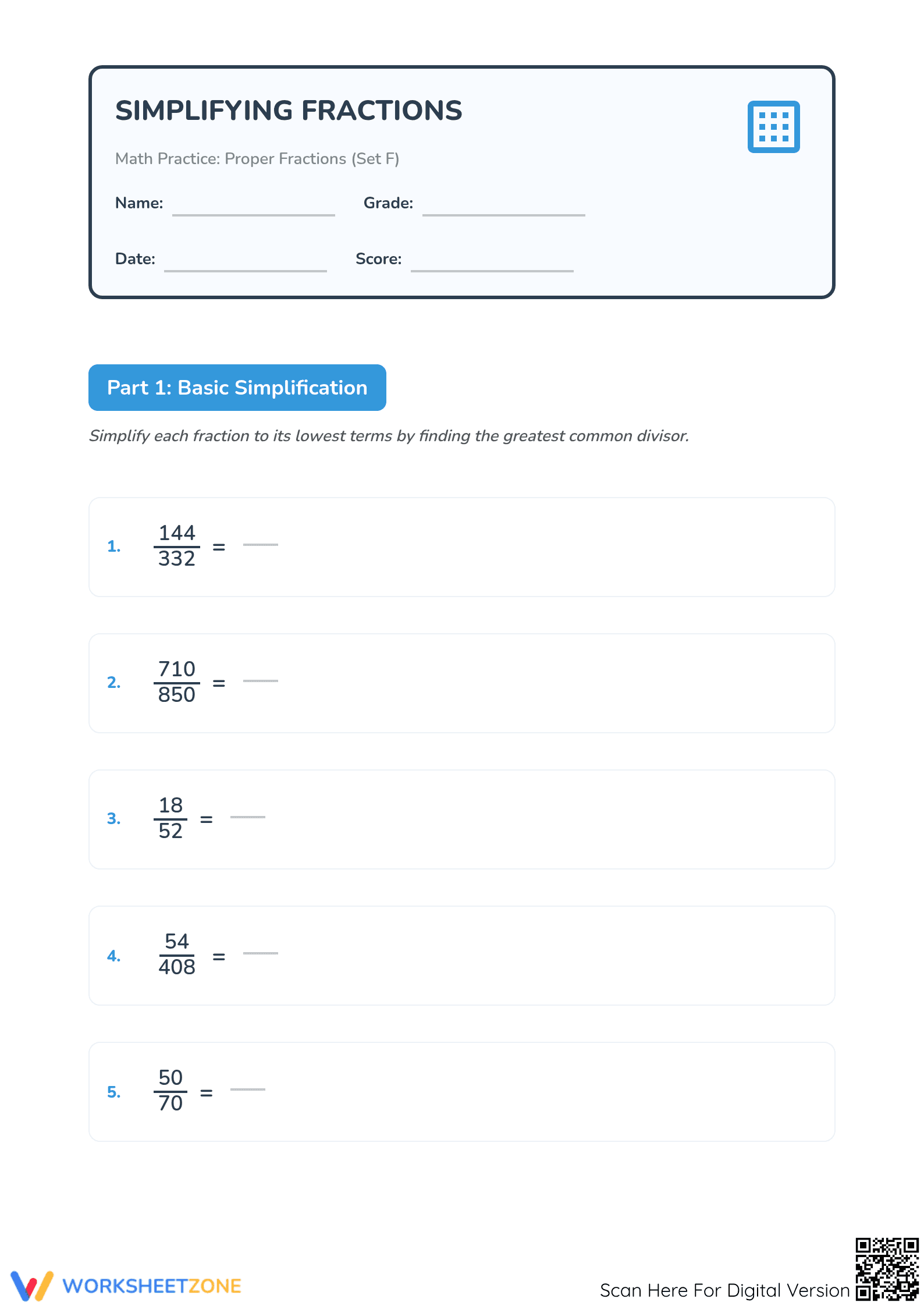
This comprehensive math worksheet empowers students to master the essential skill of simplifying proper fractions to their lowest terms. By systematically applying the greatest common divisor to a variety of numeric challenges, learners develop the procedural fluency required for higher-level algebraic operations. This resource provides the rigorous practice needed to move from basic recognition to complete computational mastery.
At a Glance
- Grade: 4 · Subject: Math
- Standard:
4.NF.A.1— Identify and generate equivalent fractions to reduce proper numeric sets to their simplest form- Skill Focus: Simplifying proper fractions to lowest terms using the greatest common divisor
- Format: 5 pages · 34 problems · Answer key included · PDF
- Best For: Differentiated independent practice, homework assignments, or math center fluency building
- Time: 30–45 minutes
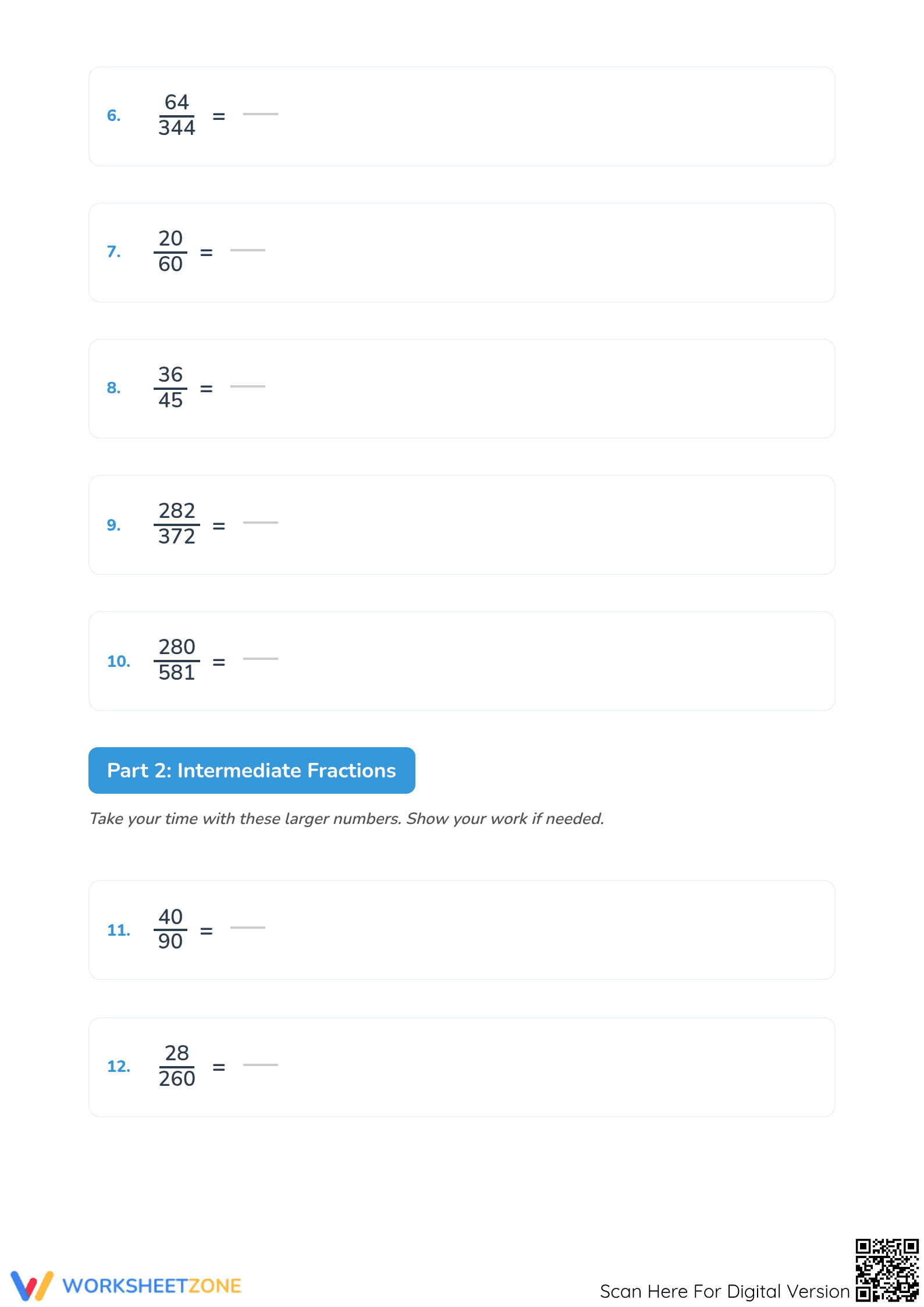
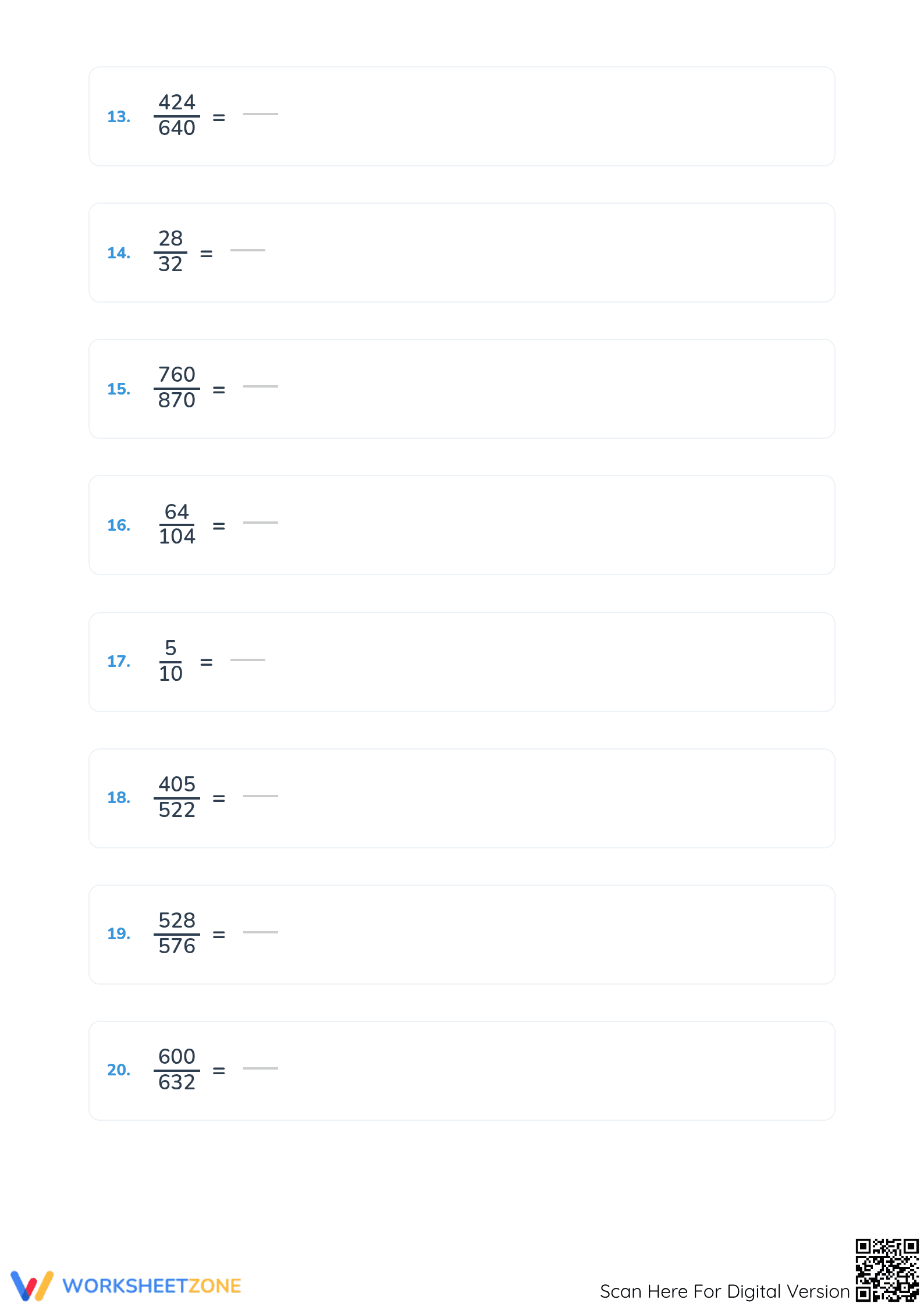
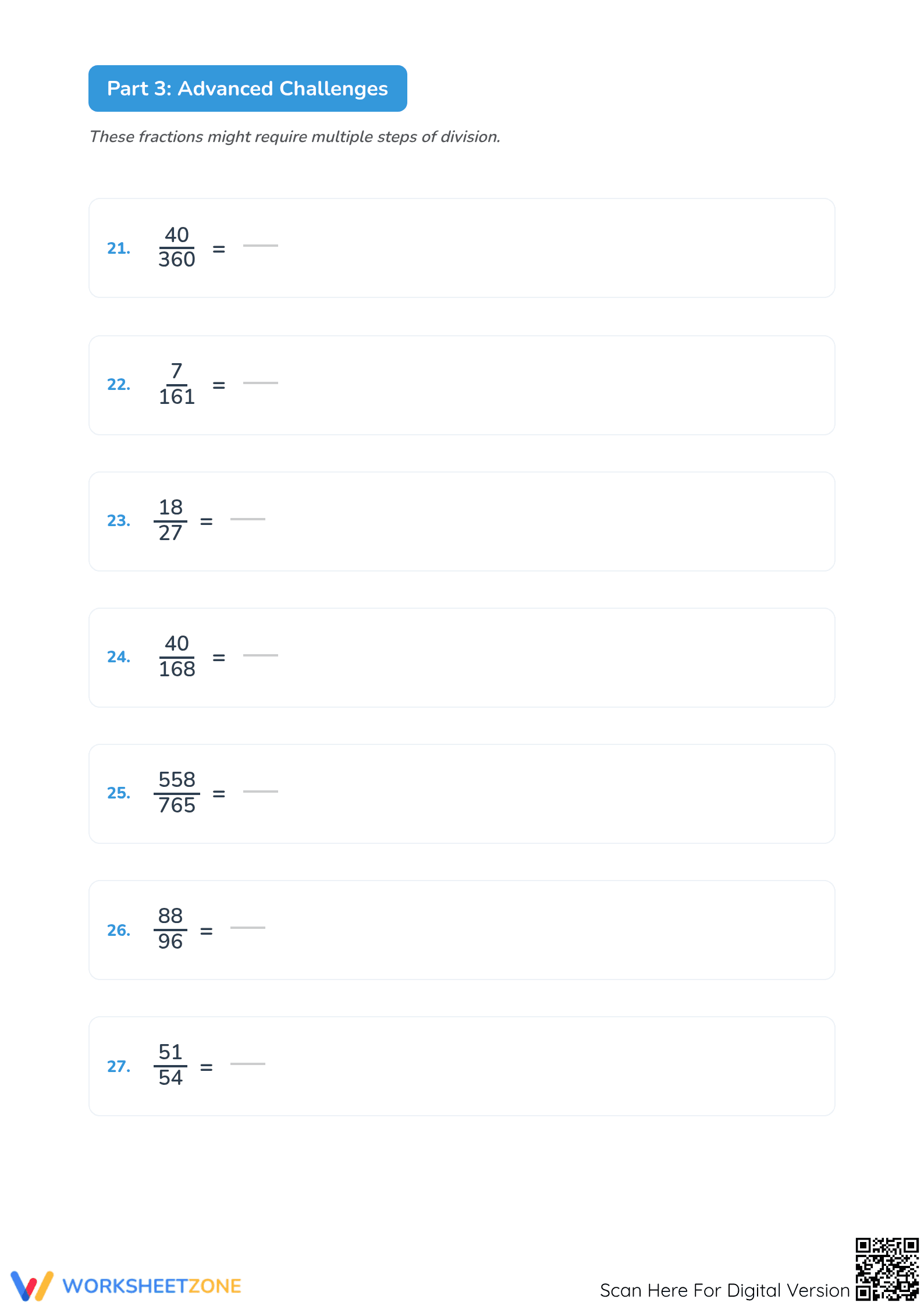
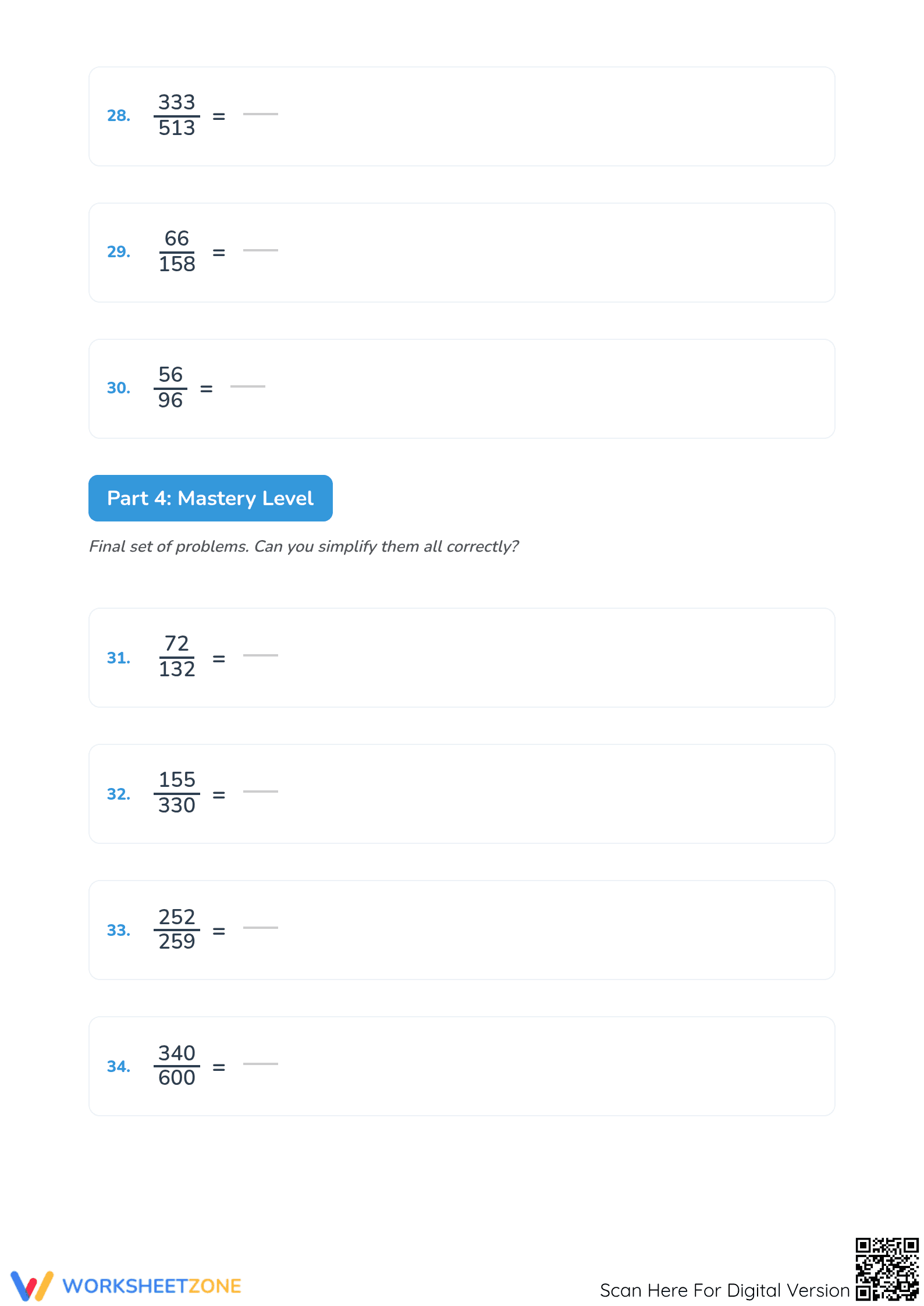
Across five structured pages, students engage with 34 distinct problems categorized by increasing complexity. The worksheet is divided into four logical parts: Basic Simplification, Intermediate Fractions, Advanced Challenges, and a final Mastery Level. Each section includes clear instructional cues and ample white space for students to show their work. A complete answer key is included to facilitate rapid grading and immediate student feedback.
Skill Progression
- Guided Practice: Part 1 focuses on 10 basic fractions where the greatest common divisor is easily identifiable, allowing for initial success.
- Supported Practice: Parts 2 and 3 introduce 17 problems with larger denominators, requiring multi-step division or more complex factor identification.
- Independent Practice: The Mastery Level provides 4 high-difficulty problems to verify student retention and total procedural fluency.
This gradual-release model ensures students build confidence with simpler numeric sets before tackling the advanced challenges of the final sections.
Standards Alignment
This resource is directly aligned to 4.NF.A.1: "Explain why a fraction a/b is equivalent to a fraction (n*a)/(n*b) by using visual fraction models... Use this principle to recognize and generate equivalent fractions." While the primary focus is on reduction, the worksheet reinforces the underlying concept of numeric equivalence through division. This standard code can be copied directly into lesson plans, IEP goals, or district curriculum mapping tools to ensure instructional alignment.
How to Use It
Implement this worksheet during the independent practice phase of a lesson on equivalent fractions. After modeling the use of the greatest common divisor, assign the first two pages to gauge initial understanding. Teachers can use the intermediate sections as a formative assessment tool; observe if students are attempting to simplify in a single step or using multiple divisions for larger numbers. The mastery level serves as an excellent exit ticket or homework assignment to confirm total proficiency.
Who It's For
This practice set is ideal for Grade 4 and Grade 5 students working toward computational fluency, as well as middle school students requiring remediation in basic fraction operations. It serves as a perfect companion to direct instruction using fraction tiles or number lines. The structured layout specifically supports students with dyscalculia or those who benefit from predictable formatting and clear section transitions for focused math work.
This worksheet incorporates research-backed principles for procedural fluency, utilizing a gradual release of responsibility model across four distinct difficulty levels. It offers extensive practice crucial for students to achieve automaticity in fraction simplification, bridging conceptual understanding with efficient computation. Mastery of these 4.NF.A.1 skills is highly predictive of future success in middle school algebra, where fraction manipulation is foundational.


