


























Views
Downloads


Printable Simplifying Fractions | Grade 5-6 Math
Paste this activity's link or code into your existing LMS (Google Classroom, Canvas, Teams, Schoology, Moodle, etc.).
Students can open and work on the activity right away, with no student login required.
You'll still be able to track student progress and results from your teacher account.
Mastering fraction reduction is a cornerstone of middle school mathematics. This comprehensive worksheet provides a systematic approach to simplifying proper fractions, ensuring students move beyond basic recognition toward procedural fluency. By working through 40 varied numeric examples, learners build the computational confidence required for complex algebraic operations and proportional reasoning in later grades.
At a Glance
- Grade: 5–6 · Subject: Middle School Mathematics
- Standard:
4.NF.A.1— Recognize and generate equivalent fractions to simplify them to lowest terms- Skill Focus: Simplifying proper fractions with diverse common factors
- Format: 4 pages · 40 problems · Full answer key included · High-quality PDF
- Best For: Independent procedural practice, daily homework, and morning work
- Time: 25–35 minutes for total completion
What's Inside
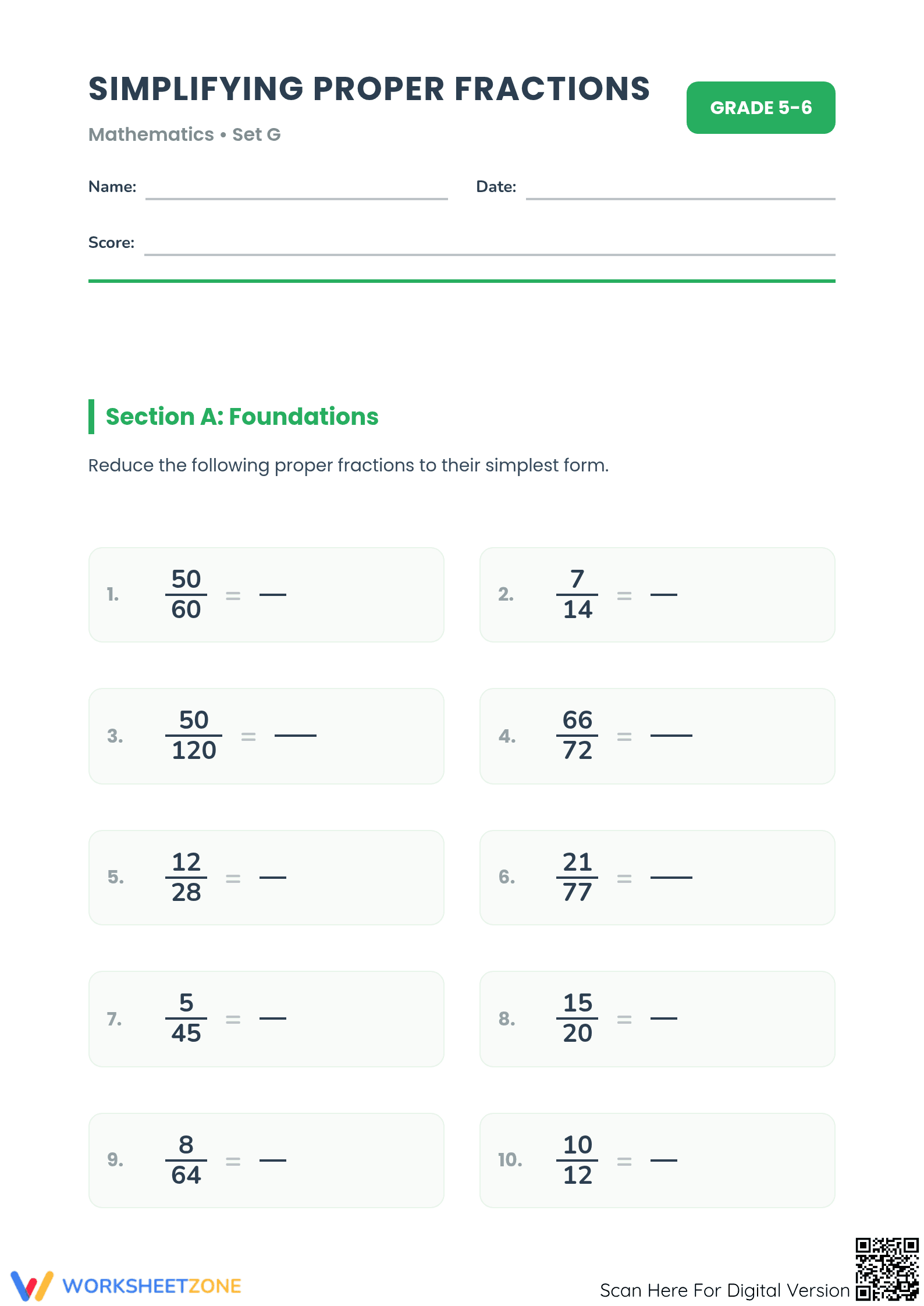
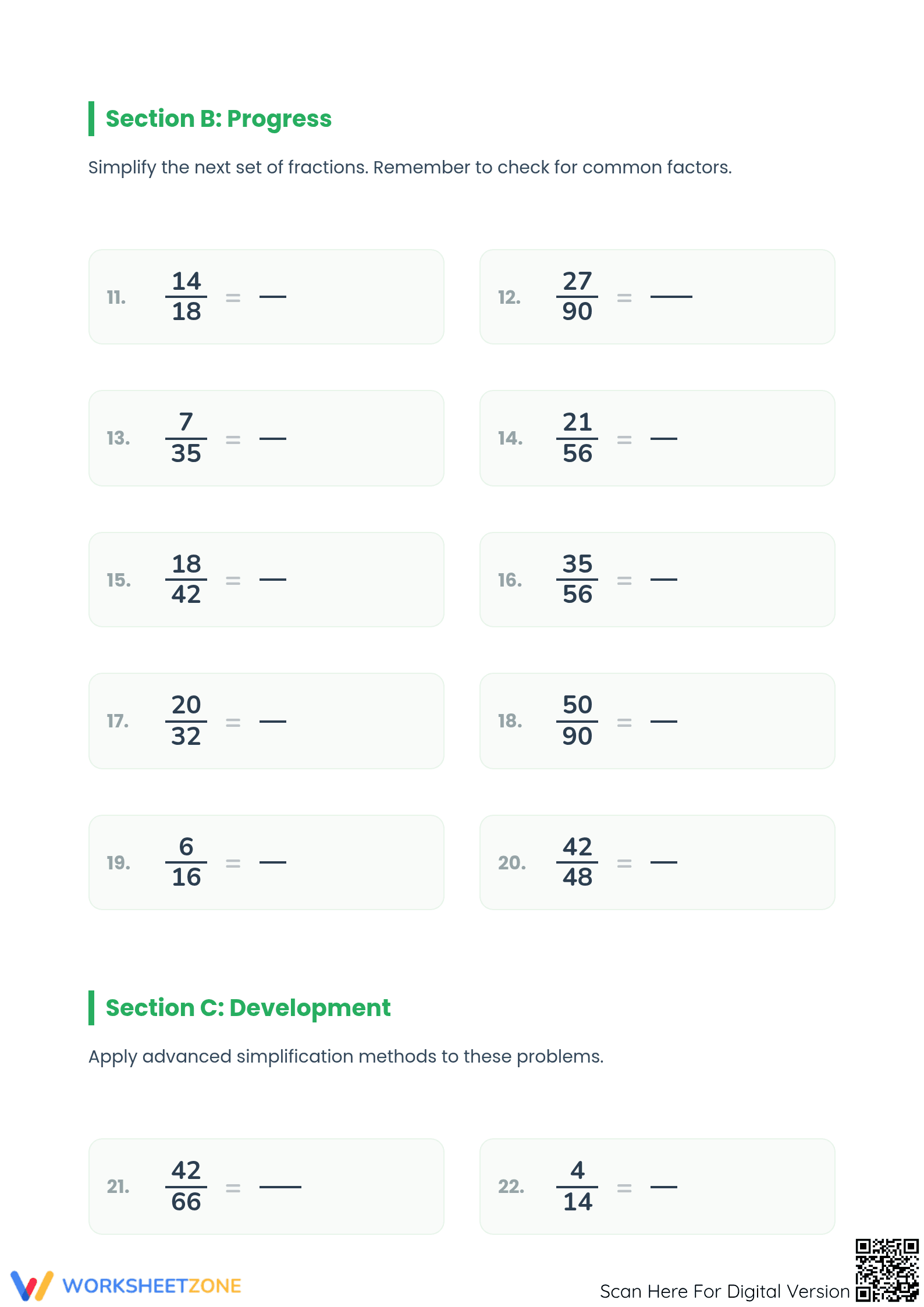
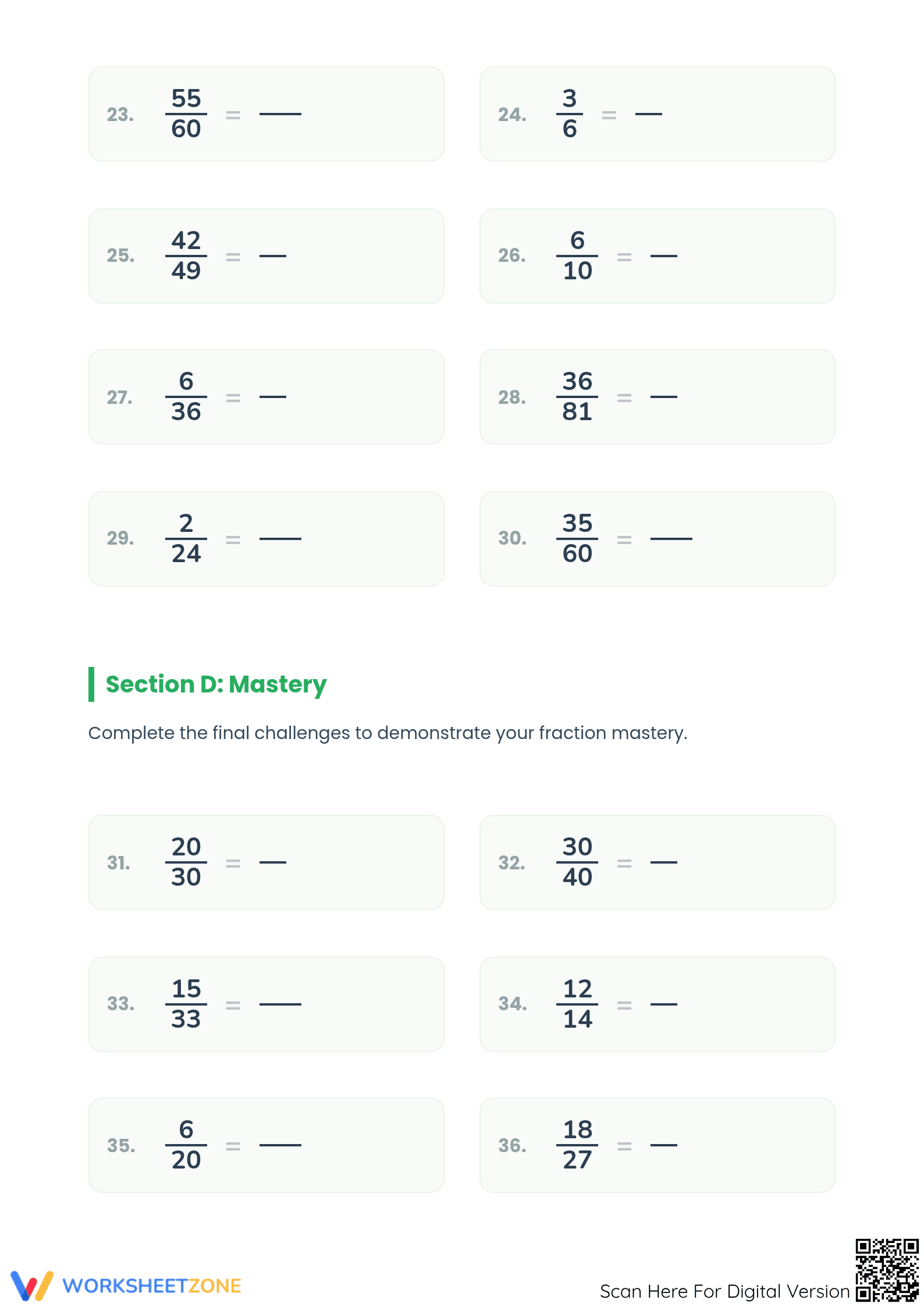
This 4-page PDF contains 40 unique proper fraction simplification problems. Labeled as "Set G," the resource is divided into four tiers: Foundations, Progress, Development, and Mastery. Each page features clean layouts with ample space for calculations. A full answer key is included to facilitate rapid grading or student self-assessment in any learning environment.
Skill Progression
- Foundations: 10 introductory problems focus on identifying common factors in a guided environment (e.g., 50/60 or 7/14).
- Progress & Development: 20 intermediate problems require sophisticated division and multi-step reduction to ensure absolute simplest form.
- Mastery: 10 challenging problems serve as a final check for fraction fluency and independent application of reduction methods.
This tiered structure supports the gradual release of responsibility, moving from guided identification to independent mastery.
Standards Alignment
The primary focus is 4.NF.A.1, regarding fraction equivalency and generating simplest forms. By simplifying fractions, students identify the most reduced equivalent form. This resource also supports 5.NF.A.1 and 6.NS.B.4, as simplification is a prerequisite for adding and subtracting fractions with unlike denominators. Both standard codes can be copied directly into lesson plans or district curriculum mapping tools.
How to Use It
Use this for independent practice following a lesson on finding the Greatest Common Factor (GCF). It works well as a formative assessment to gauge student automaticity. Observe if students simplify in a single step using the GCF or take multiple steps; this provides critical insight into their multiplication fact mastery and numeric fluency.
Who It's For
Designed for students in grades 5–6 developing core fraction competencies. It is perfect for learners requiring repeated procedural practice to reach mastery. The tiered structure allows for easy differentiation: assign "Foundations" to struggling learners and "Mastery" to advanced students. Pair this with a fraction wall for additional visual support.
Simplifying proper fractions is more than just a procedural trick; it is an essential component of mathematical literacy that underpins success in higher-level algebra. Research from the NAEP consistently highlights that students who master fraction equivalency and reduction are significantly more likely to succeed in proportional reasoning tasks. This worksheet aligns with the "I Do, We Do, You Do" gradual release model by moving students from foundational identification to independent mastery across 40 tasks. According to a RAND AIRS 2024 analysis of instructional materials, high-volume, tiered practice sets are critical for moving mathematical skills from short-term memory to long-term fluency. By providing 40 problems with clear progression, this resource addresses the need for "productive struggle" while maintaining a high success rate through scaffolding. Educators can confidently integrate 4.NF.A.1 into their curriculum, knowing this tool provides the rigorous evidence of student learning required for modern standards-based reporting and data-driven instructional adjustments.


