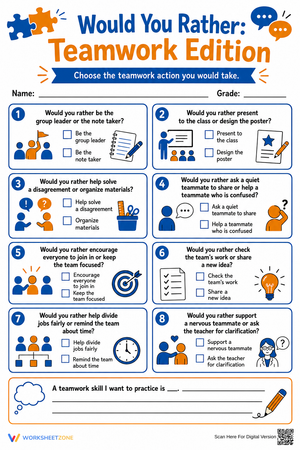
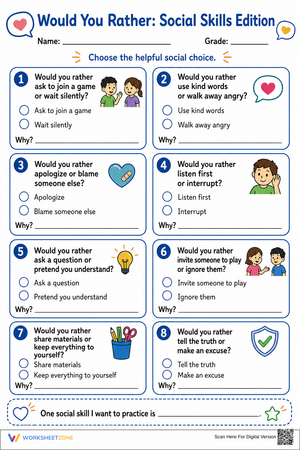
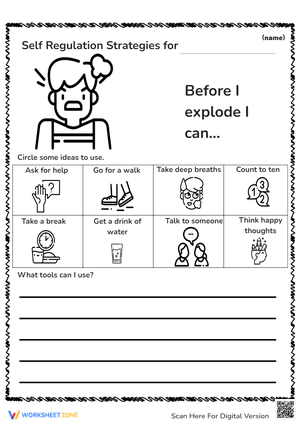
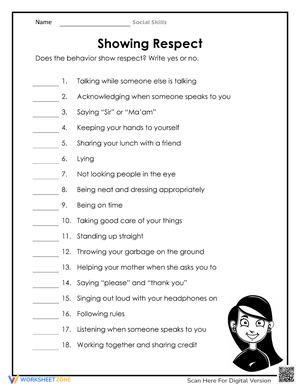
These 4th grade social skills for kids printable worksheets arrive at the right developmental moment — when peer relationships start mattering more than almost anything else in a student's day, and adult-mediated conflict resolution stops being the default. Fourth graders are cognitively ready for scenario-based practice and perspective analysis, but they're also entering the terrain of cliques, social comparison, and peer pressure for the first time. Teachers working this grade need materials that get past general kindness reminders and into the actual mechanics: how to reframe an accusation, how to hear someone's side before pushing back, how to recognize exclusion when it's happening.
What Each Worksheet Covers
The set spans six areas of social functioning that fourth graders encounter in real time, not just in theory. Each worksheet stays focused on one skill rather than spreading thin across several — combining too many social concepts in a single exercise diffuses attention rather than building it.
- Conflict resolution using "I" statements — students rewrite accusatory phrases into statements centered on their own feelings and needs, then apply the structure to a new scenario they haven't seen before.
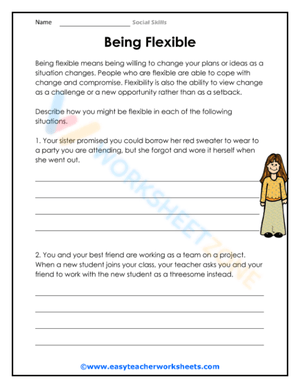
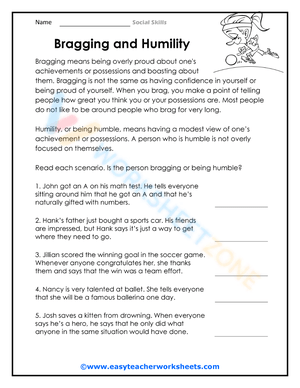
- Perspective-taking — students read a described situation and explain how each person involved might experience it differently, including details each person may not have access to.
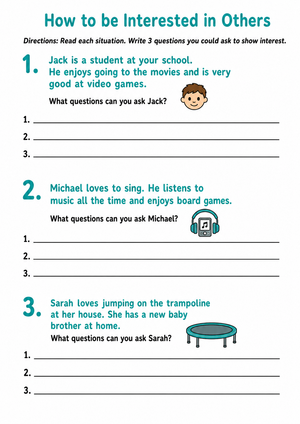
- Active listening behaviors — students identify which specific actions (paraphrasing, follow-up questions, body orientation) show a speaker they're being heard, and distinguish those from habits that quietly signal disinterest.
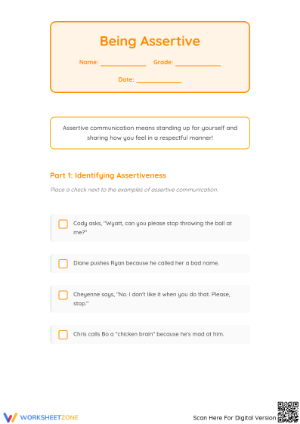
- Communication style sorting — students categorize sample responses as assertive, passive, or aggressive, then rewrite the non-assertive options.
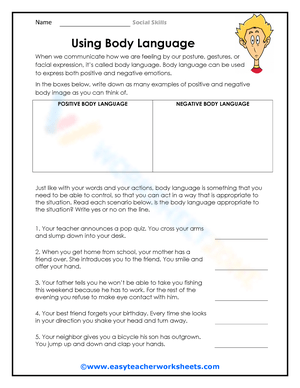
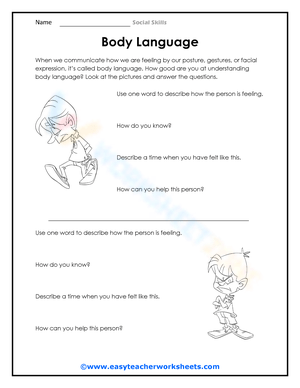
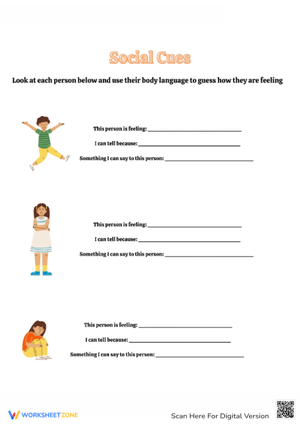
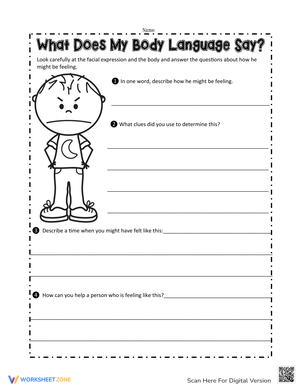
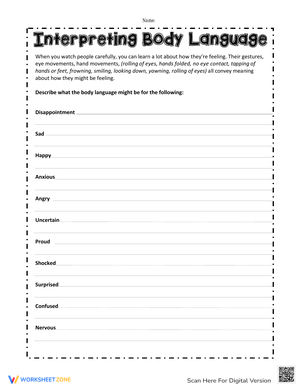
- Reading nonverbal cues — students interpret body language, facial expressions, and physical distance in illustrated scenarios, building the habit of attending to what isn't said aloud.
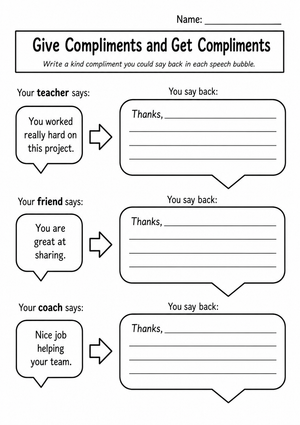
- Giving and receiving feedback — students practice phrasing critique constructively and responding to criticism without shutting down. This skill gets underemphasized in early elementary SEL, but by the time collaborative academic work becomes standard in grade four, the cost of skipping it shows up in group project dynamics almost immediately.
Error Patterns Worth Watching in Student Work
The most consistent pattern across completed worksheets is the gap between the written response and the actual behavior. A student who writes "I would use an I-statement and walk away calmly" may do neither when a real conflict arises — not because they're being dishonest, but because they genuinely believe they'd act that way. The worksheet surfaces the ideal. Observation over the following week surfaces the gap. Treating that gap as diagnostic data rather than a compliance failure is what makes these exercises instructionally useful.
A second recurring issue is the structurally correct but functionally flawed I-statement. Once students learn the "I feel ___ when ___" formula, many write responses like "I feel angry when you always steal my pencil." The format is there; the blame still leads. That near-miss is harder to catch in verbal conversation but shows up clearly on paper, which makes written practice more diagnostic than an oral discussion for identifying it.
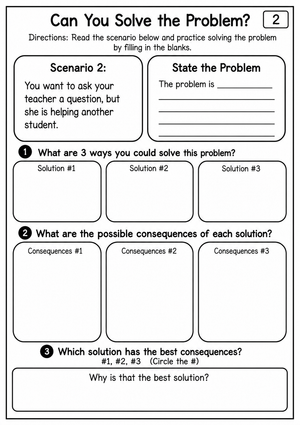
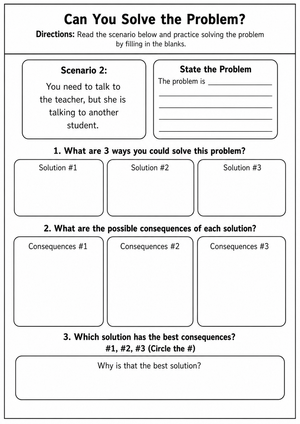
On conflict resolution sequencing tasks, students routinely skip the listening step — jumping straight from "express your feelings" to "find a solution" and omitting "hear the other person's account" entirely. The students who do this most consistently are often the socially confident ones, because in their daily experience their version of events tends to go uncontested. A student who can write down all five steps in order but skips step three in practice is telling you something concrete about their actual conflict behavior that a class discussion wouldn't surface as clearly.
Fitting These Worksheets Into the School Day
The most natural entry points are morning meeting, the transition after lunch recess, and a dedicated SEL block. Morning meeting works especially well for empathy and perspective-taking exercises — the tone is calm, and setting a social-emotional frame early shapes how the class manages interactions for the rest of the day. The post-lunch window has its own logic: recess conflicts are often still raw, and a short structured exercise gives students a way to process what happened rather than carrying the frustration into the afternoon.
One approach that works reliably is a Skill of the Week structure, where 4th grade social skills for kids printable worksheets anchor Monday's introduction of a single concept — active listening one week, assertive communication the next. The same vocabulary then carries through the week in brief, low-stakes reminders during transitions or group work. By Friday, students are applying language they've already practiced rather than meeting a new concept cold. This builds consistency without requiring a dedicated second lesson slot on any other day of the week.
Standard Alignment
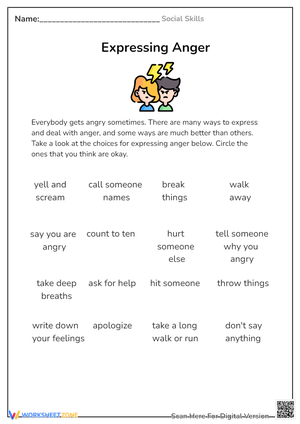
These worksheets align with the CASEL (Collaborative for Academic, Social, and Emotional Learning) framework, which most districts use as the organizing structure for SEL instruction at the K–8 level. All five core competencies are addressed: self-awareness and self-management through exercises on identifying emotions and regulating responses under social pressure; social awareness through perspective-taking and empathy scenarios; relationship skills through conflict resolution and communication style work; and responsible decision-making through activities that ask students to consider the consequences of their actions on the people around them.
For teachers in states with formal SEL standards — Illinois's ISBE framework and Washington's K–12 Social-Emotional Learning Standards are among the most developed — these worksheets support the upper elementary benchmarks focused on peer relationships, emotional regulation, and responsible communication. They're also useful for documenting SEL instruction during program reviews or in parent-teacher conferences when families ask how social-emotional development is being addressed alongside academic content.
Serving a Range of Learners With This Set
The open-ended scenario format works well for most fourth graders, but a few student populations benefit from targeted adjustments. Students who freeze in front of a blank response box do better with sentence stems — "I think [name] felt ___ because ___" — provided as a verbal prompt or a sticky note alongside the worksheet. That structure doesn't reduce the cognitive demand; the student still has to reason through the scenario. It removes the writing-output bottleneck that causes some kids to disengage before they've started thinking about the social situation at all.
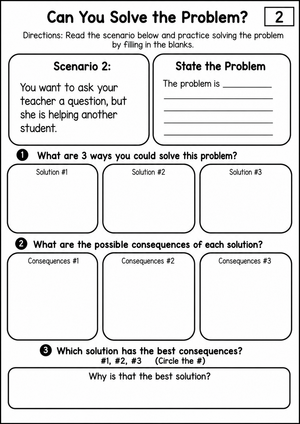
For students who move through exercises quickly, adding complexity to the scenario is more productive than assigning additional worksheets from the set. A two-person conflict is manageable; a three-person situation where two students have one account of what happened and a third has another version introduces the genuine ambiguity that characterizes most real fourth-grade disputes. Students who thrive on challenge find it measurably harder and more engaging than another straightforward exercise. On the other end of the range, 4th grade social skills for kids printable worksheets work effectively in small-group counselor-led settings, where each worksheet functions as an agenda for a guided conversation rather than a standalone independent task.
Frequently Asked Questions
How often should these worksheets be used?
Once a week is a reasonable baseline for most classrooms. If you're working through a specific skill over multiple sessions, twice a week keeps the concept active without crowding out academic instruction. Spaced practice — returning to the same skill in a new context rather than spending one long session on it and moving on — produces more durable retention, and the set is structured to support that kind of distributed approach across several weeks.
Do these worksheets work as a standalone SEL curriculum?
They work best alongside brief direct instruction, not instead of it. A worksheet on active listening lands differently after you've modeled a listening conversation in front of the class than when students encounter the concept cold on paper. Use each worksheet to anchor individual written practice after a short whole-class introduction, then return to discussion to close the loop on what students noticed in their own responses.
Are these worksheets usable for students with IEPs that include social-emotional goals?
Yes. These 4th grade social skills for kids printable worksheets are frequently used in pull-out settings by school counselors and special education teachers working on IEP goals around communication, conflict resolution, and self-regulation. The step-by-step format gives students with ADHD or anxiety a clear structure to follow, which reduces the overwhelm that open-ended social demands can produce. For students on the autism spectrum, pairing each worksheet with an explicit discussion of why the expected social response is expected — rather than just asking students to identify it — adds the explanatory layer that makes the practice genuinely transferable to real situations.
What should I do when a student's written responses are consistently "correct" but their behavior tells a different story?
Name it directly with the student in a private conversation: "I noticed on the worksheet you wrote that you'd hear the other person out first, but Thursday at lunch that didn't happen. What got in the way?" Most fourth graders can articulate the gap themselves when asked without accusation. The worksheet becomes a reference point for that conversation — a record of what the student already knows the right move looks like — rather than evidence of failure to act on it.