


























Views
Downloads

Printable Bragging vs Humility Worksheet | Grade 4 SEL
Paste this activity's link or code into your existing LMS (Google Classroom, Canvas, Teams, Schoology, Moodle, etc.).
Students can open and work on the activity right away, with no student login required.
You'll still be able to track student progress and results from your teacher account.
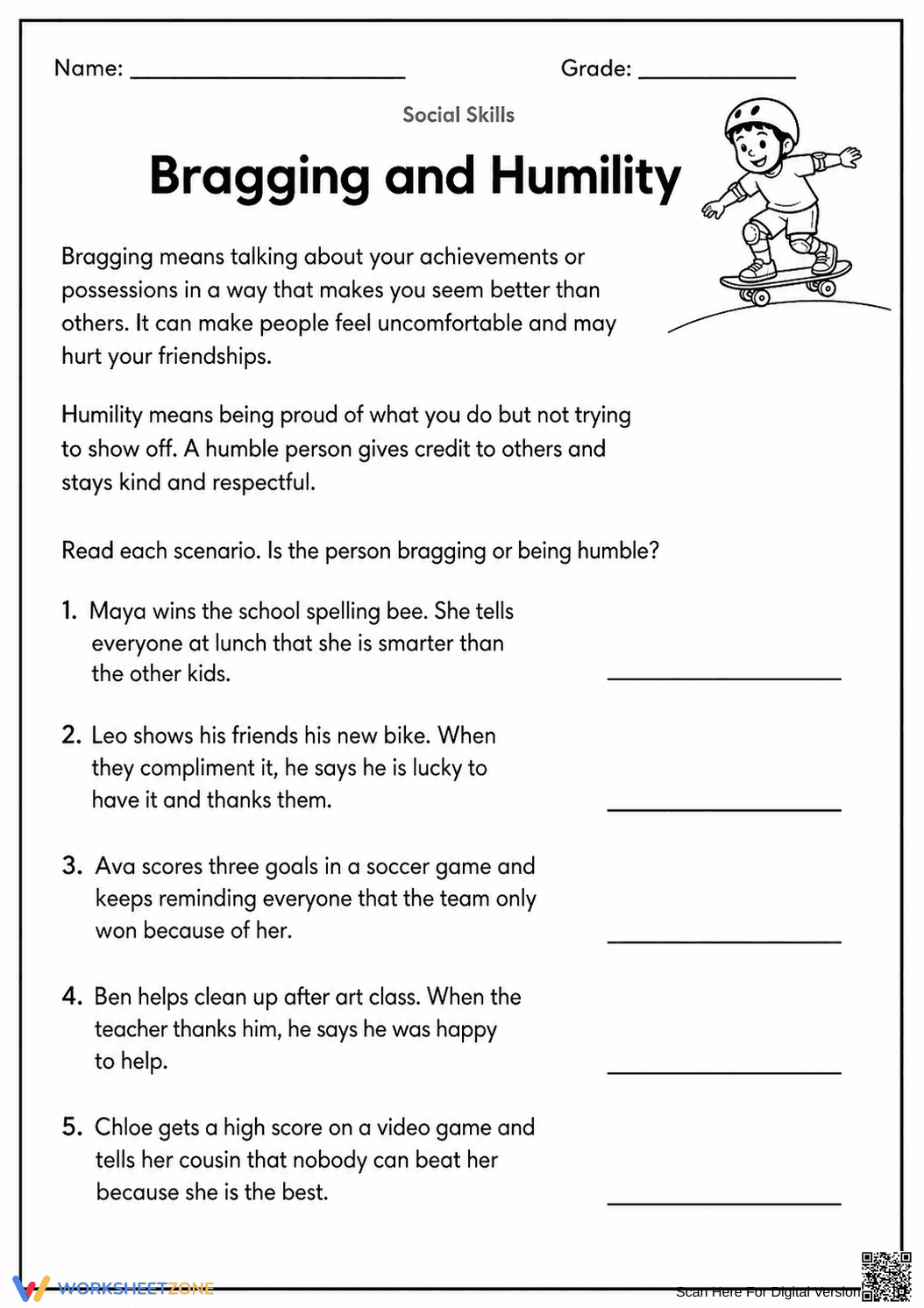
This social skills worksheet helps students distinguish between bragging and humility in everyday interactions. By analyzing relatable scenarios, learners practice identifying respectful communication and understanding how their words impact others. This foundational exercise builds empathy and self-awareness, equipping students to share their achievements without alienating their peers.
At a Glance
- Grade: 4 · Subject: Social Skills
- Standard:
CCSS.ELA-LITERACY.SL.4.1— Engage effectively in collaborative discussions and social interactions- Skill Focus: Identifying bragging versus humility
- Format: 1 page · 5 problems · PDF
- Best For: Independent practice or morning work
- Time: 10–15 minutes
Inside this resource, educators will find a single-page activity reinforcing positive social behaviors. It begins with clear definitions of bragging and humility. Students then read five real-world scenarios—like winning a spelling bee or getting a new bike. Learners must use context clues to determine if the character is demonstrating humility or bragging, writing their answer on the blank lines.
Designed for immediate use, this resource offers a zero-prep workflow:
- Print (1 minute): Single-page layout ensures quick batch printing.
- Distribute (1 minute): Hand out during morning meetings or transitions. Clear instructions let students start instantly.
- Review (3 minutes): Discuss the five scenarios together to spark conversations about empathy.
Total teacher prep time is under two minutes, making it an ideal sub plan.
This activity aligns with CCSS.ELA-LITERACY.SL.4.1: Engage effectively in collaborative discussions with diverse partners, expressing ideas clearly. By evaluating how characters communicate successes, students learn the nuances of respectful dialogue. Both standard codes can be copied directly into lesson plans, IEP goals, or district curriculum mapping tools.
Integrate this worksheet into morning meetings to set a positive tone. Use it before direct instruction to gauge baseline understanding of humility, or after discussing sportsmanship to reinforce concepts. For a formative assessment observation tip, listen to students debate the scenarios in pairs; their reasoning reveals their grasp of social cues. Expected completion time is 10 to 15 minutes.
Designed for fourth-grade students, this worksheet also supports middle schoolers needing social skills intervention. It is ideal for counselors, special educators tracking IEP goals, and teachers building classroom culture. To differentiate, read scenarios aloud for struggling readers or have advanced students write a new scenario. It pairs naturally with respectful communication anchor charts.
Integrating explicit social-emotional instruction into the daily academic curriculum significantly improves both classroom climate and individual student outcomes. This specific resource targets CCSS.ELA-LITERACY.SL.4.1, directly helping students engage effectively in collaborative discussions and social interactions by distinguishing between bragging and humility. According to a comprehensive RAND AIRS 2024 study, students who receive consistent, structured practice in recognizing social cues and regulating their interpersonal communication demonstrate a marked decrease in peer conflicts and a measurable increase in collaborative academic success. By analyzing these five distinct scenarios, learners develop the critical empathy required to navigate complex peer dynamics successfully. Providing concrete, relatable examples of abstract concepts like humility ensures that behavioral expectations remain clear and attainable for all learners. This targeted practice not only supports immediate classroom management strategies but also builds the foundational emotional intelligence necessary for long-term personal and academic achievement.


