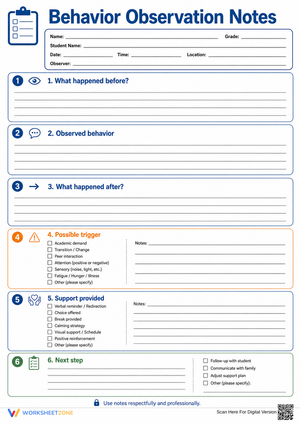
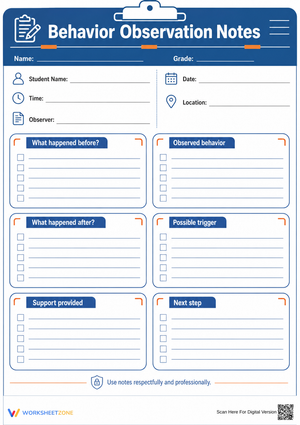
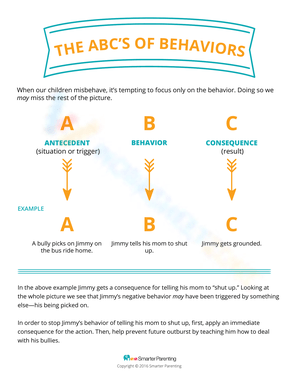
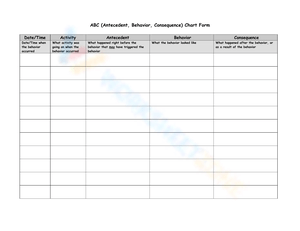
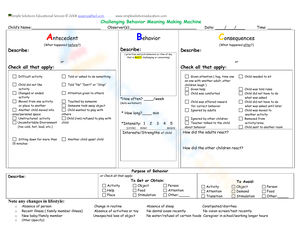
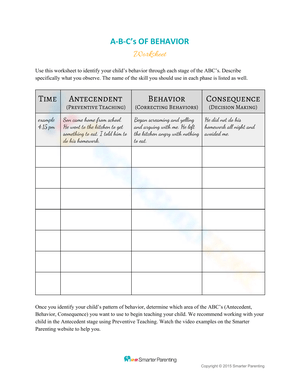
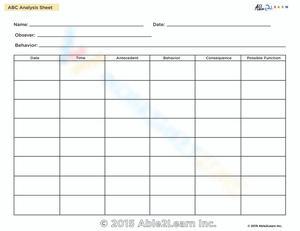
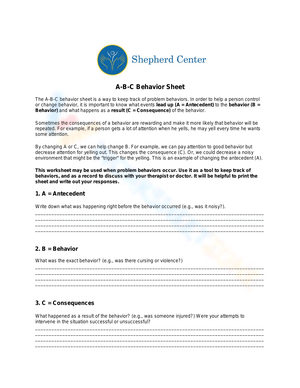
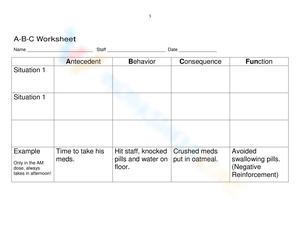
4th grade antecedent behavior consequence printable worksheets give teachers a concrete framework for moving students from reactive, in-the-moment responses to reflective, sequential thinking about their own behavior—a cognitive shift that becomes realistic around age 9 or 10, when students can trace cause-and-effect chains in their own actions but still need a structured format to do it independently. Each worksheet breaks an incident into three labeled parts: the antecedent (what happened immediately before), the behavior (the observable action), and the consequence (what followed). The set spans four distinct worksheet formats, from guided scenario analysis to student-generated self-reflection after real classroom incidents.
The Specific Skills These Worksheets Build
The core skill across 4th grade antecedent behavior consequence printable worksheets is accurate sequence analysis—learning to tell apart a trigger, an action, and an outcome without collapsing them into a single undifferentiated "incident." Students practice naming the antecedent precisely: not "lunch was bad" but "a classmate took the last chocolate milk before I got to the line." That level of specificity matters because vague antecedents produce vague interventions. When a student can name the exact trigger, a teacher can do something about it.
The set uses four formats to build that precision from different angles:
- Scenario analysis: Students read a short classroom or playground situation and label each ABC component.
- Self-reflection charts: Blank templates completed after a real incident, with emphasis on observable facts rather than retrospective feelings.
- Matching exercises: Students connect antecedent cards to likely behaviors and predict consequences—a format that surfaces assumptions worth discussing whole-class.
- Alternative-response brainstorming: One antecedent, three behavioral choices, and a consequence prediction for each. This worksheet makes visible something fourth graders often miss: the antecedent does not determine the outcome. The behavior does.
Student Errors That Surface Predictably in ABC Work
The most consistent error is placing an emotion in the behavior box. A student writes "I was furious" where the behavior field should read "I swept the books off my desk." Emotions are internal states that belong in the context surrounding the antecedent—but students conflate feeling with acting, reliably, until they have cycled through the correction several times. An anchor chart posted near the cool-down area distinguishing "what I felt" from "what I did" reduces this confusion, though expect to revisit it through November.
Reverse sequencing shows up most in students who are still emotionally raw about a recent incident. The consequence—losing recess, being sent to the office—looms largest in their memory, so they write it first and work backward. The resulting chart looks logical to them but is inverted. A simple verbal prompt during review, "Tell me what happened first, before anything else," usually catches this without triggering a defensive response.
A third pattern: students write the antecedent as a standing complaint rather than a specific observation. "The teacher always calls on me" is not a useful antecedent. "The teacher called on me right after I'd been avoiding eye contact for ten minutes because I didn't know the answer" is. Worksheets that include a sentence frame—The specific thing that happened right before was ___—reduce this drift toward generalized grievance and keep the entry concrete enough to act on.
How to Work These Worksheets Into Your Planning Week
Introduce the ABC framework during a calm block—morning meeting, a brief SEL check-in, the opening of advisory—not in the five minutes after a hallway incident. Students need to encounter the model while regulated so they can reach for it when they are not. A picture book protagonist who hits a conflict in chapter two or three works well as an entry point: read to the flashpoint, stop, and map the antecedent-behavior-consequence sequence on the board before students ever see a worksheet themselves. By the time they fill one out independently, the structure is already familiar.
The self-reflection worksheet frustrates students who are still mid-dysregulation; asking a student to complete one during a meltdown produces inaccurate data and damages their relationship with the tool. The right window is 15 to 20 minutes later, once the student is physically settled. Some teachers place a small sand timer in the cool-down corner—when it runs out, the worksheet is there as an option, not an instruction.
4th grade antecedent behavior consequence printable worksheets also work as informal data collection over time. When a student's charts cluster around a specific context—the transition back from specials, the last ten minutes before dismissal, the stretch after lunch when the room is warmest—that pattern points directly at a modifiable environmental antecedent. Incident reports rarely surface this kind of temporal detail. Student-generated ABC charts often do.
Standard Alignment
These worksheets address the CASEL SEL Framework's Self-Awareness and Self-Management competencies at the fourth-grade level, specifically the benchmarks for identifying emotions and their causes, understanding the relationship between thoughts, feelings, and behaviors, and developing strategies for responding to challenging situations. Within PBIS frameworks, structured antecedent-behavior-consequence documentation is a core component of Tier 2 behavior support—these worksheets produce that documentation in student-generated form, usable in pre-referral team meetings and as supporting evidence in a Functional Behavior Assessment process. Teachers in districts with standalone SEL standards will find that the self-reflection and alternative-response brainstorming formats map directly onto fourth-grade benchmarks for emotion regulation and behavioral problem-solving.
Tailoring the Set for Students at Different Points in Development
For students who shut down when facing open-ended writing under emotional pressure, pairing the self-reflection worksheet with a laminated emotion vocabulary card reduces the retrieval demand significantly. Students scan and circle rather than generate words from scratch, which frees working memory for the sequence analysis itself. A two-column version—antecedent and behavior only—also works as a starting point for students who find the three-part format too demanding in early weeks; the consequence column can follow as a verbal exchange with the teacher before any additional writing happens. 4th grade antecedent behavior consequence printable worksheets work best when the format serves the thinking, not the other way around.
Students who move quickly through the scenario analysis benefit from extension questions that push into perspective-taking: What might the other person in the scenario have been thinking during the antecedent? What second-order consequence—not the immediate one, but what happens the next morning—might follow each behavioral choice? These additions shift the task toward social awareness, which sits at the overlap between ABC analysis and the CASEL competency map that fourth-grade SEL often targets by mid-year.
Frequently Asked Questions
How do I explain the ABC model to a fourth grader who has never heard of it?
An analogy that lands reliably: the antecedent is a match, the behavior is whether you strike it, and the consequence is what catches fire. Students immediately understand that a match does not have to start a flame—someone has to choose to strike it. That reframe, from automatic reaction to deliberate choice, is the core message of the framework. Once students grasp the analogy during a class discussion, most are ready to apply it to a scenario worksheet the same afternoon.
What do I do when a student fills out a worksheet inaccurately—writing an emotion as the behavior, or reversing the sequence?
Do not mark it wrong and hand it back. Sit beside the student and ask them to walk you through what they wrote, out loud. Most inaccuracies correct themselves during narration—students hear themselves say "and then I felt angry, so I... wait, that's the behavior part." The correction becomes self-generated rather than teacher-imposed, which makes it stick. Once they narrate it correctly, have them revise the written version so there is an accurate record to refer back to.
Can these worksheets support a Functional Behavior Assessment?
Yes, directly. Student-completed ABC charts provide first-person antecedent data that observation-based FBA tools rarely capture. A behavior interventionist reviewing a student's collected worksheets across several weeks gains insight into the student's perceived triggers—which may differ meaningfully from what adults observe—and that gap is itself clinically significant. These worksheets do not replace formal FBA documentation, but they give the assessment team a starting point grounded in the student's own account of events, which sharpens the accuracy of any Behavior Intervention Plan that follows.












 Interactive Worksheet Maker
 Quiz Maker
 Word Search Maker
 Crossword Puzzle Maker
 Word Scramble Generator
 Sentence Scramble Generator
 Handwriting Worksheet Generator
 Name Tracing Generator
 Fill In The Blank Generator