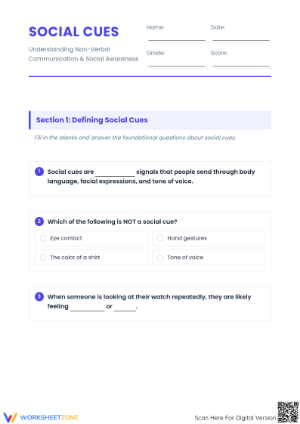
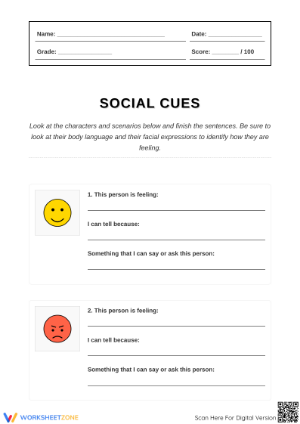
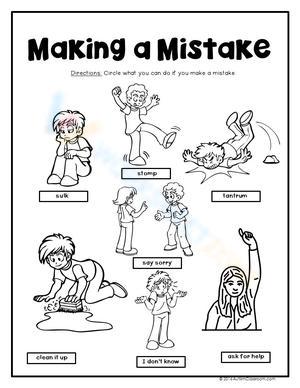
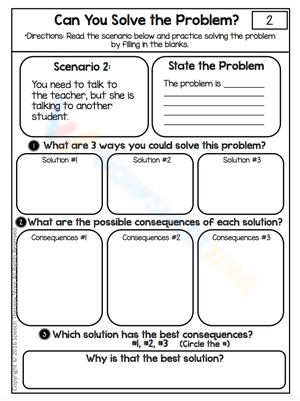
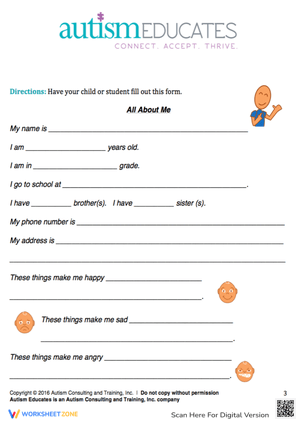
These 4th grade social skills for autism worksheets pdf resources give teachers a structured entry point for the peer interactions that actually trip students up — joining a conversation already in progress, reading a classmate's expression during group work, recovering after a social misstep. They work best as part of direct instruction and live rehearsal, not as independent seatwork handed out without context.
The Specific Skills in Each Worksheet
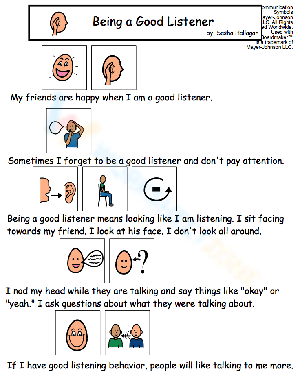
Grade 4 sits at a real inflection point for social instruction. Students this age face more unstructured peer time — collaborative projects, open recess, partner tasks, lunch table dynamics — while adults pull back from active facilitation. For autistic students, this is often the year the gap between knowing a social rule and applying it in a fast-moving, live situation becomes most visible to teachers and peers. The worksheets target six recurring challenge areas:
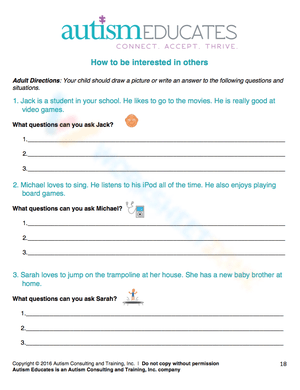
- Conversation management: staying on topic, shifting topics appropriately, and entering or exiting exchanges without disrupting them
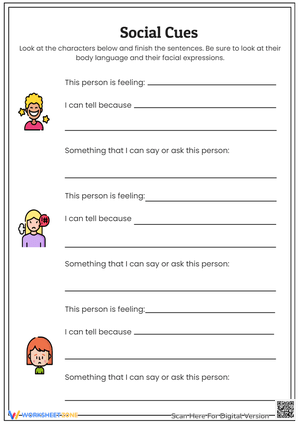
- Emotion recognition in context: reading posture, tone, and setting together rather than relying on a single facial cue
- Expected versus unexpected behavior by setting: sorting the same action across environments — what works in the hallway may be unexpected during a read-aloud
- Perspective-taking: predicting how a classmate or teacher feels and what they might do next, using short school-based scenes with a limited set of concrete choices
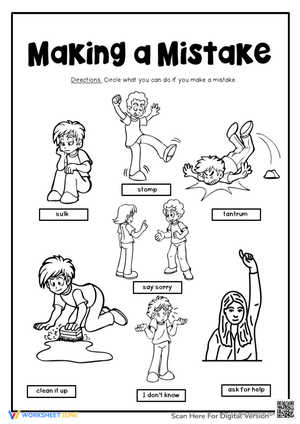
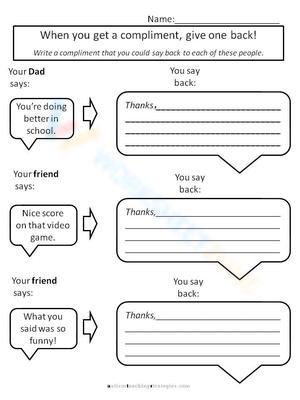
- Repair strategies: what to say or do after a social error — a skill many worksheet sets skip entirely
- Requesting help or a break: framing these requests in ways that fit actual classroom routines, not just memorized scripts
Student Misconceptions This Set Surfaces Most Reliably
The most consistent pattern at this grade is the correct-answer-without-transfer error. A student marks "raise your hand" as the expected choice — accurate — then calls out during the same type of activity the next morning because the worksheet scenario described a math discussion and today's context is a science share-out. The rule transferred to the surface features of the scenario, not to the underlying principle. When that shows up in worksheet responses, it tells a teacher the next lesson needs to slow down on the "why" behind the rule rather than just its observable form.
Emotion worksheets surface a different issue. Students practice the association "arms crossed means frustrated," then apply it to a peer who always stands that way, or who is cold, or who is concentrating hard. The static image on a worksheet strips out the contextual noise that real situations carry. After completing an emotion worksheet, asking students to name a situation where the same cue might mean something different does more instructional work than the worksheet alone. That follow-up question is where social reasoning actually develops.
Perspective-taking tasks reveal a third pattern: students who correctly label a character as "feeling left out" but cannot predict what that character will do next. Naming the emotion is the simpler step. Predicting the behavioral consequence — which is what students actually need for real-time peer navigation — requires more guided practice with concrete, familiar examples. A student who can name the feeling but not anticipate the behavior hasn't yet connected the two in a way that helps at recess.
Fitting These Worksheets Into the School Day Without Losing Instructional Momentum
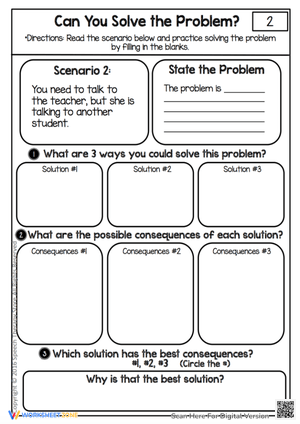
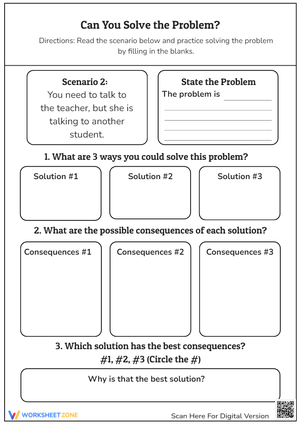
Two placements produce the most consistent carry-over: right before unstructured time and the morning after a social challenge happened in class. A conversation worksheet during the five minutes before recess primes students with vocabulary and a mental image precisely when they'll need it. A problem-solving worksheet the morning after a lunch conflict lets a teacher address the situation indirectly, with a fictional scenario standing in for the actual event — no student gets put on the spot, but the relevant skill gets revisited.
For teams supporting autistic students across multiple settings, aligning the language on each worksheet to the verbal prompt used in the classroom is worth more than it might seem. If a worksheet says "unexpected choice" and the classroom teacher says "not-okay choice" and the speech provider says "social mistake," students who rely on routine to navigate peer situations have to translate between three frameworks. The most effective 4th grade social skills for autism worksheets pdf sets are the ones where the wording on the worksheet and the words adults use in the room match exactly — which means the support team needs to look at the materials together before instruction begins, not after the first session.
Small groups benefit from returning to the same worksheet across two or three sessions: first with adult modeling, then guided discussion, then independent practice. By the third session, the format is familiar enough that students can focus on the social reasoning rather than parsing the task directions. That shift in attention is where the real instructional work happens.
Practical Adjustments for a Mixed-Ability Class
Autistic fourth graders can have very different language, reading, and processing profiles, and the same worksheet topic often needs to be presented differently across those profiles. For students who need less written output, circling, matching, or cut-and-sort tasks let them show understanding without the added demand of generating sentences. For students who need language support, sentence frames like "I could say..." or "A better choice here is..." provide enough structure to get started without removing the cognitive work of selecting a response.
For students who are overwhelmed by too many options at once, folding or covering part of a worksheet so only one section is visible at a time cuts visual clutter and reduces processing load. For students ready for a higher challenge, asking them to generate an alternate school scenario that follows the same rule — rather than responding to a given prompt — moves practice from recognition toward genuine transfer. That shift in task type, not task topic, is usually the right adjustment at this level.
In inclusive classrooms, using the same worksheet across the whole class while adjusting only the response format keeps instruction cohesive. Students who need support get it without working on visibly different materials during SEL time, which matters more to 9- and 10-year-olds than adults sometimes expect.
Frequently Asked Questions
Are PDF worksheets enough to teach social skills to autistic students?
No, and any listing that implies otherwise isn't being honest about how social skill instruction works. Worksheets support explicit teaching and help document what was targeted, but real carry-over requires modeling, role-play, and practice inside the actual situations students face. A student who completes every worksheet correctly and then struggles at recess needs more live rehearsal, not more paper practice.
What school situations should these worksheets cover to be most useful for fourth graders?
The most transferable scenarios are drawn from group work, transitions, recess, lunch, and partner tasks — not generic situations like "talking to an adult" or abstract friendship themes. The closer the scenario is to something the student will face before the end of the school day, the more useful the practice becomes. Well-designed 4th grade social skills for autism worksheets pdf materials situate nearly every prompt inside a recognizable school structure: a specific classroom activity, a named school space, or a peer dynamic common to upper-elementary routines.
How do teachers use these worksheets as part of IEP documentation?
A completed worksheet isn't direct evidence of social performance in a real context, but it shows whether a student recognized the target skill, selected an appropriate response, and worked independently or needed prompting. That information documents a baseline and tracks progress toward a goal. Keeping completed worksheets from spaced-out sessions across the school year — rather than only from a cluster of sessions in one month — gives a more accurate picture of whether the skill is building over time.
Can these be used in both general education SEL time and special education pull-out sessions?
These 4th grade social skills for autism worksheets pdf resources work in inclusive SEL lessons, pull-out support groups, counseling sessions, and speech sessions — sometimes within the same week. The condition that makes that work is shared vocabulary: every adult using the materials should use the same language with students so instruction feels consistent rather than contradictory across settings.












 Interactive Worksheet Maker
 Quiz Maker
 Word Search Maker
 Crossword Puzzle Maker
 Word Scramble Generator
 Sentence Scramble Generator
 Handwriting Worksheet Generator
 Name Tracing Generator
 Fill In The Blank Generator