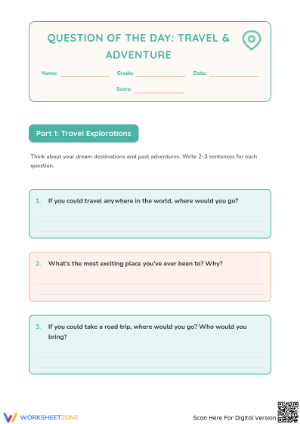
These 4th grade communication skills worksheets printable resources give teachers a concrete, repeatable way to build the social competencies nine- and ten-year-olds are actively sorting out — active listening, I-statement construction, nonverbal cue recognition, and the conversation moves that keep group work functional. Fourth grade is a genuine developmental inflection point: peer relationships are growing more complex, cooperative tasks are a daily reality, and the social stakes feel real to students this age. That combination makes explicit practice with communication both timely and worth protecting class time for.
The Specific Skills Each Worksheet Targets
Four interconnected skill areas run through the set, each grounded in situations Grade 4 students actually face across the school day.
Active listening and paraphrasing. Each worksheet presents a short speaker prompt — a paragraph or brief dialogue — and asks students to restate the main idea in their own words. The writing requirement is the point: you can nod along convincingly without processing a word, but you cannot fake a paraphrase. The task makes comprehension visible in a way that a raised hand never does.
Nonverbal cue recognition. Students match illustrations of facial expressions and body postures to emotion words, then move to scenario-based questions where they decide whether a character's body language aligns with what they claim to be feeling. The matching task reads like a vocabulary activity; the scenario questions are where the real analytical work happens.
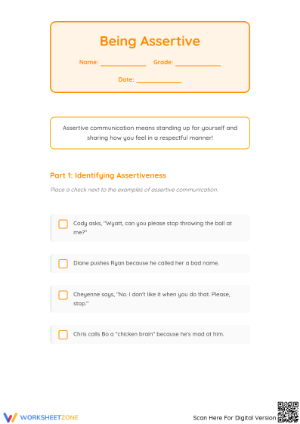
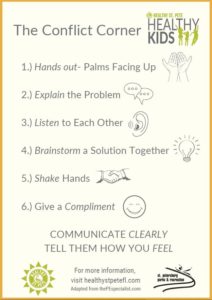
I-statement construction. Students read a conflict scenario — a group member who didn't contribute, a peer who dismissed their idea — and rewrite an impulsive reaction using the "I feel ___ when ___ because ___" structure. Each worksheet prompts students to circle their emotion word, a small design choice that pays off when scanning for the most common error in this type of exercise (addressed below).
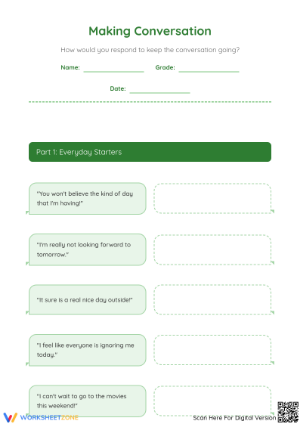
Collaborative conversation starters. Sentence-stem worksheets give students specific language for polite disagreement, negotiation, and consensus-building before they're already in the middle of a tense group moment. Students fill in the stems using a provided scenario, then compare their responses with a partner.
Errors That Surface in the Work — and What to Do About Them
The most predictable mistake across I-statement worksheets is the false I-statement. A student writes "I feel like you never include me" and considers the task done because the sentence starts with "I feel." But "I feel like" precedes an accusation, not an emotion word — the structure imitates the formula while slipping blame back in. When students follow the worksheet prompt to circle their emotion word and land on "like you never" rather than a single word, the error becomes visible immediately and is easy to address with a brief exchange or a quick whole-class share.
Paraphrasing surfaces a different problem: many students conflate staying quiet with listening. They sit attentively through a spoken prompt, then write little or nothing because they were waiting for their turn to respond rather than constructing a mental model of what the speaker meant. A two-minute class discussion about the difference between hearing and processing before the first paraphrase worksheet reduces this error noticeably — and gives students language for what active listening actually involves.
On the nonverbal cue worksheets, students consistently read a furrowed brow of concentration as anger. That specific misread is predictable enough that it's worth building into whole-class instruction the first time you run the activity: project the illustration, invite the debate, name the ambiguity out loud. Students who argue through the distinction together retain it far better than any individual written correction delivers.
How to Work These Worksheets Into the Week Without Adding a New Block
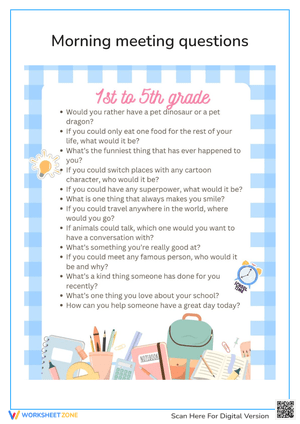
The most sustainable entry point is the morning meeting warm-up — 5 minutes, already built into a slot most classrooms have. One partner reads a short prompt aloud; the other restates it on the paraphrase worksheet. Rotating partners daily means students practice reading different communication styles, which is where the skill actually accumulates over time rather than plateauing after the first week.
Post-read-aloud time works well for nonverbal cue worksheets. After a chapter, ask students to apply the activity to a character moment: what did the character's posture or expression communicate, and did it match what they actually said? The task functions simultaneously as reading comprehension and social-emotional reflection, which makes the time easier to justify when the schedule is tight.
I-statement worksheets land differently when they follow an actual classroom friction point — not to address the specific students involved, but to give the whole class low-stakes practice with realistic scenarios right when the skill feels relevant. Distributing a scenario-based I-statement worksheet in the 10 minutes before lunch after a rough morning communicates clearly that assertive communication is a usable tool, not just a school exercise. Teachers who work 4th grade communication skills worksheets printable activities into the schedule this way — responding to real classroom moments rather than fixed calendar slots — consistently report stronger student investment than when the same worksheets appear on a random Tuesday with no social context behind them.
Standard Alignment
These worksheets align with the CASEL Relationship Skills competency, which covers establishing and maintaining healthy relationships through clear communication, active listening, and constructive conflict resolution. CASEL positions fourth grade as the stage where students shift from external rule-following toward internalized social reasoning — they are developmentally ready to reflect on their own communication patterns and consider the listener's perspective, which is exactly what the I-statement and paraphrase tasks require.
For districts that integrate SEL with language arts instruction, 4th grade communication skills worksheets printable resources targeting active listening connect directly to CCSS.ELA-LITERACY.SL.4.1, which calls for fourth graders to engage in collaborative discussions by building on others' ideas and expressing their own clearly. The paraphrase task is a direct practice vehicle for that standard's "building on others' ideas" clause — one of the harder expectations in SL.4.1 to assess through whole-class discussion alone.
Adjusting the Set for Mixed Readiness Levels
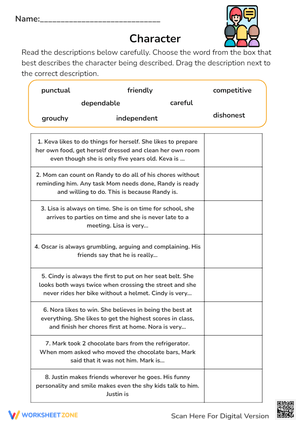
The 4th grade communication skills worksheets printable set includes built-in features that make tiered adjustments simple without requiring teachers to prepare multiple versions of the same activity. The emotion word banks printed at the top of the I-statement worksheets give students who freeze in front of a blank line specific vocabulary to scan and select from. Students who don't need the word bank simply ignore it — a clean, low-prep way to address different readiness levels within a single activity.
Students who move through the standard tasks quickly benefit from the generative extension: rather than responding to a provided scenario, they create their own conflict situation and write two responses — one reactive, one assertive. That version demands more abstract reasoning and produces writing that serves as a strong class discussion anchor. The contrast between the reactive and assertive versions often teaches the rest of the group more than the original worksheet scenario did.
For the nonverbal cue activities, students who struggle to process static illustrations often find their way into the task by physically making the expression first — forming the face, noticing the muscle tension — before labeling it. That quick kinesthetic step costs nothing and helps students connect the visual to something felt, rather than guessing from an image alone.
Frequently Asked Questions
Do these worksheets require a formal SEL curriculum to make sense?
No. Each worksheet introduces its target skill briefly and includes a worked example or model before moving into student practice. Teachers who use them without a formal SEL curriculum typically add a short class discussion — 3 to 5 minutes — before distributing the worksheet, and that context is enough for most students to engage productively. The worksheets are not a substitute for ongoing SEL instruction, but they function as solid practice tools when used independently.
How do you explain active listening to a fourth grader in a way that actually sticks?
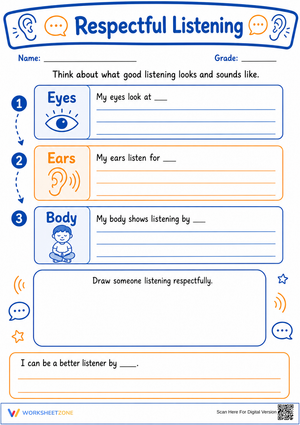
Tell students that active listening means their brain is busy while their ears are open. Give them three concrete steps: face the speaker, think about what the words actually mean rather than what you want to say next, and repeat the main idea back in your own words. The paraphrase worksheet reinforces that third step with guided practice — students who stall on the worksheet prompt almost always reveal that they skipped step two entirely.
How consistently do students need to practice before these skills carry over into real interactions?
Transfer takes longer than a single unit. Teachers who build short, frequent practice into the daily routine — rather than one longer SEL block per week — see more consistent carry-over into authentic situations. The morning warm-up rotation maintained across 4 to 6 weeks is typically enough for most students to begin reaching for the I-statement structure during actual conflicts rather than only on paper. A smaller group of students will need direct coaching alongside the worksheet practice, and that's expected and normal.