Why Communication Skills Needed in the 4th Grade Behavior Block
Communication is not a soft add-on to classroom management, it is one of the mechanisms behind it. CASEL names relationship skills, which include communication, as one of its five core social-emotional competencies, placing it on equal footing with self-management and responsible decision-making. When a fourth grader cannot express frustration, ask a clarifying question, or read a peers body language, small misunderstandings escalate into behavior referrals. Worksheets that isolate communication as its own skill give teachers a concrete artifact to point to during a behavior conversation, rather than relying on a vague reminder to use kind words.
CASEL-reviewed SEL programs are associated with roughly an 11 percent gain in academic performance alongside improved behavior, which matters for a principal or grade-level team weighing whether communication practice is worth the instructional minutes. That data point reframes communication worksheets from a nice-to-have behavior support into something that plausibly supports the same students academic growth.
What 4th Graders Should Practice
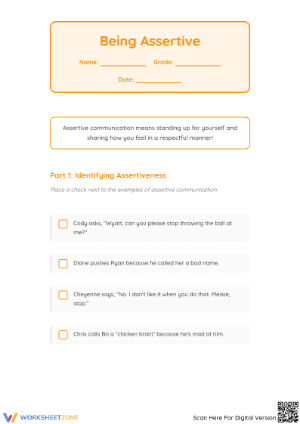
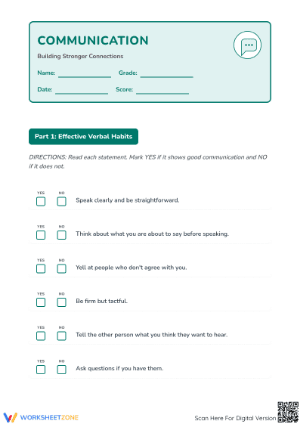
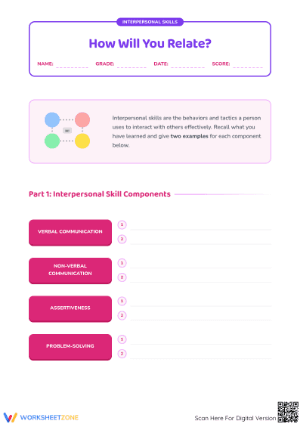
At this grade band, communication instruction should move past simple use your words prompts. Worksheets should target four specific skills: active listening with a check for understanding, turn-taking in partner or small-group talk, distinguishing assertive from passive or aggressive phrasing, and reading nonverbal cues like tone, facial expression, and posture. A strong worksheet sequence walks a student through identifying a communication style in a short scenario, then rewriting a passive or aggressive line into an assertive one. That rewrite step is what turns a worksheet from a passive reading exercise into actual skill rehearsal.
- Active listening with a paraphrase or check-back step
- Turn-taking language for partner and small-group discussion
- Assertive versus passive or aggressive phrasing practice
- Nonverbal cue identification tied to a written scenario
Pairing Worksheets With Role-Play and Peer Feedback
A worksheet alone teaches recognition, not performance. Once students complete a scenario worksheet, have them act out the corrected version with a partner, then use a short peer feedback sentence starter such as I noticed you or I liked how you. This two-step pattern, worksheet first and role-play second, gives students a chance to apply what they identified on paper in a live exchange, which is where communication skills actually get tested. For students who are hesitant to perform in front of peers, a small-group pull-out setting works just as well as a whole-class one.
Classroom Implementation
Communication worksheets work best on a predictable schedule rather than as an occasional filler activity. Many 4th grade teachers build them into morning meeting two to three times a week, or into a 15 to 20 minute advisory block, so that students expect and recognize the routine. For small-group pull-out settings, a single scenario worksheet paired with a two-minute role-play fits comfortably into a 20 minute session. Keep a simple tracking sheet of which skill, such as active listening or assertive phrasing, was the focus each week so the sequence builds instead of repeating the same lesson.
Frequently Asked Questions
1. How should teachers use these worksheets in a 4th grade classroom
Use them during morning meeting, advisory, or a dedicated behavior block, pairing each worksheet with a short role-play so students practice the skill out loud, not just on paper.
2. What communication skills should a 4th grader be practicing
Focus on active listening with a check for understanding, turn-taking in discussion, assertive versus passive or aggressive phrasing, and reading nonverbal cues like tone and facial expression.
3. How can these worksheets support students with social skills IEP goals
The scenario, response, and rewrite structure gives a case manager a ready-made, low-prep way to target relationship-skills goals and collect work samples for progress monitoring.
4. How often should communication skills worksheets be used each week
Two to three sessions a week, each 15 to 20 minutes, is enough to build a recognizable routine without crowding out core academic instruction.
















 Interactive Worksheet Maker
 Quiz Maker
 Word Search Maker
 Crossword Puzzle Maker
 Word Scramble Generator
 Sentence Scramble Generator
 Handwriting Worksheet Generator
 Name Tracing Generator
 Fill In The Blank Generator