




























Views
Downloads
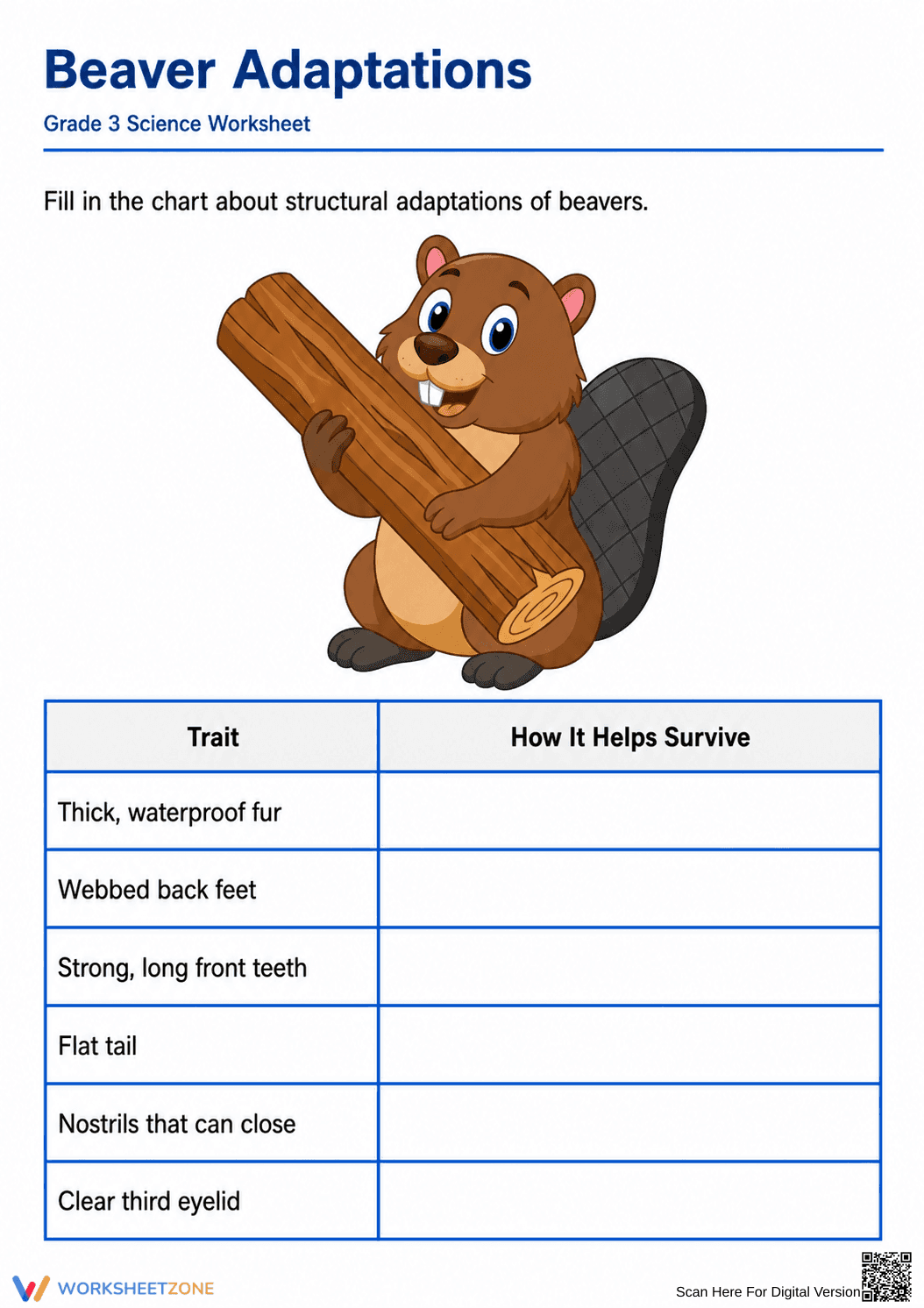
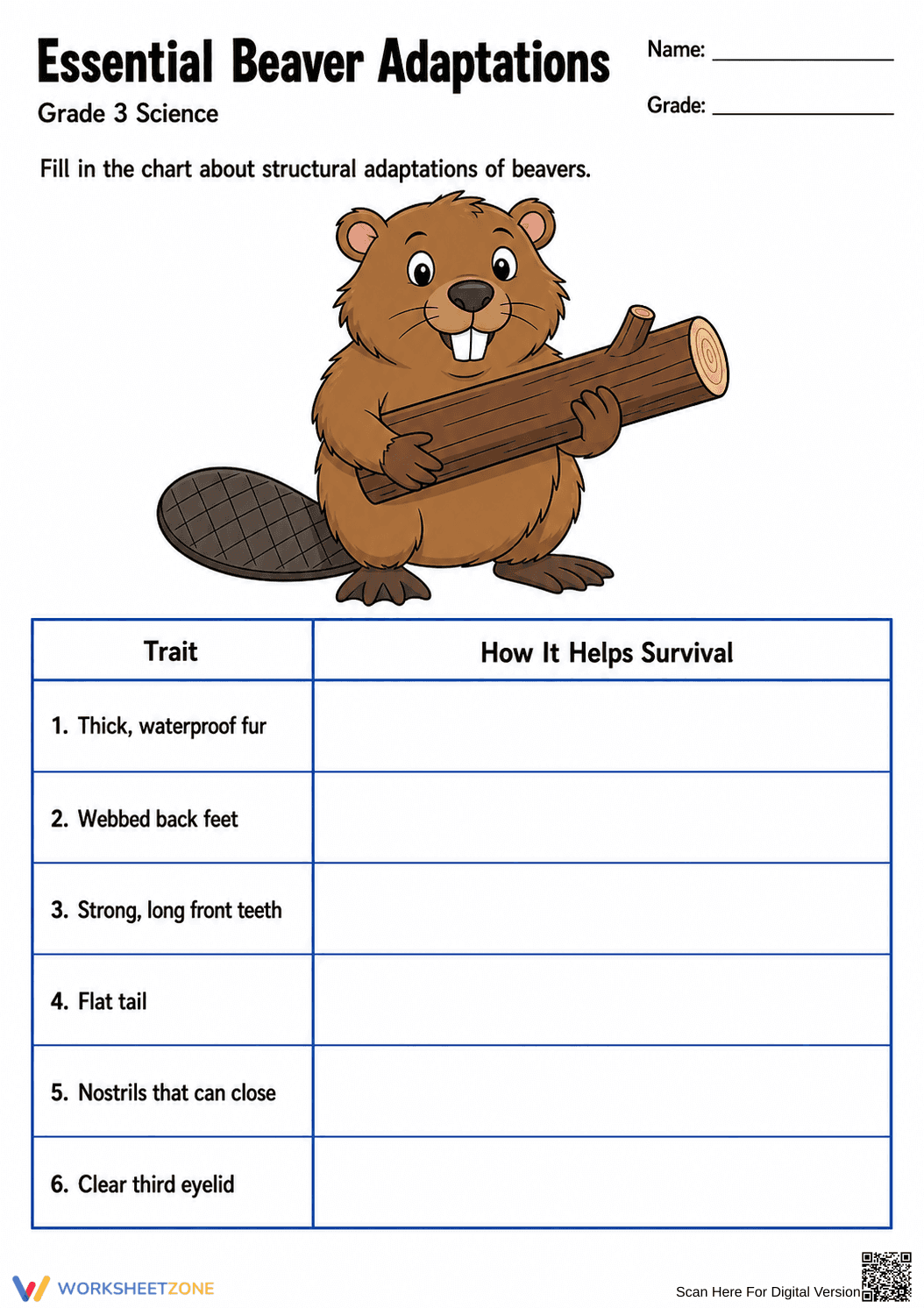

Grade 3 Beaver Adaptations — Printable No-Prep Worksheet

Paste this activity's link or code into your existing LMS (Google Classroom, Canvas, Teams, Schoology, Moodle, etc.).
Students can open and work on the activity right away, with no student login required.
You'll still be able to track student progress and results from your teacher account.
This Grade 3 science worksheet helps students identify and explain the structural adaptations of beavers that ensure their survival. By analyzing six specific physical traits—from waterproof fur to webbed feet—students connect physical characteristics to biological functions. This printable resource provides a structured way to master essential life science concepts.
At a Glance
- Grade: 3 · Subject: Science
- Standard:
3-LS4-3— Explain how organism variations provide survival advantages- Skill Focus: Structural adaptations and survival functions
- Format: 2 pages · 6 problems · PDF
- Best For: Independent practice or formative assessment
- Time: 15–20 minutes
This resource contains a two-page PDF featuring a high-quality illustration of a beaver holding a log, accompanied by a structured graphic organizer. The worksheet lists six key physical traits, providing dedicated space for students to write descriptions of how each trait aids the animal's survival. The clean layout makes the task highly accessible for young learners.
The zero-prep workflow for this resource is designed for maximum teacher efficiency, requiring under two minutes of setup. First, print the single-page student chart (30 seconds). Second, distribute the worksheets for a 15-minute independent session where students use prior knowledge, classroom texts, or group discussion to complete the analysis. Third, review the responses as a whole-class check to ensure comprehension (5 minutes). This straightforward format makes it an excellent, reliable option for a substitute teacher plan.
This worksheet is aligned to 3-LS4-3: Construct an argument with evidence that in a particular habitat some organisms can survive well. Students provide the specific evidence needed to support an argument about a beaver's fitness for its environment. Both standard codes can be copied directly into lesson plans, IEP goals, or district curriculum mapping tools.
Use this worksheet as a mid-lesson check after introducing the concept of physical adaptations and habitat suitability. Alternatively, assign it as a meaningful exit ticket to gauge individual student understanding of how specific body parts function to aid survival. Teachers should observe whether students can clearly distinguish between a physical trait (like a flat tail) and its actual survival purpose (like swimming efficiency or communication). Expected completion time ranges from 15 to 20 minutes.
This worksheet is ideal for third-grade students during a comprehensive life science unit on ecosystems, habitats, or animal behavior. The clear, uncluttered layout supports diverse learners, including those needing visual cues to anchor their thinking. It pairs naturally with a non-fiction reading passage about North American mammals, a classroom anchor chart on structural adaptations, or a short video clip demonstrating beavers building a dam in the wild.
According to the RAND AIRS 2024 report on elementary science instruction, utilizing structured graphic organizers like this beaver adaptations chart significantly improves student retention of domain-specific vocabulary. By requiring students to articulate the reasoning behind a physical trait, this worksheet moves beyond simple identification toward higher-order biological reasoning. Aligned to the 3-LS4-3 standard, the activity focuses on the plain-English skill of explaining how organism variations provide survival advantages. This targeted practice ensures that learners can evidence-base their claims about habitat suitability, a cornerstone of inquiry-based science education. Such scaffolding is essential for developing the analytical frameworks necessary for later investigations into natural selection. This resource serves as a ready-to-use tool that bridges the gap between observing nature and understanding biological adaptation.


