


























Views
Downloads
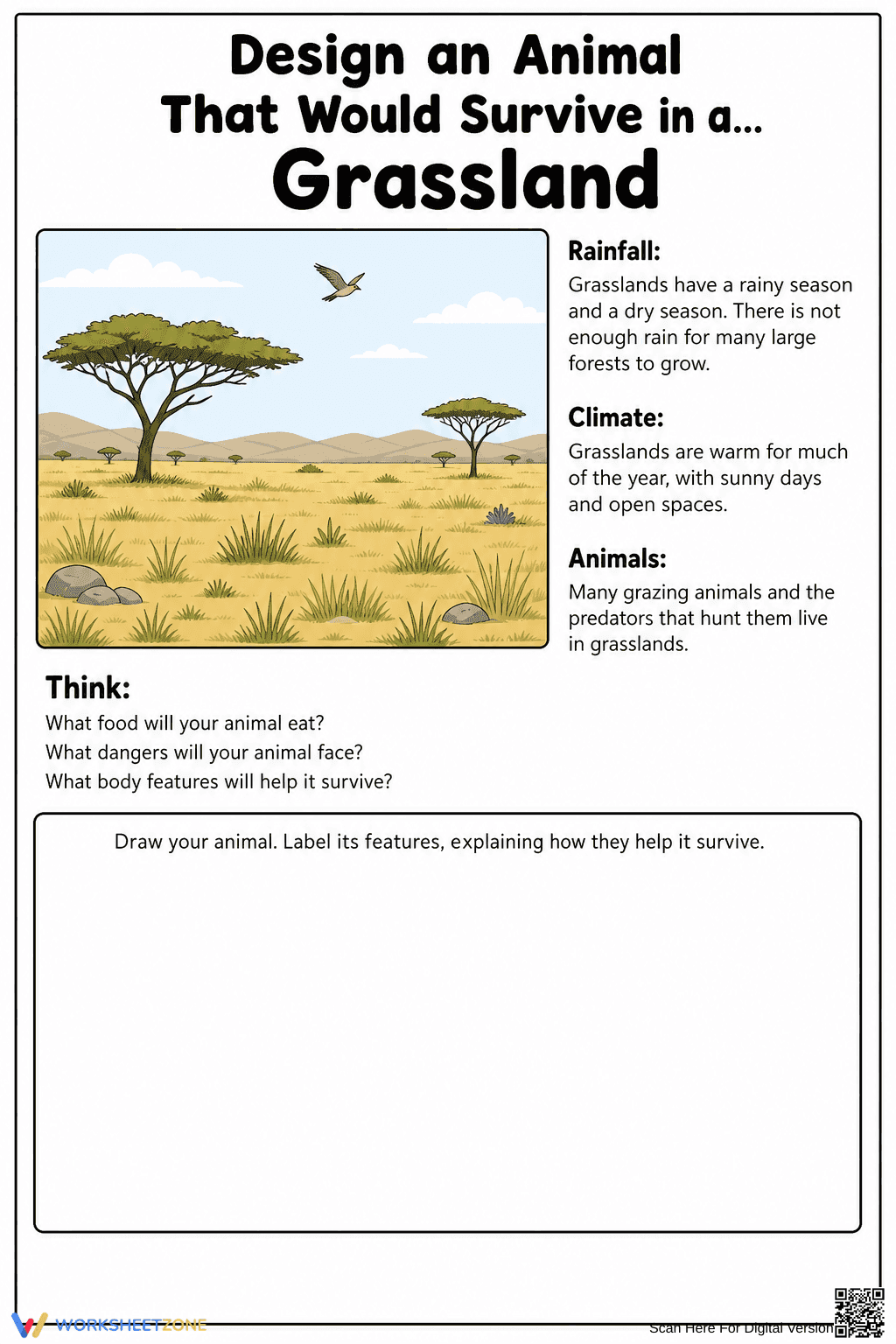

Grade 4 Animal Adaptations — Printable No-Prep Worksheet
Paste this activity's link or code into your existing LMS (Google Classroom, Canvas, Teams, Schoology, Moodle, etc.).
Students can open and work on the activity right away, with no student login required.
You'll still be able to track student progress and results from your teacher account.
This Grade 4 science worksheet prompts students to design a custom animal adapted for survival in a grassland habitat. By reading brief environmental facts and applying that knowledge to a creative drawing task, learners actively demonstrate their understanding of how physical traits support animal survival.
At a Glance
- Grade: 4 · Subject: Science
- Standard:
4-LS1-1— Explain how physical structures support animal survival- Skill Focus: Animal adaptations and habitats
- Format: 1 page · 1 task · No answer key · PDF
- Best For: Independent practice or science centers
- Time: 20–30 minutes
Inside this single-page resource, students find a concise informational text block detailing the rainfall, climate, and typical wildlife of a grassland ecosystem. Three guiding questions prompt critical thinking about diet, predators, and necessary physical features. The bottom half provides a blank workspace where students draw their original creature and label its specific adaptations, explaining how each trait helps the animal thrive.
This resource is designed for immediate classroom implementation with a highly efficient zero-prep workflow:
- Print (1 minute): Download the PDF and print a class set.
- Distribute (1 minute): Hand out the page during your science block. Instructions are self-explanatory, requiring no complex teacher setup.
- Review (3 minutes): Walk the room as students draw, asking them to verbally defend their design choices.
With under two minutes of total teacher prep time, this activity is an excellent addition to any emergency sub plan.
This activity is directly aligned to 4-LS1-1: Construct an argument that plants and animals have internal and external structures that function to support survival. By requiring students to label their animal's features and explain their survival function, the task provides clear evidence of this standard. Both standard codes can be copied directly into lesson plans, IEP goals, or district curriculum mapping tools.
Teachers can utilize this worksheet as a formative assessment after direct instruction on biomes and adaptations. Once students understand basic survival traits, this task allows them to synthesize their knowledge creatively. Alternatively, use it as an engaging science center activity. While circulating, teachers should observe whether students connect specific environmental challenges—like low rainfall—to logical physical traits, such as water storage. Expected completion time ranges from 20 to 30 minutes.
This resource is designed for fourth-grade science students, though it scales down to third grade or up to fifth grade depending on required explanation depth. For students needing extra support, teachers can provide a word bank of common adaptations (e.g., camouflage, hooves) to guide their labeling. It pairs perfectly with an introductory anchor chart on grassland ecosystems.
Integrating creative design tasks into science instruction significantly enhances student retention of complex biological concepts. When students actively apply knowledge of environmental constraints to construct their own models, they develop a deeper understanding of ecological relationships. This worksheet aligns with 4-LS1-1, requiring learners to explain how physical structures support animal survival. According to a recent EdReports 2024 analysis of high-quality instructional materials, science tasks that blend informational text with open-ended, creative application yield higher engagement and better formative assessment data than traditional multiple-choice formats. By asking students to justify their design choices with evidence from the provided text, this resource bridges the gap between rote memorization and critical scientific thinking. The open-ended nature of the drawing and labeling task ensures that students of varying ability levels can successfully demonstrate mastery of the core standard.


