


























Views
Downloads


Animal Adaptations Worksheet | Essential Grade 3 Science
Paste this activity's link or code into your existing LMS (Google Classroom, Canvas, Teams, Schoology, Moodle, etc.).
Students can open and work on the activity right away, with no student login required.
You'll still be able to track student progress and results from your teacher account.
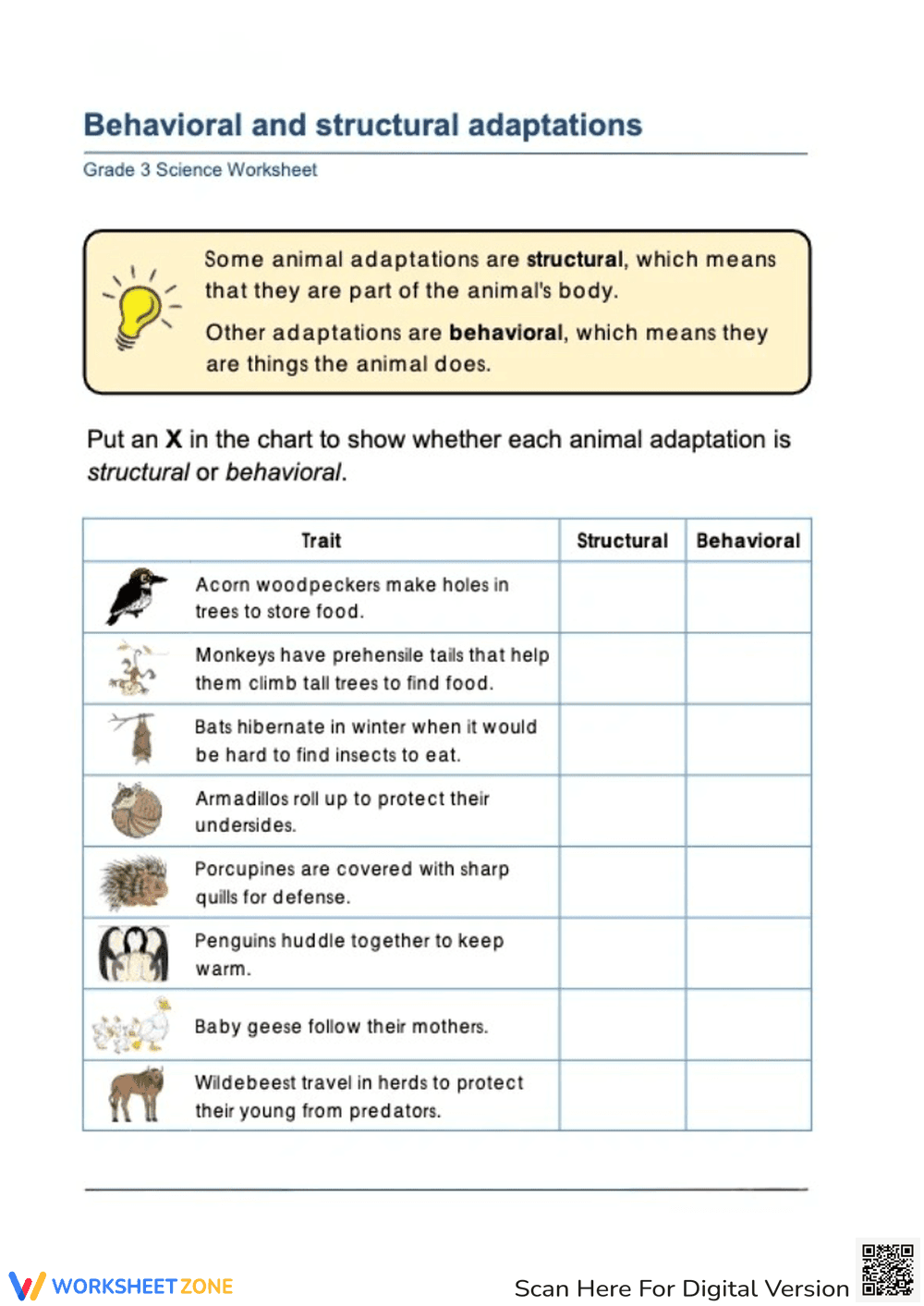
This Grade 3 science worksheet helps students master the difference between structural and behavioral animal adaptations. By classifying eight unique traits—from a monkey's prehensile tail to a bat's hibernation—learners build a foundation in life sciences. This activity provides immediate clarity on how physical features and actions support survival in diverse habitats.
At a Glance
- Grade: 3 · Subject: Science
- Standard:
3-LS4-2— Use evidence to explain how variations in animal characteristics support survival and reproduction- Skill Focus: Structural vs Behavioral Adaptations
- Format: 2 pages · 8 problems · Answer key included · PDF
- Best For: Independent science practice or formative assessment
- Time: 15–20 minutes
This two-page PDF resource features a clear, definitions-first layout designed for student independence. The first page defines structural adaptations as body parts and behavioral adaptations as animal actions. Below, an eight-row chart challenges students to analyze traits—such as porcupine quills or penguin huddling—and mark the correct category. A full answer key is provided on page two.
Zero-Prep Workflow
Integrating this resource into your science block is effortless. First, print the single-sided worksheet (30 seconds). Second, distribute the pages as a "quick check" following your survival traits lesson (1 minute). Finally, use the answer key to review results or allow student self-correction (1 minute). This streamlined approach makes it ideal for emergency sub plans or low-prep science stations.
Standards Alignment
This worksheet is strictly aligned to 3-LS4-2, which requires students to use evidence to construct explanations for how variations in characteristics provide advantages for survival. By distinguishing between physical structures and behavioral patterns, students satisfy the core requirements of life science structures and functions. This standard code can be copied directly into lesson plans or curriculum mapping tools.
How to Use It
Deploy this worksheet as a summative assessment at the conclusion of an "Animal Survival" unit to verify that students can differentiate between what an animal has versus what it does. Alternatively, use it as a collaborative sorting activity where pairs discuss the evidence for each classification. Observe whether students can explain why hibernation is behavioral while a tail is structural to gauge understanding.
Who It's For
This resource is crafted for third-grade students exploring the Next Generation Science Standards (NGSS), though it is highly appropriate for fourth-grade review. The use of clear animal illustrations and simplified definitions makes it accessible for English Language Learners (ELL) and students requiring literacy scaffolds. Pair this with a local habitat video or an anchor chart for a comprehensive science experience.
The differentiation between structural and behavioral adaptations is a fundamental component of K-5 life science literacy, as highlighted in the RAND AIRS 2024 analysis of elementary curriculum effectiveness. Research from Fisher & Frey (2014) emphasizes that classifying traits using evidence-based reasoning, as required by the 3-LS4-2 standard, significantly improves long-term retention of biological concepts. This worksheet provides the structured classification practice necessary for students to bridge the gap between simple observation and scientific explanation. By engaging with eight distinct animal examples, learners develop the cognitive frameworks required for more complex ecosystem modeling in later grades. The inclusion of a clear answer key ensures that formative feedback is immediate, a practice that EdReports 2024 identifies as a critical driver for student mastery in science education.


