


























Views
Downloads

Essential Grade 3 Adaptations Worksheet | Printable
Paste this activity's link or code into your existing LMS (Google Classroom, Canvas, Teams, Schoology, Moodle, etc.).
Students can open and work on the activity right away, with no student login required.
You'll still be able to track student progress and results from your teacher account.
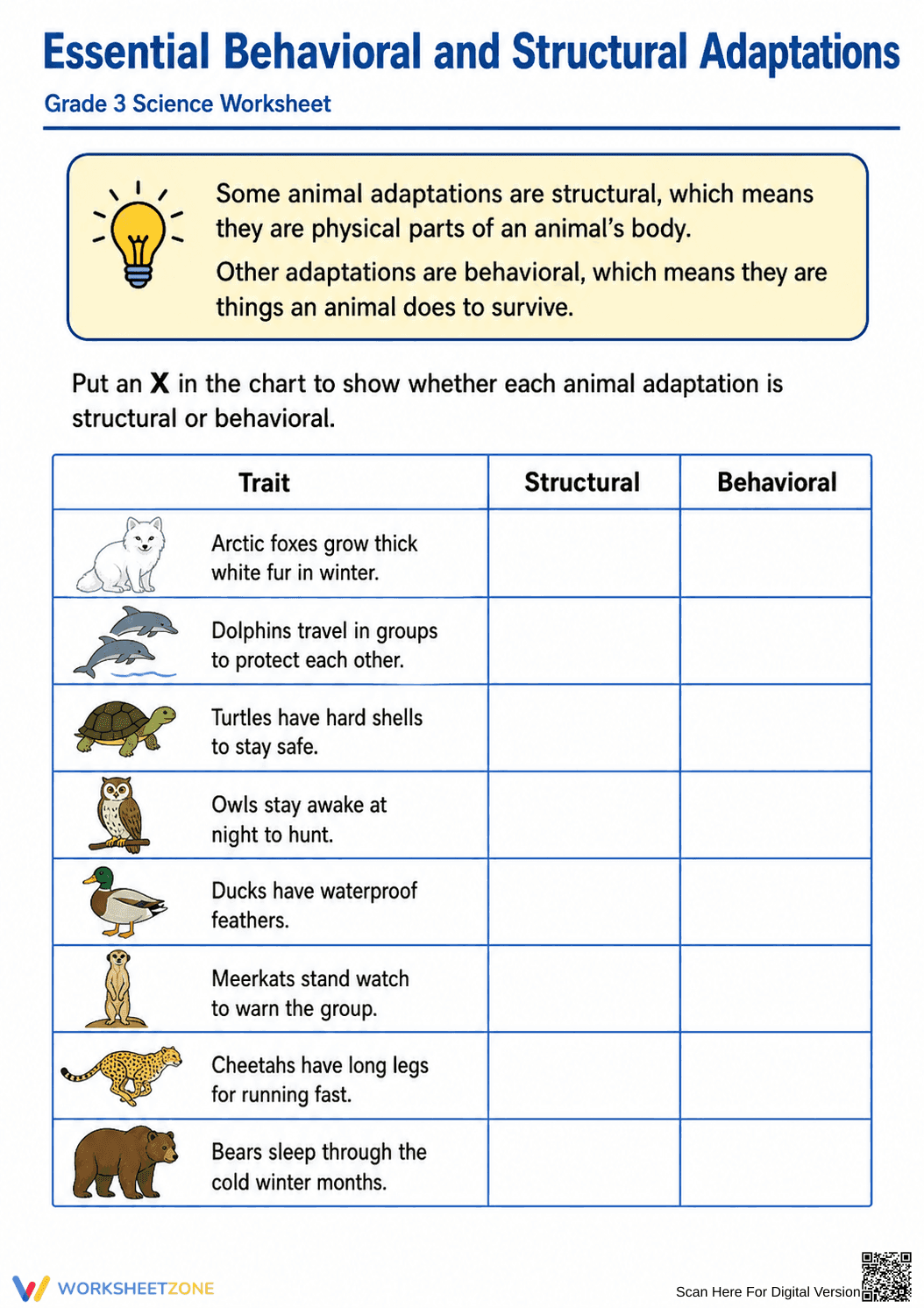
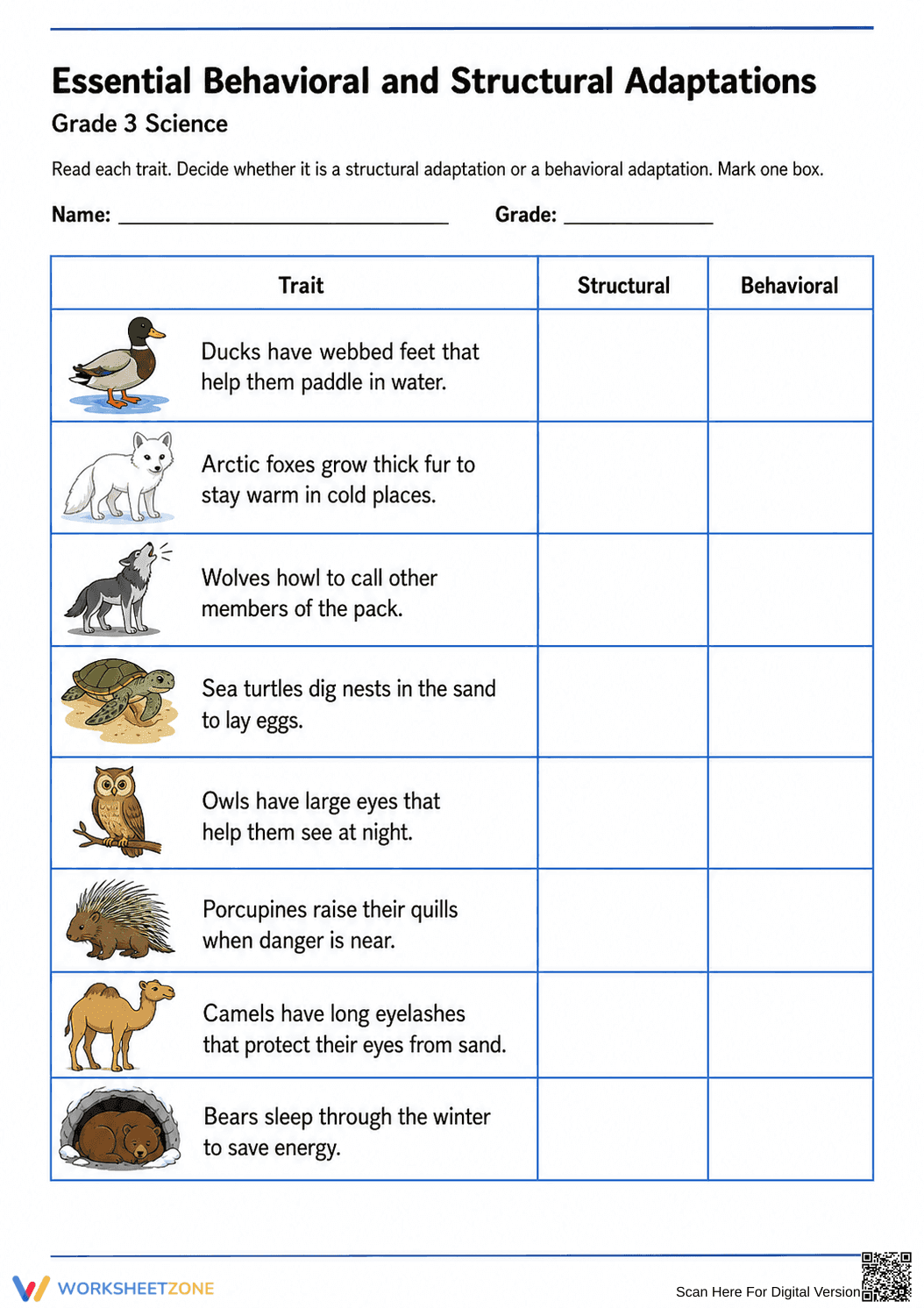
Students identify and categorize animal traits to understand how physical features and behaviors support survival in various environments. This Grade 3 science resource provides immediate practice in distinguishing between structural and behavioral adaptations using real-world examples like arctic foxes and meerkats. It ensures learners can provide evidence for biological arguments.
At a Glance
- Grade: 3 · Subject: Science
- Standard:
3-LS4-3— Construct an argument with evidence that organisms have traits that help survival- Skill Focus: Structural vs Behavioral Adaptations
- Format: 2 pages · 16 problems · Answer key included · PDF
- Best For: Independent science practice and formative assessment
- Time: 15–20 minutes
This two-page PDF resource includes a focused student worksheet and a comprehensive answer key. The first page features a clear definition box to front-load vocabulary, followed by a classification chart. Students analyze 16 distinct animal traits—such as a turtle's hard shell or a wolf's howl—and mark whether the adaptation is a physical body part or a specific action.
The instructional workflow is designed for maximum efficiency: Print the two-page set (30 seconds), Distribute to students for independent or partner work (30 seconds), and Review using the provided answer key (1 minute). This zero-prep structure makes it an ideal choice for emergency sub plans or a quick check for understanding during a busy science block.
This resource aligns directly with 3-LS4-3: "Construct an argument with evidence that in a particular habitat some organisms can survive well, some survive less well, and some cannot survive at all." By identifying specific traits, students gather the evidence needed to support claims about survival. Both standard codes can be copied directly into lesson plans, IEP goals, or district curriculum mapping tools.
Assign this worksheet as a formative assessment immediately following a lesson on animal habitats. It serves as a concrete way to verify that students can apply definitions to new examples. During the activity, walk around and observe students as they categorize the "bears sleeping" or "meerkat standing watch"; those who hesitate may need a quick reminder that behaviors are actions.
This resource is tailored for Grade 3 students but works well for Grade 4 review or Grade 2 enrichment. The inclusion of clear animal illustrations supports English Language Learners (ELLs) by providing visual context for the text. Pair this worksheet with a short reading passage about specific biomes to deepen the connection between traits and environments.
The classification of animal characteristics into structural and behavioral categories is a fundamental step in developing biological literacy and ecological reasoning. According to Fisher & Frey (2014), the use of scaffolded practice tools like this chart helps students move from simple identification to the complex argumentation required by standards like 3-LS4-3. By evaluating 16 distinct survival mechanisms—such as the structural talons of a hawk or the behavioral sun-basking of a lizard—students build the evidence-based mindset necessary for higher-order science inquiries. Research indicates that clear categorical definitions combined with immediate application tasks significantly improve long-term retention of scientific vocabulary and concepts. This worksheet serves as a reliable classroom artifact for documenting student progress toward mastery in the life sciences, providing the data needed for IEP progress notes or district-level curriculum reporting while ensuring that students remain engaged with real-world biological examples.


