


























Views
Downloads

Essential Animal Adaptations Worksheet | Grade 2-3
Paste this activity's link or code into your existing LMS (Google Classroom, Canvas, Teams, Schoology, Moodle, etc.).
Students can open and work on the activity right away, with no student login required.
You'll still be able to track student progress and results from your teacher account.
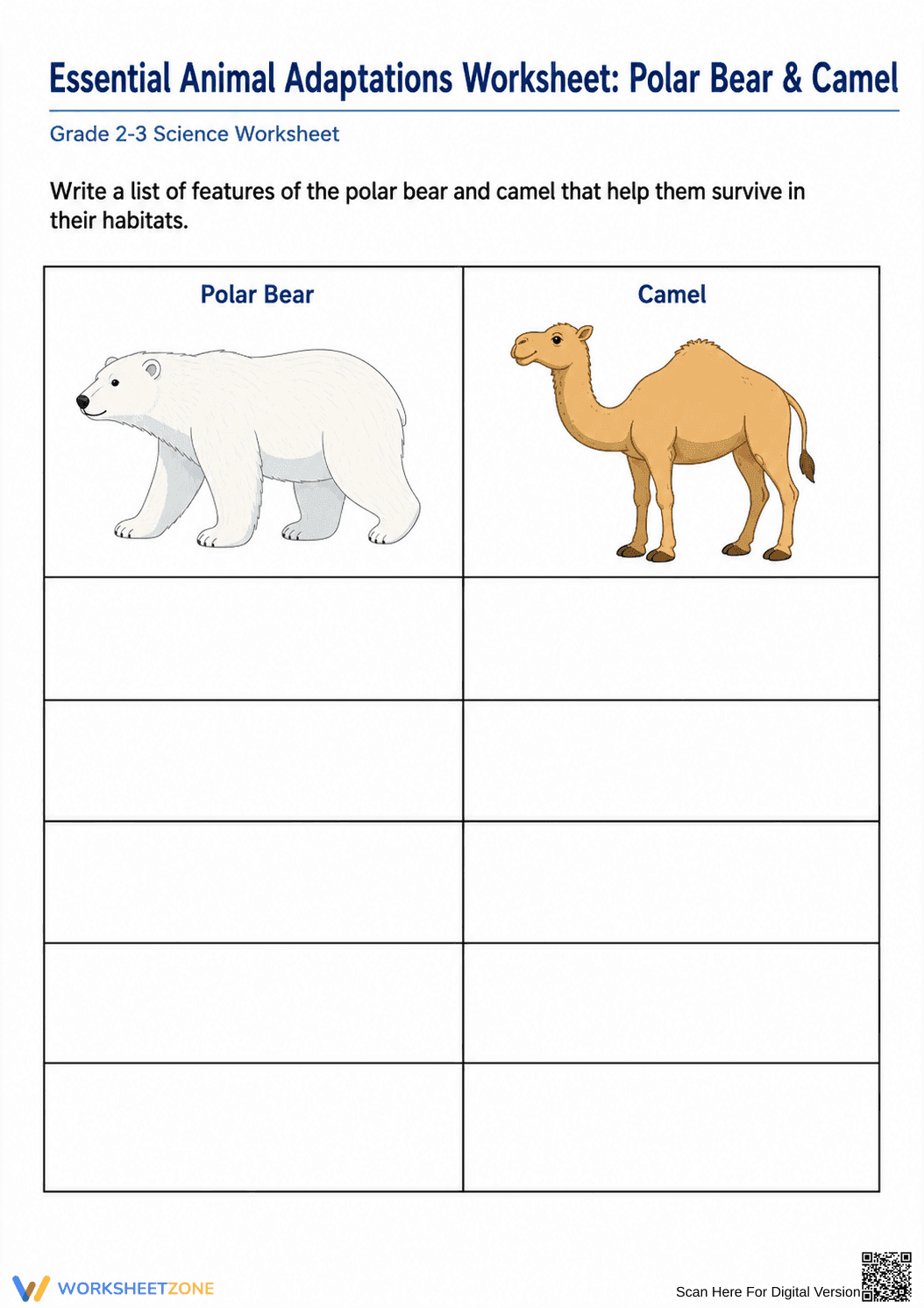
This Grade 2-3 science worksheet helps students identify and analyze specific structural adaptations that enable survival in diverse habitats. By comparing the contrasting features of the polar bear and the camel, learners develop a concrete understanding of how biological structures serve functional needs. Students move beyond simple identification to explain the logic behind each physical trait.
At a Glance
- Grade: 2–3 · Subject: Science
- Standard:
3-LS4-3— Construct an argument with evidence that organisms survive in specific habitats- Skill Focus: Structural adaptations for survival
- Format: 2 pages · 10 problems · Answer key included · PDF
- Best For: Independent practice or formative science assessment
- Time: 15–20 minutes
What's Inside
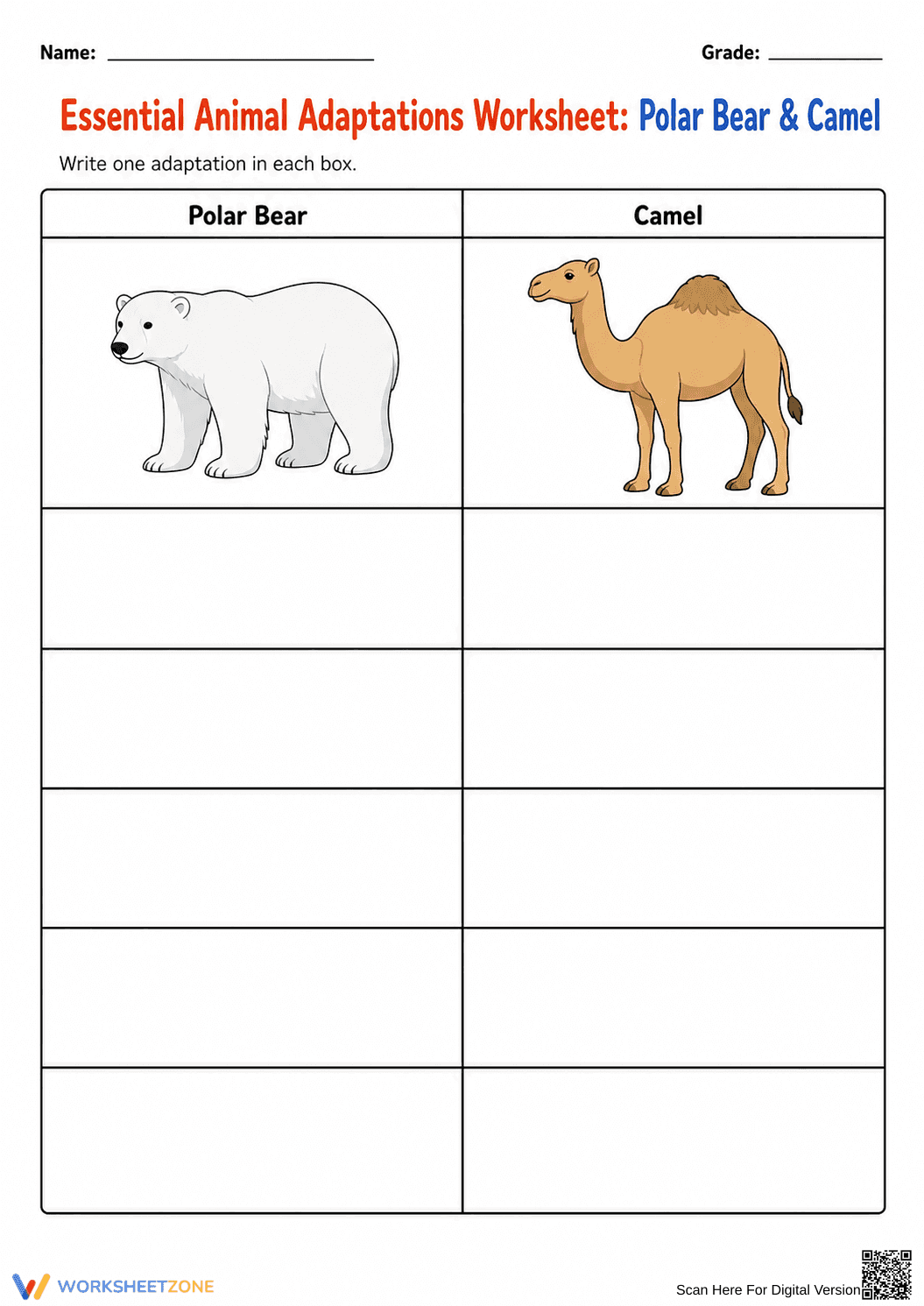
Includes a two-page PDF featuring a focused worksheet and a comprehensive answer key. The primary task utilizes a dual-column table, providing space for students to list five distinct features for both the polar bear and the camel. High-quality illustrations act as visual anchors, while the structured rows ensure students provide multiple pieces of evidence for their survival arguments.
Zero-Prep Workflow
The zero-prep workflow involves three simple steps: Print (30 seconds), Distribute (1 minute), and Review (5 minutes). With a total teacher preparation time under two minutes, it serves as an ideal solution for emergency sub plans. The self-contained nature of the table allows students to work independently without the need for additional textbook references or complex laboratory setup.
Standards Alignment
Aligned to 3-LS4-3, students construct an argument with evidence that in a particular habitat organisms survive well, while others cannot. It targets the evidence component by having students catalog the physical traits necessary for survival in extreme climates. Both standard codes can be copied directly into lesson plans, IEP goals, or district curriculum mapping tools.
How to Use It
Use this worksheet as a mid-lesson check for understanding after introducing the concept of habitats. For a formative assessment observation, walk around and note if students can connect the hump to fat storage or thick fur to insulation. It also functions well as a closing ticket, taking approximately 15 minutes for students to complete their 10-point analysis of animal traits.
Who It's For
This resource is designed for students in Grades 2 and 3, but can be adapted for Grade 1 with teacher support. It provides natural differentiation for English Language Learners through visual cues and a predictable structure. Pair this worksheet with a short non-fiction passage about biomes or an anchor chart detailing cold versus hot climates.
This science resource focuses on the fundamental biological concept of adaptation, specifically how structural features facilitate survival in extreme environments like the Arctic and Sahara. By comparing the polar bear’s thick fur with the camel’s fat-storing humps, students engage in evidence-based reasoning aligned to 3-LS4-3. This instructional approach aligns with findings from EdReports (2024), which emphasizes the importance of using concrete examples to build foundational understanding of life science systems in elementary grades. The worksheet requires students to identify 10 distinct survival traits, promoting a deep analysis of how morphology meets physiological needs. This structured comparison helps bridge the gap between simple observation and the more complex evolutionary concepts introduced later. The clear, tabular format provides a scaffolded environment where learners can organize their thoughts and prepare for scientific discourse regarding habitat-specific survival strategies and biological diversity.


