


























Views
Downloads
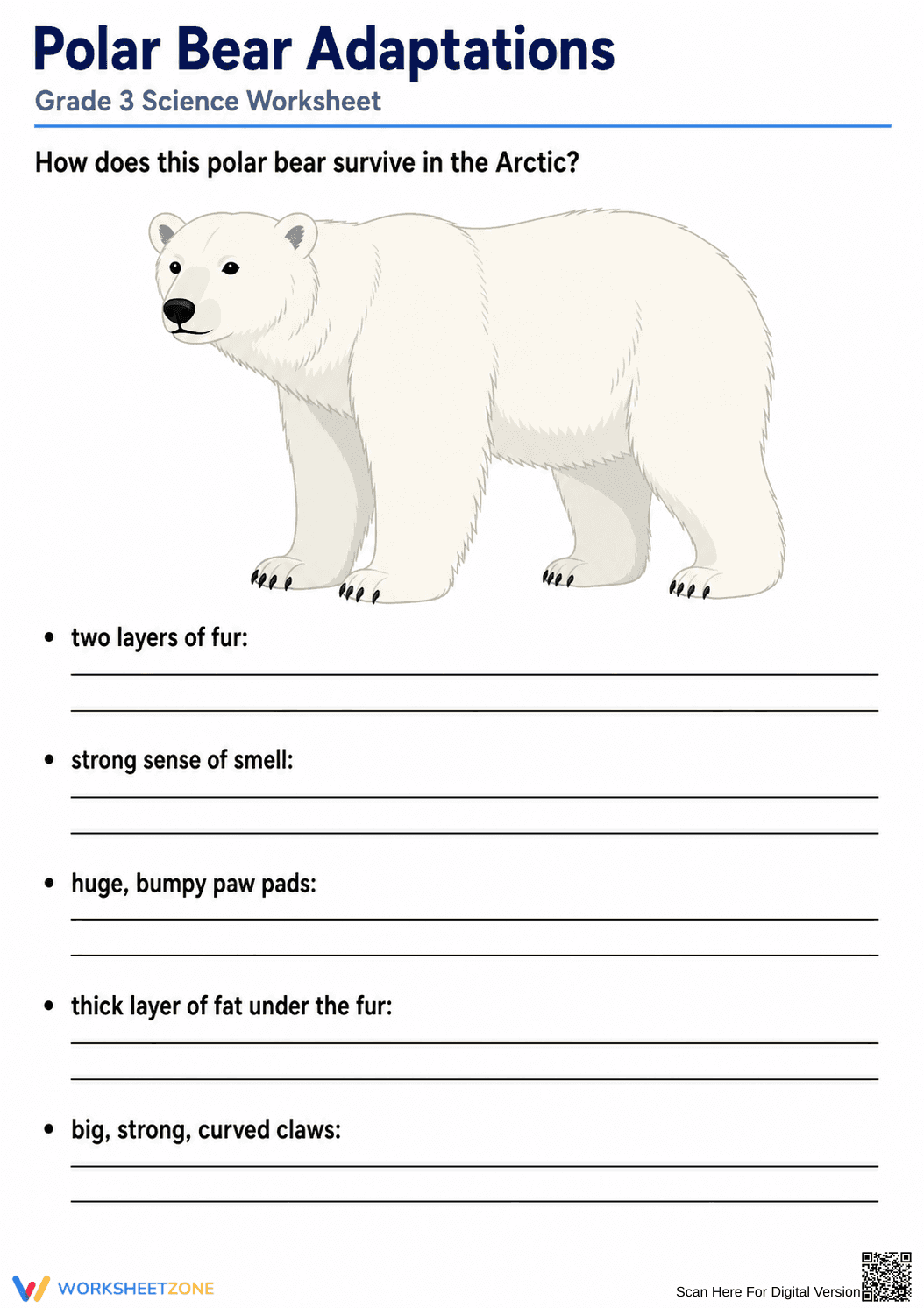
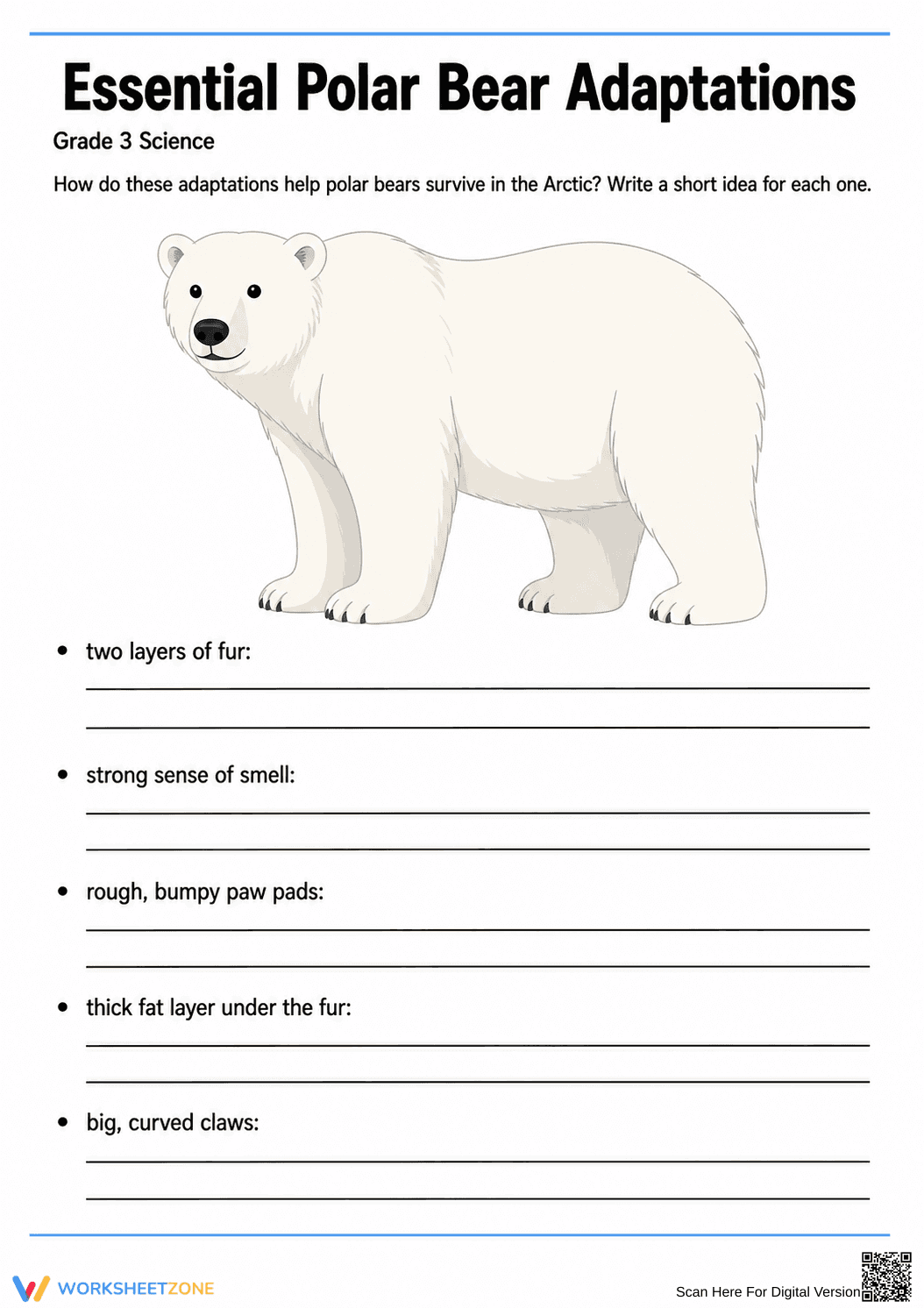

Essential Polar Bear Adaptations Worksheet | Grade 3 Science
Paste this activity's link or code into your existing LMS (Google Classroom, Canvas, Teams, Schoology, Moodle, etc.).
Students can open and work on the activity right away, with no student login required.
You'll still be able to track student progress and results from your teacher account.
Students explore the fascinating world of arctic survival with this focused science worksheet. By analyzing specific physical traits of polar bears, learners connect biological characteristics to environmental advantages. This activity strengthens critical thinking and scientific observation skills, ensuring students understand how organisms thrive in extreme habitats through evolved specialized features and behaviors.
At a Glance
- Grade: 3 · Subject: Science
- Standard:
3-LS4-3— Construct an argument that in a particular habitat organisms can survive well- Skill Focus: Animal Adaptations & Survival
- Format: 2 pages · 5 problems · Answer key included · PDF
- Best For: Independent practice or quick formative assessment
- Time: 15–20 minutes
What's Inside
This resource features a high-quality illustration of a polar bear paired with five specific inquiry prompts. Over two pages, including a comprehensive answer key, students investigate five distinct adaptations: two layers of fur, a strong sense of smell, bumpy paw pads, a thick fat layer, and curved claws. The layout provides ample writing space for students to explain the survival benefit of each observed characteristic.
Skill Progression
- Guided Practice: Students observe the central visual of the polar bear to identify physical traits.
- Supported Practice: Five specific prompts provide the "what," requiring students to determine the "why" for each adaptation.
- Independent Practice: Learners synthesize their knowledge to explain how these traits ensure survival in the Arctic.
This follows a gradual-release model to build scientific reasoning and evidence-based argumentation.
Standards Alignment
This worksheet aligns directly with `3-LS4-3`: "Construct an argument with evidence that in a particular habitat some organisms can survive well, some survive less well, and some cannot survive at all." By identifying how specific traits help the polar bear, students provide the evidence required for this performance expectation. This standard code can be copied directly into lesson plans, IEP goals, or district curriculum mapping tools.
How to Use It
Incorporate this worksheet immediately after a direct instruction session on arctic environments. It serves as an excellent formative assessment tool; observe if students can differentiate between thermal insulation and hunting tools. Expected completion time is approximately 20 minutes, making it perfect for a science center rotation. You might also pair it with a short video clip showing polar bears in their natural habitat to provide additional visual context.
Who It's For
This activity is tailored for third-grade students beginning their journey into life sciences and environmental biology. It is accessible for various learners, with clear bullet points and a central visual anchor that supports English Language Learners and students with specific learning needs. It pairs naturally with non-fiction passages about the Arctic or an anchor chart detailing different types of animal adaptations across various global biomes.
Biological science education research emphasizes the importance of connecting observable traits to functional survival outcomes. According to Fisher & Frey (2014), the use of scaffolded inquiry in science—such as identifying specific adaptations like the 3-LS4-3 standard requires—helps students build robust mental models of ecological relationships. This worksheet facilitates that process by focusing on five key attributes that allow the polar bear to dominate its icy environment. By moving from the "what" (bumpy paw pads) to the "why" (preventing slipping on ice), students engage in higher-order thinking that transcends simple identification. This resource provides a reliable bridge between introductory habitat concepts and the more complex evolutionary biology taught in later grades. Educators can use these five data points to measure mastery of NGSS evidence-based argumentation, ensuring that every student understands the vital link between an organism’s physical form and its ability to persist in a challenging climate.


