


























Views
Downloads
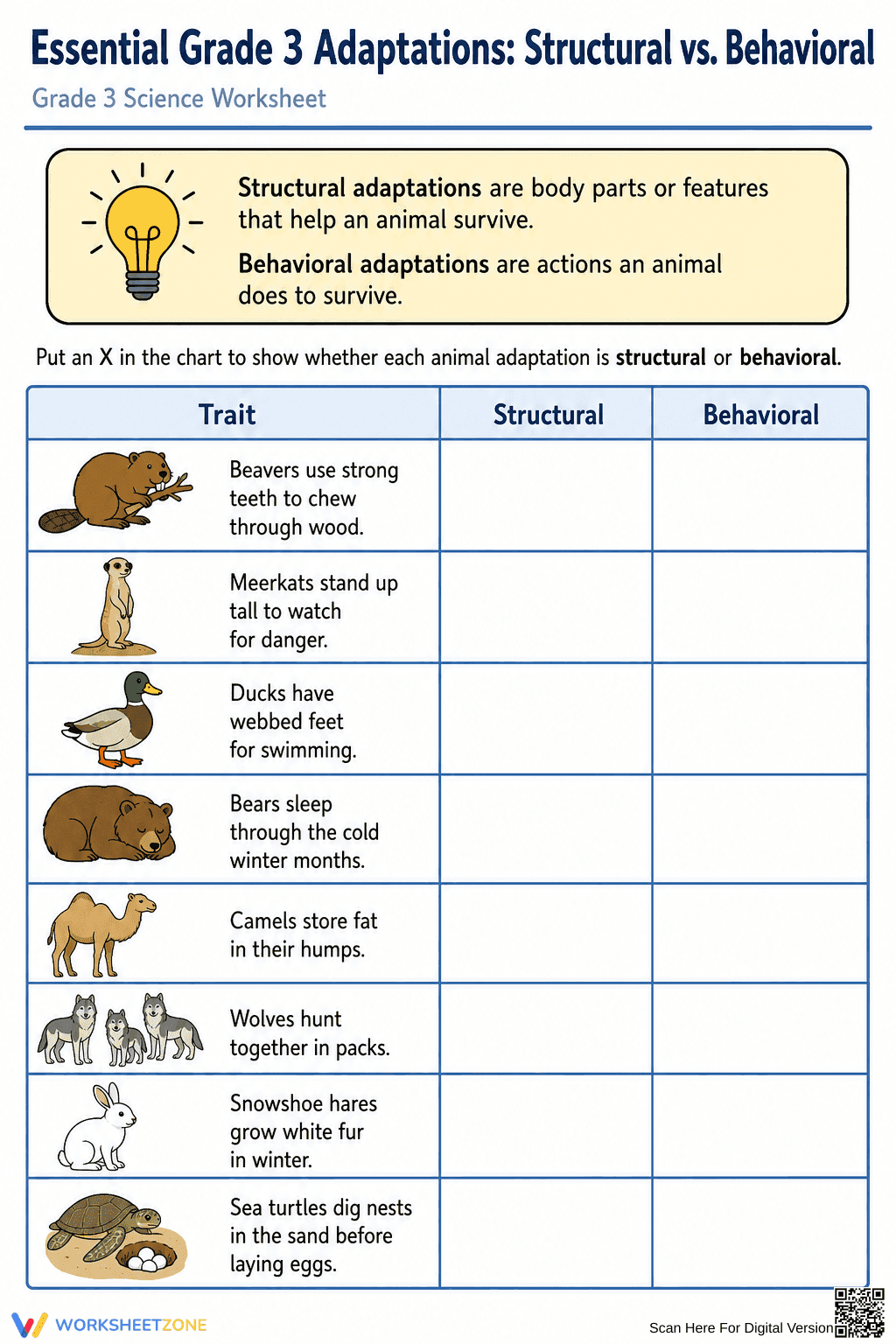

Grade 3 Animal Adaptations — Printable No-Prep Worksheet
Paste this activity's link or code into your existing LMS (Google Classroom, Canvas, Teams, Schoology, Moodle, etc.).
Students can open and work on the activity right away, with no student login required.
You'll still be able to track student progress and results from your teacher account.
This Grade 3 science worksheet helps students master the distinction between structural and behavioral adaptations through active classification. Students analyze specific animal traits to determine if they are physical body parts or learned actions, ensuring they can identify how different organisms survive in their environments.
At a Glance
- Grade: 3 · Subject: Science
- Standard:
3-LS4-2— Explain how variations in characteristics provide survival advantages- Skill Focus: Classifying Structural vs. Behavioral Adaptations
- Format: 1 page · 8 problems · Answer key included · PDF
- Best For: Independent practice or science centers
- Time: 10–15 minutes
What's Inside
This focused one-page resource features clear, concise definitions of structural and behavioral adaptations at the top, supported by a visual lightbulb icon. Below, a clean eight-row chart presents specific animal examples—ranging from beaver teeth to bear hibernation—with check-box columns for easy student classification and rapid teacher grading. A complete answer key is included.
Zero-Prep Workflow
- Step 1: Print (1 minute) — Select the single-page PDF and print enough copies for your science block.
- Step 2: Distribute (1 minute) — Hand out the worksheets as students transition to independent practice or science centers.
- Step 3: Review (2 minutes) — Use the included answer key to project the correct classifications for immediate whole-group feedback.
Total teacher prep time for this activity is under two minutes, making it an ideal choice for emergency sub plans or last-minute lesson extensions.
Standards Alignment
Primary standard 3-LS4-2: Use evidence to construct an explanation for how the variations in characteristics among individuals of the same species may provide advantages in surviving, finding mates, and reproducing. This resource supports the foundational understanding of how specific traits function as adaptations. Both standard codes can be copied directly into lesson plans, IEP goals, or district curriculum mapping tools.
How to Use It
Assign this worksheet during the independent practice phase of a lesson on animal survival. It serves as an excellent mid-lesson check to ensure students can differentiate between internal physical traits and observable behaviors. Observe if students struggle with "hibernation" (behavior) versus "webbed feet" (structural) to identify misconceptions. Expect students to complete the eight-item classification chart within 10 to 15 minutes.
Who It's For
Designed for Grade 3 general education classrooms, this worksheet also supports English Language Learners through visual cues and simplified definitions. It is an ideal pairing for an anchor chart on adaptations or a short informational passage about local wildlife. The structured layout provides necessary scaffolding for students requiring organizational support during independent work times.
Effective science instruction in the elementary grades relies on the ability to categorize complex biological concepts into manageable frameworks. This Grade 3 worksheet focuses on the fundamental skill of classifying animal adaptations as either structural or behavioral, directly supporting the 3-LS4-2 performance expectation to explain how variations in characteristics provide survival advantages. By engaging with eight distinct examples, students develop the evidence-based reasoning necessary to explain survival advantages in various ecosystems. Research from EdReports 2024 emphasizes that high-quality, standards-aligned science materials must provide students with opportunities to analyze traits through structured inquiry. This worksheet facilitates that process by requiring students to map observable traits to specific biological categories. The inclusion of diverse species—from meerkats to sea turtles—ensures a broad understanding of the animal kingdom's adaptive strategies. Such targeted practice is essential for building the domain-specific vocabulary required for success in higher-level life science units and standardized state assessments.


