


























Views
Downloads
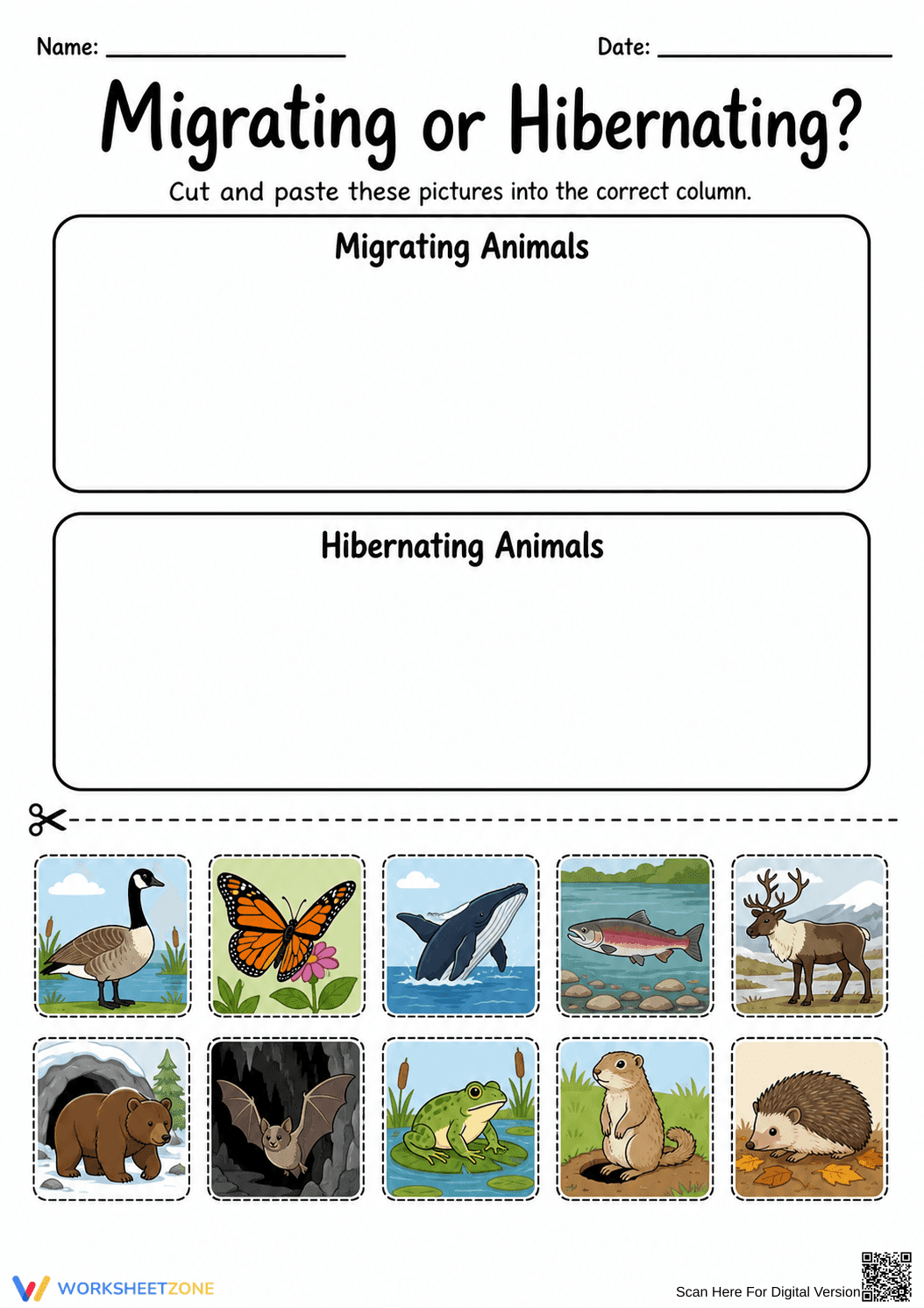

Essential Migrating or Hibernating Sorting Worksheet
Paste this activity's link or code into your existing LMS (Google Classroom, Canvas, Teams, Schoology, Moodle, etc.).
Students can open and work on the activity right away, with no student login required.
You'll still be able to track student progress and results from your teacher account.
This essential science worksheet helps students distinguish between two primary survival behaviors: migration and hibernation. By categorizing specific animals based on their seasonal responses, learners develop a concrete understanding of how biological adaptations ensure species survival during environmental shifts. It transforms abstract biological concepts into a tactile, memorable learning experience for young scientists.
At a Glance
- Grade: Grade 3 · Subject: Science
- Standard:
3-LS2-1— Identify and categorize animal behaviors that help species survive seasonal environmental changes- Skill Focus: Animal behavioral adaptations
- Format: 1 page · 10 problems · Answer key included · PDF
- Best For: Science centers and seasonal units
- Time: 15–20 minutes
The resource features a single-page layout divided into two primary classification zones: Migrating Animals and Hibernating Animals. At the bottom of the page, students find 10 illustrated animal cards—including a bear, butterfly, whale, and bat—designed for cutting and pasting. This structure supports fine motor development alongside scientific inquiry and vocabulary building.
Zero-Prep Workflow
- Print: Generate the single-page PDF for each student in approximately 30 seconds.
- Distribute: Provide scissors and glue sticks as students begin the 15-minute sorting task.
- Review: Conduct a 5-minute whole-class review to verify animal placements and discuss reasoning.
This streamlined process requires less than 2 minutes of teacher preparation, making it an ideal choice for sub plans or last-minute science block additions.
Standards Alignment
Aligned to 3-LS2-1, which focuses on how animal behaviors and group dynamics help members survive environmental challenges. This worksheet provides the foundational evidence needed to discuss seasonal survival strategies like migration and hibernation. Both standard codes can be copied directly into lesson plans, IEP goals, or district curriculum mapping tools.
How to Use It
Use this during a "Winter Survival" thematic unit or as a formative assessment after a lesson on animal adaptations. It works exceptionally well in science centers where students can collaborate on classification. Expect students to complete the sorting and gluing within 15 to 20 minutes depending on their scissor proficiency. It provides immediate visual feedback on student comprehension.
Who It's For
This resource is designed for Kindergarten through Grade 3 students, particularly those requiring kinesthetic learning opportunities. It serves as an excellent companion to an anchor chart about seasonal changes or a read-aloud book regarding animal journeys. It is also highly effective for English Language Learners (ELLs) due to the heavy visual support and clear categorization requirements.
According to the RAND AIRS 2024 analysis of elementary science instruction, tactile sorting activities significantly improve the retention of categorical biological data compared to passive observation. This worksheet targets the 3-LS2-1 standard by requiring students to identify specific behavioral adaptations—migration and hibernation—as survival mechanisms. By engaging in the physical act of classification, students build the cognitive frameworks necessary for more complex ecological reasoning in later grades. Research from Fisher & Frey (2014) suggests that such scaffolded, hands-on tasks bridge the gap between vocabulary acquisition and conceptual mastery in early childhood science. The inclusion of 10 distinct animal examples ensures a broad enough data set for students to recognize patterns in animal behavior across different species and habitats, fulfilling the evidence-based requirements of modern state science frameworks. This resource provides a clear pathway for students to demonstrate their understanding of how animals adapt to their environments to ensure long-term survival.


