


























Views
Downloads
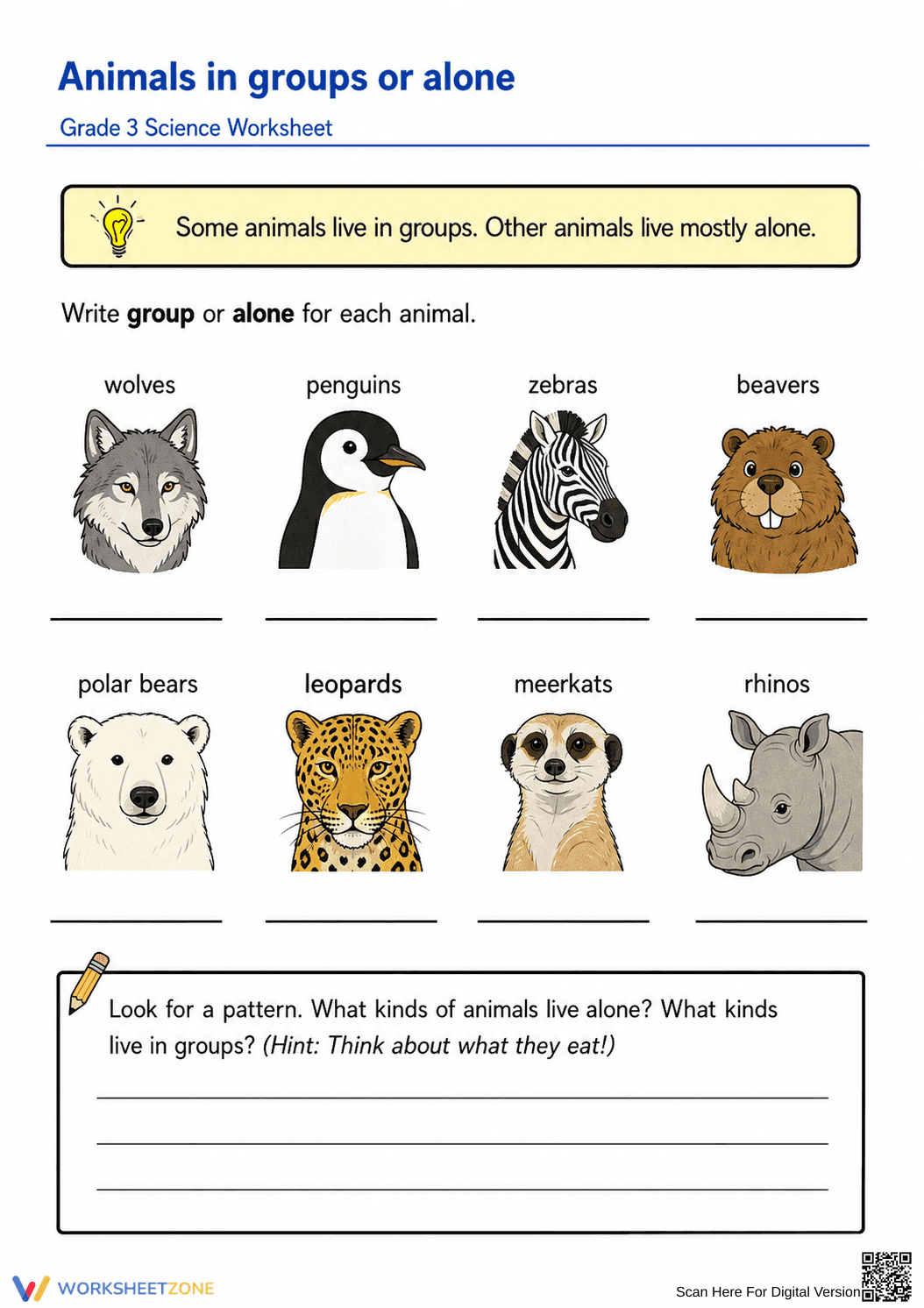

Grade 3 Animal Groups — Printable No-Prep Worksheet
Paste this activity's link or code into your existing LMS (Google Classroom, Canvas, Teams, Schoology, Moodle, etc.).
Students can open and work on the activity right away, with no student login required.
You'll still be able to track student progress and results from your teacher account.
Determine why social structures vary across the animal kingdom with this focused Grade 3 science worksheet. Students identify whether specific species live in groups or alone, then analyze dietary patterns to find the underlying survival logic. This activity builds a foundation for understanding biological evolution and ecological relationships.
At a Glance
- Grade: 3 · Subject: Science
- Standard:
3-LS2-1— Construct arguments about how animal groups help members survive- Skill Focus: Identifying animal social behaviors
- Format: 1 page · 9 problems · Answer key included · PDF
- Best For: Independent practice or science centers
- Time: 15–20 minutes
This single-page worksheet features high-quality illustrations of eight different animals, including wolves, penguins, and polar bears. Students must label each as living in a "group" or "alone" based on their natural social structures. The resource concludes with a critical thinking prompt that asks students to look for patterns related to animal diets, pushing them beyond simple recall into scientific reasoning. A complete answer key is provided for quick grading.
This resource is designed for immediate classroom implementation with zero teacher setup. The workflow is highly efficient: spend 30 seconds printing the necessary copies, allow 1 minute for distribution, and plan for a 5-minute group review at the end of the lesson. The self-explanatory layout makes it an ideal choice for emergency sub plans or as a quiet transition activity between core science modules.
This worksheet is primarily aligned to 3-LS2-1: Construct an argument that some animals form groups that help members survive. By examining the diet-based hint in the final section, students begin to gather evidence for how group living provides survival advantages for certain species. Both standard codes can be copied directly into lesson plans, IEP goals, or district curriculum mapping tools.
Use this worksheet as a formative assessment during a unit on ecosystems or animal adaptations. It works best after a short introductory video or reading passage about animal social structures. During the activity, circulate the room and observe if students can explain why a polar bear might live alone while a meerkat lives in a group; these observations serve as excellent qualitative data for science grading. Expected completion time is 15 to 20 minutes.
This resource is tailored for third-grade students exploring life sciences but is also suitable for second-grade enrichment or fourth-grade review. It supports diverse learners through visual cues and clear, simple instructions. Pair this worksheet with an anchor chart detailing the differences between herbivores and carnivores to help students bridge the gap between social behavior and biological needs during independent work sessions.
The study of animal sociality in Grade 3 aligns with the Next Generation Science Standards framework, which emphasizes the shift from rote memorization to evidence-based argumentation. According to the RAND AIRS 2024 analysis of elementary science instruction, utilizing visual classification tasks helps young learners internalize complex biological concepts like social evolution and predator-prey dynamics more effectively than text-only instruction. This worksheet leverages that research by providing concrete examples to anchor student understanding of identifying animal social behaviors. By identifying these patterns early, students develop the foundational schemas necessary for higher-level ecological studies in middle school. The inclusion of a pattern-seeking prompt at the conclusion of the activity mirrors the scientific inquiry process advocated by current pedagogical standards. This resource provides a structured, evidence-based approach to mastering the social survival strategies described in standard 3-LS2-1.


