


























Views
Downloads
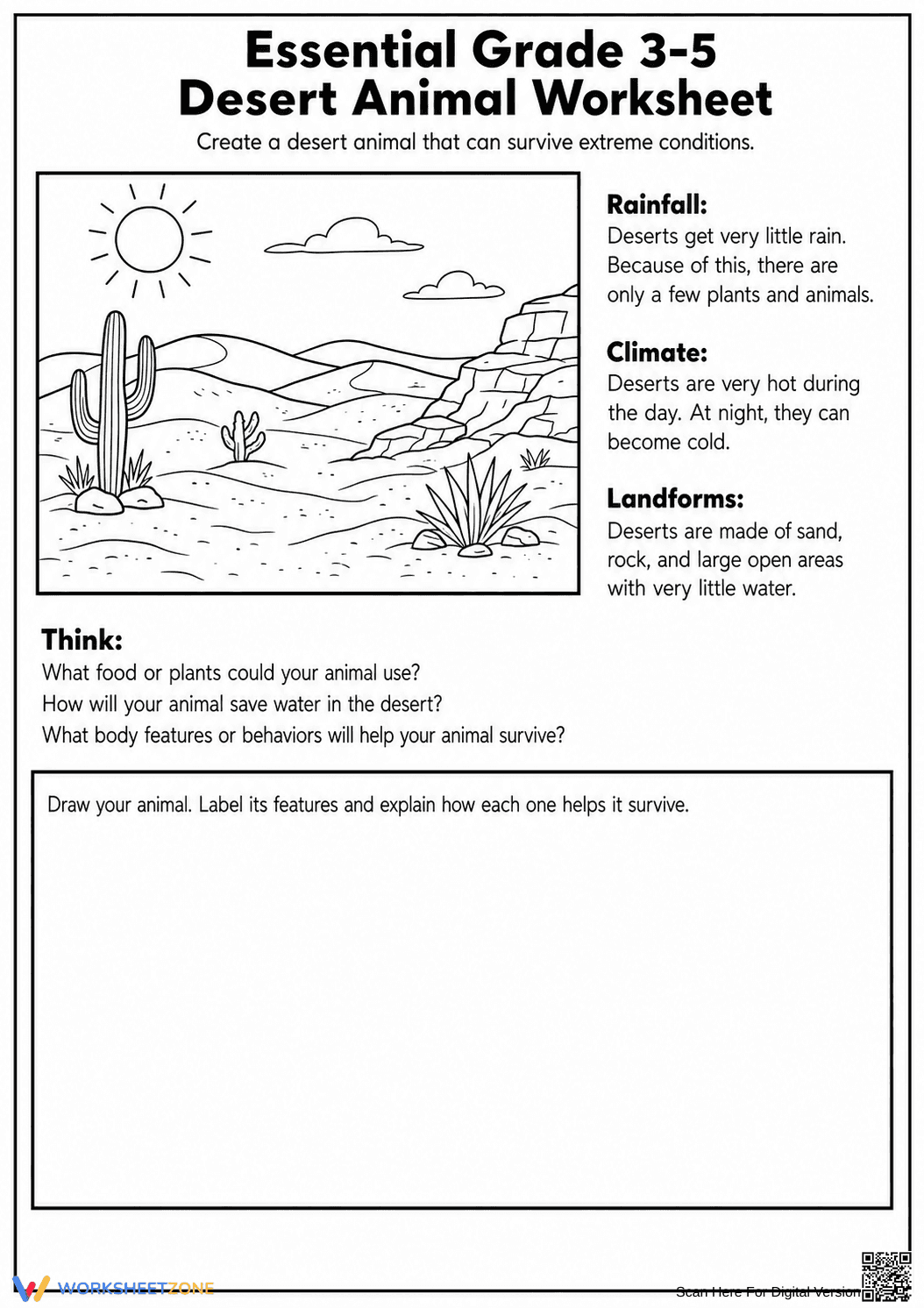

Essential Grade 3-5 Desert Animal Worksheet
Paste this activity's link or code into your existing LMS (Google Classroom, Canvas, Teams, Schoology, Moodle, etc.).
Students can open and work on the activity right away, with no student login required.
You'll still be able to track student progress and results from your teacher account.
This Grade 3-5 science worksheet challenges students to apply their knowledge of biological adaptations by designing a unique creature capable of surviving in a desert environment. By synthesizing information about climate and geography, students move beyond rote memorization to demonstrate a deep understanding of how physical features support survival in extreme conditions.
At a Glance
- Grade: 3-5 · Subject: Science
- Standard:
3-LS4-3— Construct an argument that in a particular habitat some organisms survive well- Skill Focus: Animal Adaptations
- Format: 1 page · 1 creative task · Answer key not applicable · PDF
- Best For: Habitat unit formative assessment
- Time: 20–30 minutes
What's Inside
This single-page PDF includes a concise informational text block covering three key environmental factors: rainfall, climate, and geographical features of a desert. It features a "Think" prompt section to guide student brainstorming and a large dedicated workspace for drawing, labeling, and explaining specific anatomical or behavioral adaptations.
Zero-Prep Workflow
- Print: Select the desert animal design page and print enough copies for your class (under 1 minute).
- Distribute: Hand out the worksheets as a culminating activity after discussing desert biomes (under 1 minute).
- Review: Use the labeled drawings to quickly assess student understanding of the relationship between environment and physical traits (under 1 minute).
Standards Alignment
This resource is aligned to `3-LS4-3`: Construct an argument with evidence that in a particular habitat some organisms can survive well, some survive less well, and some cannot survive at all. It also supports 4-LS1-1 by focusing on internal and external structures that function to support survival. Both standard codes can be copied directly into lesson plans, IEP goals, or district curriculum mapping tools.
How to Use It
Assign this worksheet during the "elaborate" phase of a 5E lesson cycle on habitats. It serves as an excellent formative assessment; when reviewing student work, look for specific links between the provided "Climate" text and the "Features" labeled on the animal. Completion typically takes 20 to 30 minutes depending on the level of artistic detail.
Who It's For
This resource is designed for students in Grades 2 through 5, with scaffolds that support English Language Learners through visual modeling. It pairs naturally with habitat anchor charts or a direct instruction lesson on nocturnal behaviors and water conservation in desert species.
According to Fisher & Frey (2014), the use of visual modeling and creative application tasks significantly enhances the retention of complex biological concepts in elementary learners. This worksheet utilizes that research by requiring students to translate text-based environmental constraints into visual biological solutions. By focusing on the 3-LS4-3 standard, the activity ensures that students are not just drawing, but are actively constructing an evidence-based argument for survival. The integration of specific environmental data—such as the extreme temperature fluctuations between day and night—forces students to consider multiple layers of animal adaptations, including thermoregulation and physical protection. This approach aligns with modern pedagogical shifts toward higher-order thinking and cross-cutting concepts in the life sciences. Educators can use the resulting student models as a baseline for classroom discussions on biodiversity and the impact of environmental changes on specialized species.


