


























Views
Downloads
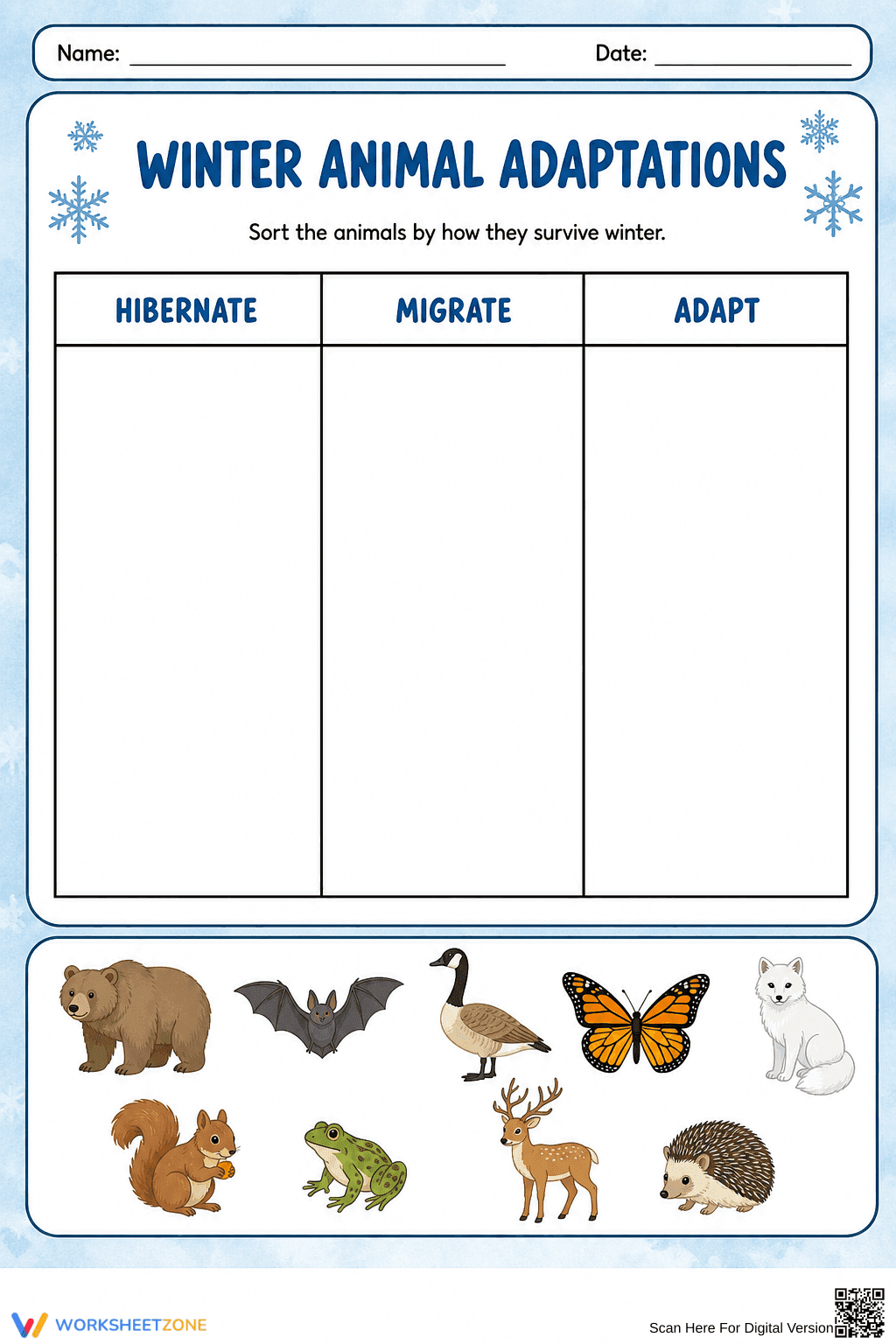

Grade 3 Winter Animal Adaptations — Printable Worksheet
Paste this activity's link or code into your existing LMS (Google Classroom, Canvas, Teams, Schoology, Moodle, etc.).
Students can open and work on the activity right away, with no student login required.
You'll still be able to track student progress and results from your teacher account.
This printable winter animal adaptations worksheet helps students understand how species survive seasonal changes. By sorting nine animals into hibernate, migrate, or adapt categories, learners apply life science concepts while building critical thinking skills.
At a Glance
- Grade: 3 · Subject: Science
- Standard:
3-LS4-3— Evaluate how organisms survive in specific habitats- Skill Focus: Sorting winter survival strategies
- Format: 1 page · 9 problems · Answer key included · PDF
- Best For: Independent practice and science centers
- Time: 15–20 minutes
Inside this resource, educators will find a single-page sorting activity featuring a three-column graphic organizer labeled Hibernate, Migrate, and Adapt. The bottom provides nine animal illustrations, including a bear and arctic fox. Students cut and paste these images into the correct category. An answer key is included for quick reference.
Zero-Prep Workflow
Designed for immediate use with minimal preparation:
- Print (1 minute): Print the PDF and copy. No special materials needed beyond scissors and glue.
- Distribute (1 minute): Hand out worksheets. Instructions are self-explanatory.
- Review (3 minutes): Use the answer key to check work or project for whole-class review.
With under two minutes of total teacher prep time, this activity is perfect for emergency sub plans.
Standards Alignment
Aligned to 3-LS4-3: "Construct an argument with evidence that in a particular habitat some organisms can survive well, some survive less well, and some cannot survive at all." Students gather evidence of how traits allow organisms to endure seasonal changes. Both standard codes can be copied directly into lesson plans, IEP goals, or district curriculum mapping tools.
How to Use It
Use this as independent practice after direct instruction on seasonal adaptations. Alternatively, it serves as an engaging science center activity where small groups discuss the correct placement of each animal. Formative assessment tip: observe students while they sort and listen to their reasoning for placing the arctic fox in the "adapt" column to gauge understanding. Expected completion time is 15 to 20 minutes.
Who It's For
Designed for third-grade students, this is adaptable for second graders studying habitats. For differentiation, teachers can pre-cut images for students needing motor support. Advanced learners can write a sentence explaining one animal's adaptation. Pairs perfectly with an anchor chart defining hibernation and migration.
Aligning instructional materials with rigorous science standards is essential for developing students' analytical skills. This resource directly supports 3-LS4-3 by requiring learners to evaluate how organisms survive in specific habitats through distinct behavioral and physical strategies. According to EdReports 2024, hands-on classification tasks significantly improve elementary students' retention of complex life science vocabulary and core concepts. By physically sorting animals into categories like hibernation, migration, and physical adaptation, students move beyond rote memorization and engage in active, evidence-based reasoning. This tactile approach to learning helps solidify the crucial connection between an organism's specific traits and its changing environment. Integrating such targeted, standards-aligned activities into the daily curriculum ensures that students build a robust foundation in scientific inquiry, ultimately preparing them for more advanced ecological and biological studies in their future academic careers.


