


























Views
Downloads
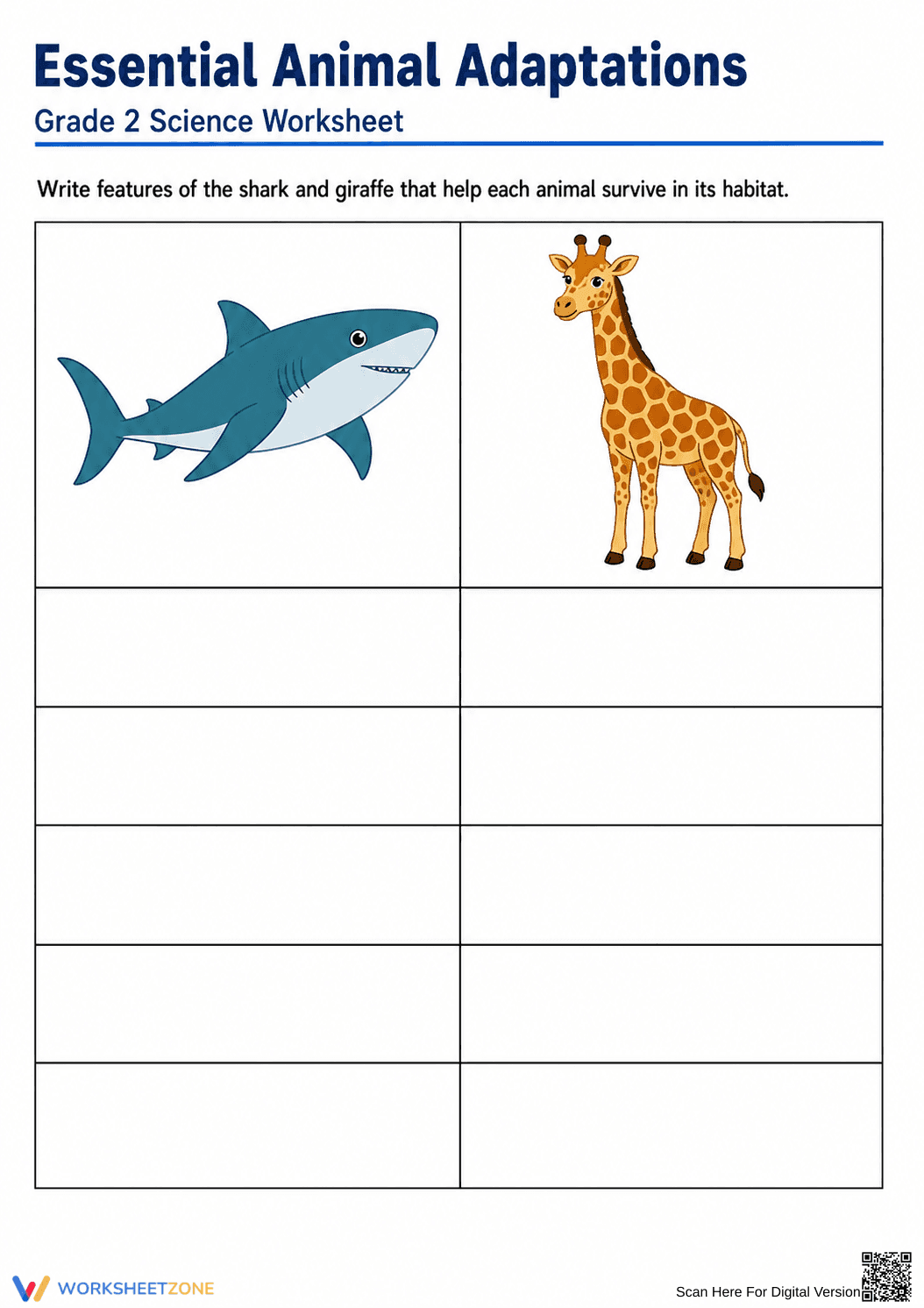
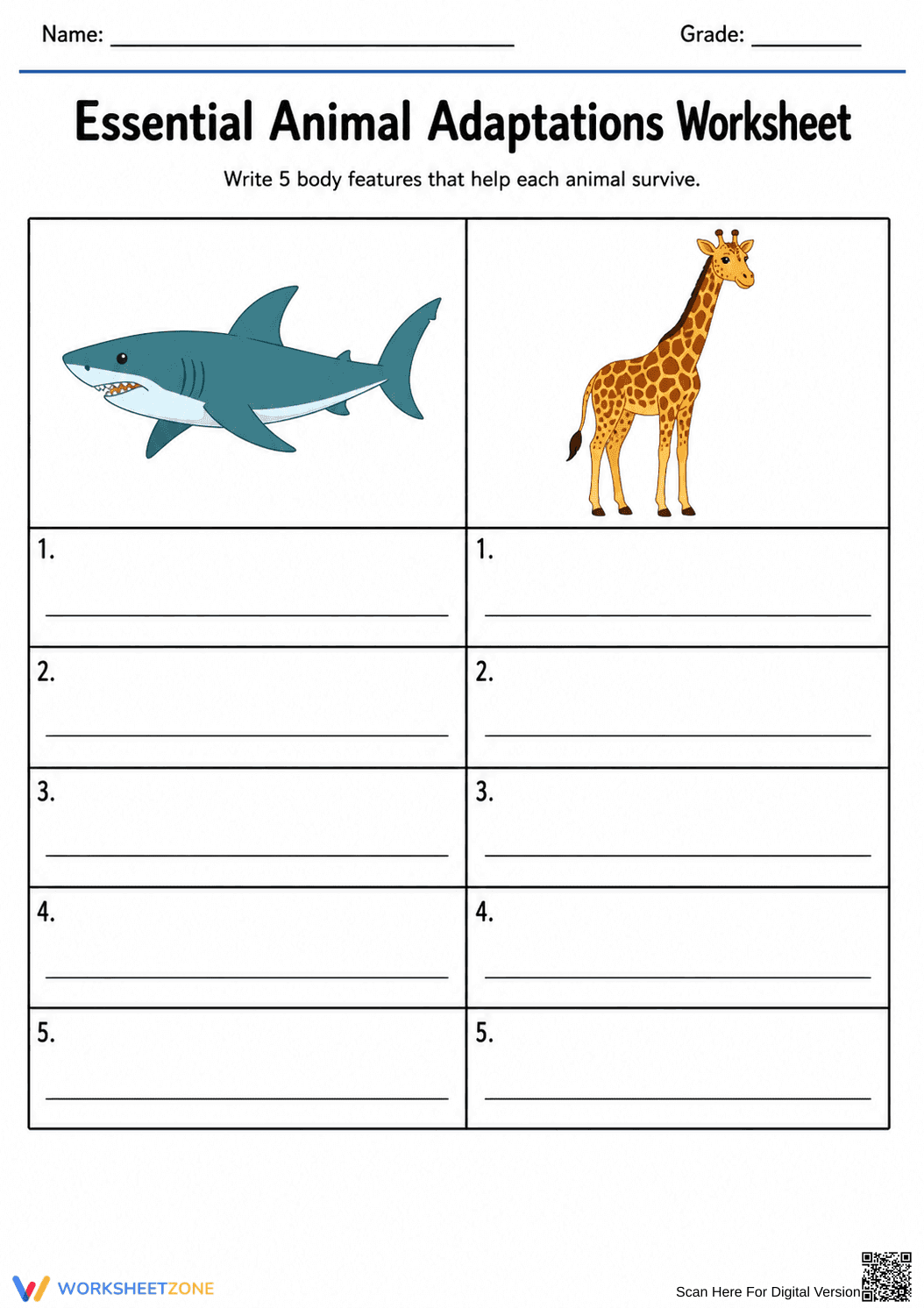

Grade 2 Animal Adaptations — Printable No-Prep Worksheet
Paste this activity's link or code into your existing LMS (Google Classroom, Canvas, Teams, Schoology, Moodle, etc.).
Students can open and work on the activity right away, with no student login required.
You'll still be able to track student progress and results from your teacher account.
This Grade 2 science worksheet helps students identify and compare structural adaptations by analyzing the physical features of a shark and a giraffe. By observing these distinct animals, learners develop a concrete understanding of how specific biological traits enable survival in different habitats.
At a Glance
- Grade: 2 · Subject: Science
- Standard:
2-LS4-1— Observe animals to compare how features enable survival- Skill Focus: Structural Adaptations
- Format: 2 pages · 10 problems · Answer key included · PDF
- Best For: Independent practice or substitute plans
- Time: 15–20 minutes
The resource features a dual-column graphic organizer with clear illustrations of a shark and a giraffe to anchor student thinking. Students complete 10 total tasks by generating five distinct survival features for each animal, such as gills for breathing or long necks for reaching foliage. A comprehensive answer key is included, providing detailed biological justifications for each structural adaptation to ensure accurate grading.
Zero-Prep Workflow
This resource is designed to respect teacher time with a streamlined, three-step process:
- Print (30 seconds): Generate the student-facing graphic organizer instantly.
- Distribute (1 minute): Hand out the single-page activity to students with minimal instructions needed.
- Review (5 minutes): Use the detailed answer key for rapid self-correction or whole-class discussion.
With under two minutes of total teacher preparation required, this activity is an ideal addition to emergency sub plans or quick transition periods.
Standards Alignment
This worksheet is aligned to 2-LS4-1: Make observations of plants and animals to compare the diversity of life in different habitats. Students must cite visual evidence to explain how specific traits provide advantages in finding food or avoiding predators. It also supports W.2.8 by having students recall information from provided sources. Both standard codes can be copied directly into lesson plans, IEP goals, or district curriculum mapping tools.
How to Use It
Deploy this worksheet as a mid-unit check for understanding after introducing basic habitat concepts. During independent work time, observe if students can differentiate between behavioral actions and structural traits; if a student lists "swimming" instead of "fins," use that moment to discuss the physical tools required for specific movements. Expected completion time ranges from 15 to 20 minutes, depending on individual writing speed and prior knowledge.
Who It's For
This resource is primarily tailored for second-grade learners, though it serves as excellent remediation for third-grade students exploring biodiversity. To support differentiation, teachers can provide a word bank of terms like "camouflage" and "predator" for English Language Learners or students needing extra scaffolding. It pairs naturally with non-fiction reading passages about ocean or savanna biomes to provide deeper context for the animal studies.
According to the NAEP Science Framework and AIRS 2024 reports, early exposure to structural biology through comparative observation is a critical predictor of later success in life science disciplines. This worksheet facilitates the development of scientific inquiry skills by requiring students to map physical attributes to environmental pressures. By focusing on the 2-LS4-1 standard, the activity ensures that learners move beyond simple identification toward an understanding of functional biology, specifically how features enable survival. Research by Fisher & Frey (2014) highlights that graphic organizers with visual anchors, like the shark and giraffe used here, significantly increase retention of domain-specific vocabulary. This 10-task exercise provides the necessary repetition for students to internalize the relationship between form and function, serving as a robust piece of evidence for mastery within elementary science portfolios.


